
At VivaTech, two defense executives described a reality that European manufacturers are still struggling to grasp: in a war where technology evolves every week, bureaucratic sluggishness becomes a strategic handicap. Ukraine isn’t just innovating under fire. It’s reinventing the very rules of innovation.
In the aisles at VivaTech, discussions about artificial intelligence often revolve around productivity, autonomous agents, or process automation. On stage, the tone was radically different. Here, innovation isn’t about gaining a few efficiency points. It’s about survival.
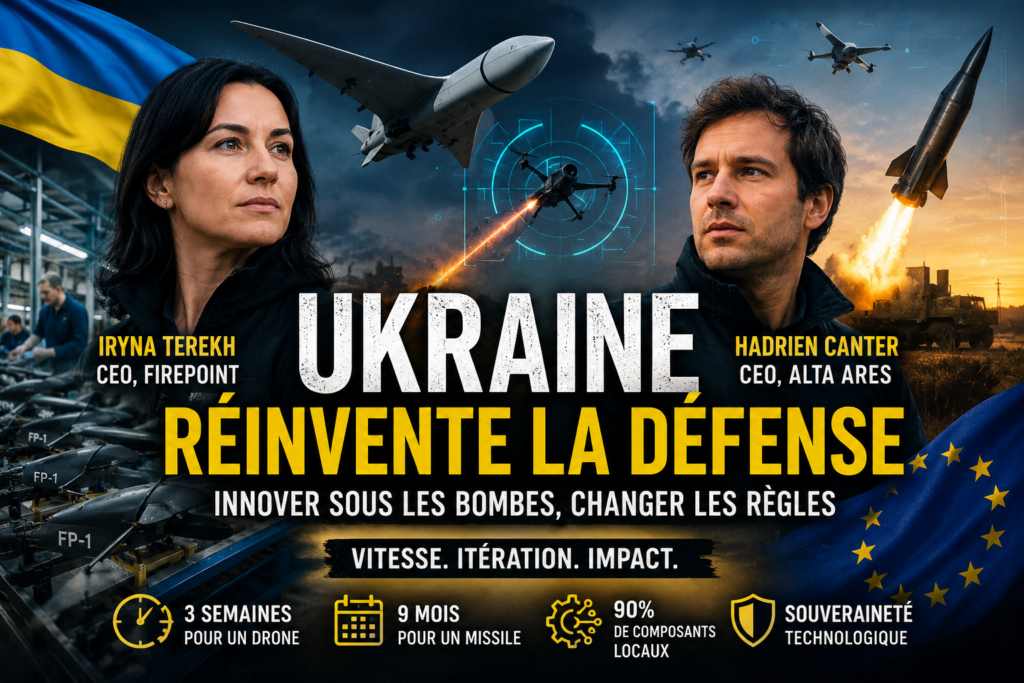
Speaking to a Parisian audience, Iryna Terekh, CEO of FirePoint, and Hadrien Canter, CEO of Alta Ares, offered a rare glimpse into what it means to develop technologies in an environment where every delay can have immediate operational consequences.
Their account reveals a deeper transformation: Ukraine has become the world’s largest laboratory for military innovation.
When Three Years Replace Three Decades
The story told by Iryna Terekh alone illustrates this shift in scale.
When the war broke out, her company was not producing weapons. The team then set out to develop long-range drones with a goal that was already considered ambitious: to manufacture twenty units per month.
Three years later, the company is producing 260 drones per day.
Even more striking, FirePoint claims to have developed a ballistic missile in less than two years, with 90% of its components sourced in Ukraine. A program that would have required several years of procedures, validations, and certifications in most European countries.
The reality is stark: the war has compressed innovation cycles.
Where Western industry still thinks in terms of years, Ukrainian players now think in terms of weeks.
An intermediate-range strike drone designed to meet a new operational need was reportedly developed in just three weeks. The Flamingo cruise missile took nine months to develop.
In both cases, speed is not a competitive advantage. It has become an existential necessity.
The End of the Myth of Perfection
This acceleration is accompanied by a major cultural shift.
For decades, the Western defense industry operated according to a model of perfection: lengthy development, exhaustive certification, and a product that was virtually final before deployment.
For Hadrien Canter, this model is now a thing of the past.
In his view, it’s better to have a system that’s 80% operational within a few weeks than to wait several years to reach 99% maturity.
This philosophy is more reminiscent of the methods used by tech startups than those of major defense contractors.
But it reflects a simple reality: on the ground in Ukraine, threats are evolving faster than administrative procedures.
A system that is effective today may become obsolete just a few weeks later.
Innovation thus ceases to be a one-off project. It becomes a continuous process.
The Battlefield as a Laboratory
One phrase came up repeatedly during the discussion:
“The truth is out on the field.”
For both executives, no simulation can replace real-world conditions.
Alta Ares learned this firsthand during the deployment of its systems in the Middle East. Designed and tested under Ukrainian conditions, certain components proved unsuitable for extreme temperatures and sandstorms.
The propellers were disrupted by airborne particles. Some parts overheated due to the desert climate.
As a result, the company had to redesign several critical components in less than ten days.
Such an adaptation would likely have taken several months in a traditional industrial cycle.
This approach of continuous iteration is now bringing the defense industry closer to the methods used in software and artificial intelligence.
The difference is that errors are not measured in terms of bugs, but in terms of operational capabilities.
The Details
Perhaps the most revealing account concerns administration rather than technology.
Iryna Terekh explains that she waited eighteen months to obtain the necessary authorizations to test a component developed by a French company.
During that time, FirePoint estimates it could have designed two entirely new systems.
This contrast illustrates the growing gap between the pace of technological advancement and the pace of regulation.
In the war over drones, missiles, or autonomous systems, competitive advantage no longer depends solely on technical capabilities. It also depends on how quickly institutions authorize their development.
A New Industrial Doctrine
Beyond the equipment itself, Ukraine is undergoing a more profound transformation in the relationship between the state and industry.
Traditionally, defense programs enforce a strict separation between development, certification, procurement, and upgrades.
According to the speakers, the Ukrainian model operates differently.
Manufacturers have greater freedom to upgrade their systems without constantly having to restart new administrative cycles. Responsibility is increasingly shifted to the manufacturers themselves, who must ensure the operational effectiveness of their products.
This approach significantly reduces adaptation times.
It also introduces a novel principle: in an environment where technology changes daily, waiting for bureaucratic approval can pose a greater risk than experimentation itself.
People Remain at the Center
Despite the ubiquity of AI and autonomous systems, the two executives emphasized a point often overlooked in technological debates.
People remain the decisive resource.
Iryna Terekh is even skeptical of certain promises of total automation. In her view, behind every autonomous system there are always men and women making the essential decisions.
The same observation holds true at Alta Ares.
Nights spent in the field alongside operators serve as a reminder that system autonomy does not eliminate human responsibility—it transforms it.
While many sectors are debating whether AI will replace human labor, Ukraine’s defense sector offers a different perspective: automation only makes sense when it reduces people’s exposure to the highest risks.
What Europe Is Seeing in Real Time
The key lesson from this discussion extends far beyond the military sphere.
For the past two years, Ukraine has served as a historic catalyst for industrial transformation.
Innovation cycles are shortening. Feedback from the field is immediate. Products are constantly evolving. The boundaries between development, deployment, and continuous improvement are blurring.
In other words, war is driving the defense sector toward an approach similar to the one that transformed the software industry twenty years ago.
The question now facing European manufacturers is no longer a technological one.
It is an organizational one.
For while drones, missiles, and interception systems can now be developed in a matter of months, will administrative structures and procurement procedures be able to keep pace?
This is perhaps where the real battle for European innovation is being fought today.
Cette publication est également disponible en :

