
With sales down significantly in 2020, the global luxury goods market has fallen by almost 25% since January, stabilizing at 217 billion euros, a level not seen since 2009.
Although the effects of the crisis are already fading, the luxury goods industry needs to reinvent itself to return to growth.
IG carried out research into the impact of COVID-19 on the French luxury goods industry, in order to predict changes in the sector and decipher emerging trends.
Major luxury goods market falls by 217 billion euros due to health crisis
French luxury brands such as LVMH , L’Oreal , Kering and Hermes , all among the world’s top 11 luxury companies, have been forced to adapt to meet urgent public health needs and provide financial support for their employees.
While it is too early to quantify the financial impact of the Covid-19 on the luxury goods industry in France, it can nevertheless be said that this global health crisis has shaken certain fundamental aspects of the luxury goods industry, bringing about changes that could be permanent.

Covid-19 and the luxury sector: figures you need to know
Before the global health crisis, all luxury market indicators were in the green:
In 2019, the growth of the “experiential experiential ” was driven by sales of luxury cruises (+9%), luxury cars (+7%) and gourmet products (+6%) generating 1,300 billion euros, up 4% on 2018.
In the luxury goods sector personal ” sector, shoes and jewelry posted a growth rate of 9%, leather goods 7%, cosmetics 3%, the apparel sector 1%, while the watch sector was down 2%. Total sales generated by the top 100 international luxury players in 2019 were $247 billion, compared with $217 billion in 2018.

Covid-19 and its measures of containment, air traffic disruptions and border closures put an end to more than a decade of sustained growth, and swept away all predictions of a +3.2% expansion of the luxury market in 2020.
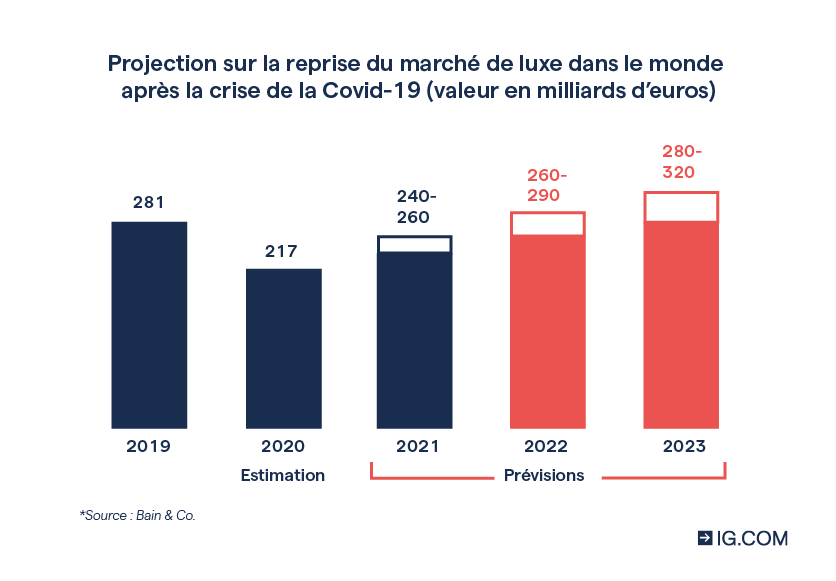
According to a study published by Bain & Company Luxury Study in collaboration with Fondazione Altagamma, all luxury goods have experienced a real recession. Sales of luxury clothing have been particularly hard hit, with a decline of over 30%, in the face of competition from less upscale brands.
After a second quarter that was the worst the sector had ever seen, signs of recovery appeared in the third quarter of 2020. The fourth-quarter result will depend heavily on the future evolution of Covid-19, restrictive measures and the effectiveness of the worldwide vaccination campaign.
According to this study, it will take until 2022 or 2023 to return to profitability similar to that of 2019. Market growth, which will depend essentially on consumer confidence, tourist flows and the ability of brands to anticipate and respond to new consumer demands, will gradually pick up again, reaching around 320 or 330 billion euros in the next five years. By 2025, the luxury market should be back to normal, with over 450 million luxury consumers worldwide, or 60 million more than today.
Cette publication est également disponible en :

