
MASERATI CELEBRATES 60TH ANNIVERSARY OF ELDORADO On June 29, 1958, Europe’s first sponsored single-seater took to the track at Monza, with Stirling Moss at the wheel.
Some vehicles have left their mark on history through their legendary victories, their technical innovations or the drivers who led them to glory. Others have become veritable icons, representing: a unique story, a historic turning point, a social phenomenon, an event that, beyond the racetrack, defined an era. One such vehicle is the Maserati Eldorado, which became famous in 1958 as the first single-seater in Europe to be sponsored by a brand detached from motor racing. The brand in question was Eldorado, an ice-cream manufacturer. It was the first example of modern sponsorship to show a vehicle painted in the partner company’s colors, abandoning the color of each country, traditionally defined by the Fédération Internationale. It was a real revolution at the time, and of vital importance to the future of motor racing, opening the door to new patrons. Maserati was chosen to design the car for Gino Zanetti, owner of the Eldorado ice-cream company. Determined to promote his brand on the international stage, Zanetti turned to the House of Trident to create a single-seater to take part in the “Trofeo dei dû Mondi” (Race of the Two Worlds) at Monza: inspired by the Indianapolis 500, the Automobile Club d’Italia had organized a 500-mile race on this circuit, inviting top American drivers to compete alongside the best European drivers.
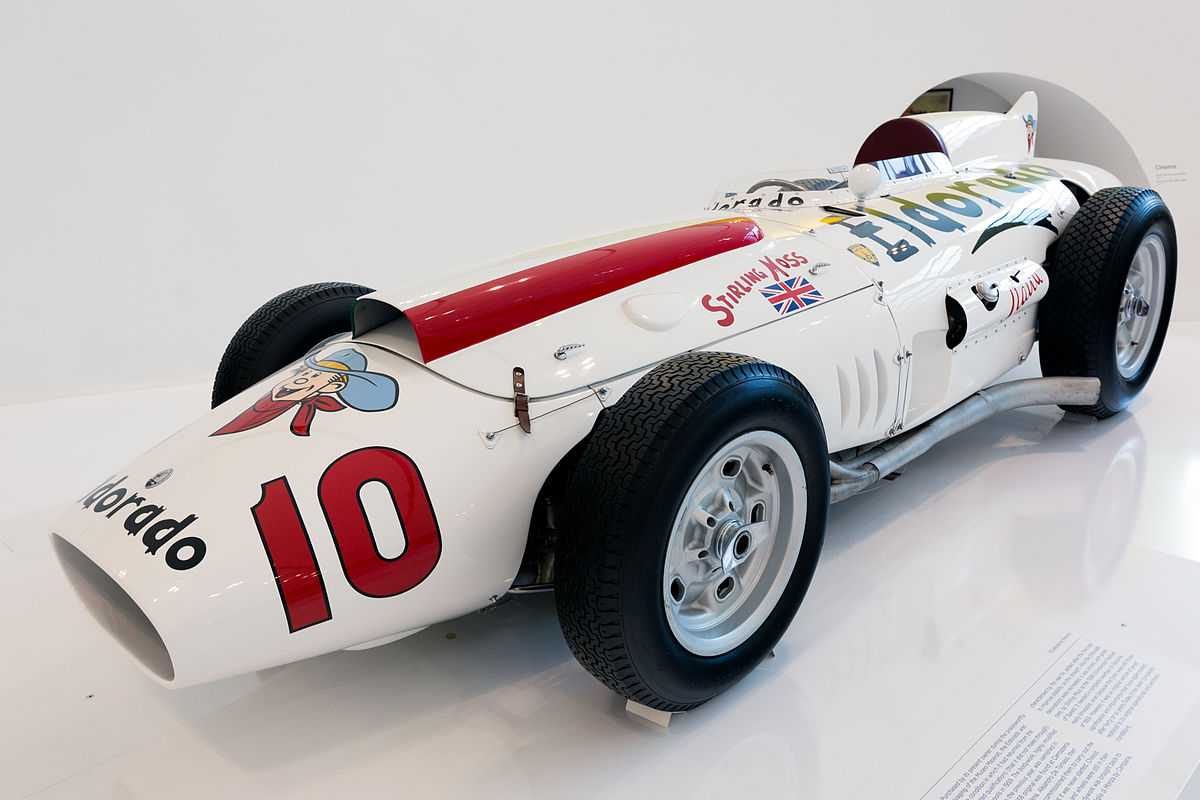
The Maserati 420/M/58, chassis 4203, was thus adorned with a cream exterior color rather than the Italian red used in racing. The Eldorado name was emblazoned in bold black letters on each side of the car, with two additional smaller logos at the front and under the small windscreen. The smiling cowboy head logo was placed in the center of the hood and on each rear spoiler. Beneath the Eldorado logo on each side, “Italia” was inscribed in sparkling racing red, to indicate the sponsor’s nationality as well as that of the vehicle’s manufacturer. The long silhouette of the “Eldorado” also bore the name of the driver chosen for the “Monzanapolis” race: Stirling Moss, one of the greatest drivers in motor racing history and a former Maserati driver. The year before, in 1957, the Modena-based manufacturer had won the Formula 1 World Championship with Juan Manuel Fangio, before deciding to retire from motor racing and build racing cars solely to order, for private customers, also providing the necessary assistance. This was precisely the ideal configuration Zanetti was looking for, and the reason why the Italian entrepreneur turned to Maserati. In just a few months, engineer Giulio Alfieri designed the “Eldorado”. The engine, derived from the V8 unit fitted to twin-cam 450S models, reduced displacement to 4,190 cm3, generating 410 hp at 8,000 rpm; the engine and transmission being offset nine centimetres to the left. This decision was intended to ensure a more balanced weight distribution, taking into account the counter-clockwise orientation of the course and the sharp bends at Monza.
The gearbox had only two speeds, while the De-Dion axle at the rear had no differential. The tubular chassis was inspired by that of the high-performance 250F, although it proved to be oversized in the case of the Eldorado due to the numerous reinforcements needed to enable the car to withstand the mechanical stresses imposed by Monza’s concrete track. To lighten the car, Halibrand’s magnesium wheels were fitted with helium-filled 18-inch braided tires. With these measures, the car weighed in at 758 kg. The Fantuzzi hand-built aluminum body was recognizable by its aerodynamic vertical fin behind the cockpit and an adjustable front carburetor. On June 29, 1958, on the Monza track, the race was held in three heats to determine the final classification. This strategy was designed to encourage European carmakers to enter their own vehicles, which had not been initially designed for such a mechanically demanding race. In the first heat, Moss finished 4th. In the second, he crossed the line in 5th position. However, in the final heat, his steering broke and the Maserati crashed into the guardrail, dashing the English driver’s hopes of finishing the race in third place. Taking into account the three heats and the total number of laps covered, Moss nevertheless finished the race in seventh position. He escaped the accident unscathed, and in the end, the Eldorado suffered only minimal damage, demonstrating the vehicle’s solid structure. Despite its success in terms of spectator numbers and entertainment value, the Monza 500 did not become a regular fixture on the racing calendar. Based on the findings of the race, the “Eldorado” was modified by coachbuilder Gentilini, who removed the rear spoiler and reduced the hood air intake. The vehicle then entered the Indianapolis 500 in 1959.
This time, the finish chosen was red, the color designating Italy in competition, but it was still marked with the name of its sponsor, Eldorado, in white letters on each side, as well as the cowboy logo in a white circle on the front and rear. Gentleman driver Ralph Liguori’s inexperience prevented the vehicle from qualifying, as it slipped to 36th place from the top 33. A professional driver behind the wheel would undoubtedly have finished in a better position. But that’s another story. The Indy 500 was dear to Maserati, which won in 1939 and 1940 with Wilbur Shaw at the wheel of an 8CTF. Shaw came close to a hat-trick of victories in 1941, but was forced to retire on the penultimate lap when a broken wheel cost him victory. Maserati is the only Italian carmaker and the only European brand to have won twice on the Indiana circuit. The Maserati “Eldorado”, perfectly restored to its original white color, is part of the Panini Collection in Modena.
Cette publication est également disponible en :

