
9Maserati Alfieri, the concept car created for Maserati’s 100th anniversary, revisits the brand’s historic style and hints at its future design
The Alfieri is a fascinating prototype that we came across at the Geneva Motor Show, but realistic and completely functional, it says a lot about the design of future Maseratis.
With its extraordinary design, the Alfieri is named after the most eminent of the Maserati brothers, the engineering genius who created the “Officine Alfieri Maserati” in Bologna a hundred years ago. The Alfieri was created by a small group of talented young designers, under the direction of Marco Tencone at the Centro Stile Maserati in Turin, headed by Lorenzo Ramaciotti.
In its centenary year, Maserati is a company in excellent health. An ambitious plan launched in 2013 with the presentation of the Quattroporte and Ghibli models is transforming the Italian carmaker into a major player in the premium sports car segment.
Sales rose 150% in one year, from 6,200 units in 2012 to 15,400 in 2013.
Today, Maserati is a major player in the automotive sector, with a range that includes two four-door sedans, two sporty GTs, four engines (V8 and V6 twin-turbo, naturally-aspirated V8 and a turbo diesel), two different architectures (all-wheel drive and rear-wheel drive) and a soon-to-be-unveiled SUV.



The Maserati Alfieri Concept, Design Concepts
While the new Quattroporte and Ghibli may have given the impression that the company was more oriented towards high-end four-door sports sedans, Maserati designers are striking back to remind everyone of the brand’s considerable sporting heritage and unique tradition of exceptional GT cars.
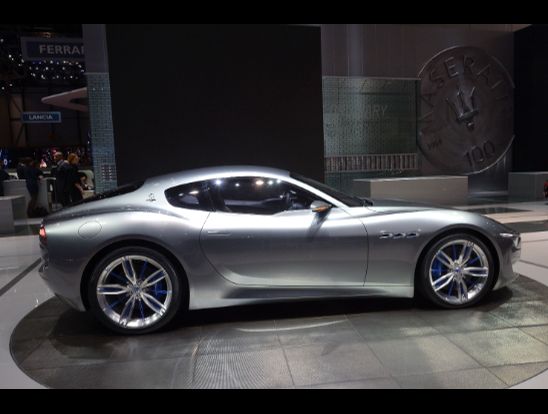
The Alfieri undoubtedly represents the very essence of the Maserati brand. An elegant Italian-style 2+2 like the 1957 3500 GT, the 1959 5000 GT and the 1969 Indy. The Alfieri concept is more aggressive than the current GranTurismo and confirms Maserati’s sporting DNA. Its proportions could anticipate the arrival of a future coupé, and demonstrate the brand’s stylistic direction for the near future.
“A Maserati will always be a Maserati,” says Ramaciotti. In any case, Maserati always remains a work of art in its own right.
Like all concept cars, the Alfieri has the ambition to become a reality. The final step from prototype to reality has not yet been taken, but the Alfieri has been designed and created with a resolutely realistic approach.
According to Lorenzo Ramaciotti, “The Alfieri represents the transition between a glorious 100-year past and a future that is opening up to us. To be honest, I can’t say for sure that this car will go into production in the next two years, but a similar model will certainly see the light of day.
Work on this project began this summer, when the designers were asked to create a concept, from scratch, for the brand’s 100th anniversary. Among several proposals, the sketches that gave rise to the current Alfieri were selected.
One of the most fascinating cars of all time was a source of inspiration for the designers: the Maserati A6 GCS-53 designed by Pininfarina in 1954. More than just a racing car for Gentlemen Drivers, the A6 GCS-53 was a masterpiece of design.
It was the last car designed by Pininfarina for Maserati, before his return in the first decade of the 19th century with the Quattroporte and GranTurismo. The A6 GCS-53, with its breathtaking proportions and aesthetics, was a mythical model for Maserati.
The Alfieri is obviously much more than a futuristic reinterpretation of the A6 GCS-53. “With the Alfieri we wanted to show the brand’s aspirations for the years to come,” explains Ramaciotti. “The car is at once aggressive and sober, powerful yet restrained.
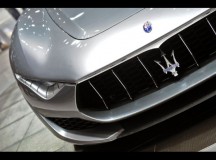
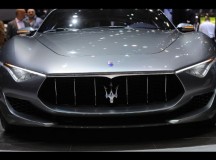
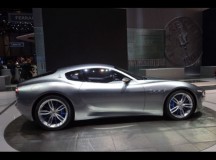
The acronym A6 GCS-53 stood for Alfieri 6 cylinders, Ghisa, Corsa, Sport, due to the very long hood and the two-seater cockpit in the rear position. The visual effect created by the sculpted line running from the hood to the top of the doors gives the windscreen a sense of depth. The sleek front headlamps reinforce the vehicle’s sporty look, aided in particular by the V-shaped hood.
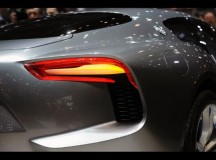
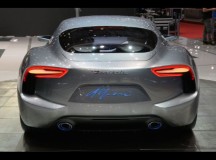
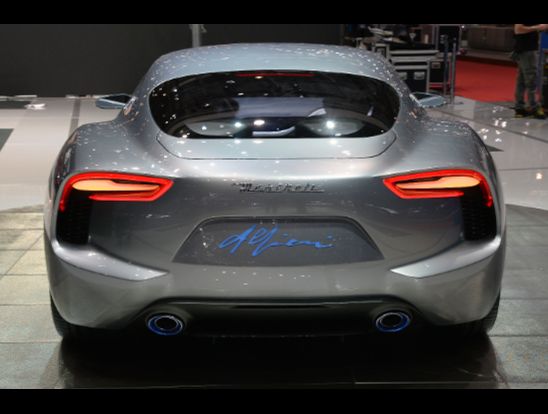
The taillights, whose shapes emphasize the car’s curvature, reinforce the vehicle’s aggressive appearance.
The Alfieri’s designers focused on a streamlined aerodynamic shape, reinforced by the 3 side grilles that adorn the front fenders and emphasize the vehicle’s aggressive, sporty appearance.
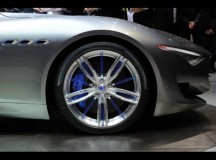
The wheels, specially designed for the Alfieri, are forged from a single block of aluminum. Their diameter is 21 inches at the rear and 20 inches at the front. These are spoke wheels, reminiscent of the classic rims of the 50s.
While the line is the most striking element, the colors and details complete the exceptional character of this concept. For the Alfieri, a metallic color called “Steel Flair” has been chosen. A choice that brings a refined, elegant and contemporary touch to this concept.
The wheel spokes, calipers, grille, 3 side grilles, rear diffuser, exhaust tips and Alfieri signature are in Maserati blue. This signature on the rear of the vehicle was found and reproduced from an old Maserati document.
The front bumper spoiler and rear diffuser are made of carbon fiber with aluminum inserts.
Minimalist interiors
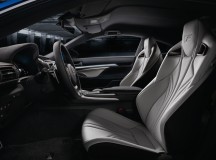
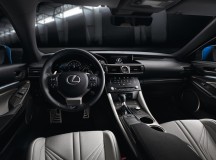
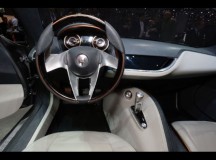
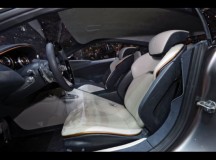
In the 2+2-seat cabin, simplicity and elegance are the designers’ inspiration. The suspended dashboard is inspired by that of the Maserati 5000 GT. The cockpit, with its sleek, two-tone design, frames a TFT screen.
The dashboard layout is classic, with two main gauges separated by two smaller ones. A miniature “Officine Maserati” label is affixed to the edge of each instrument.
Analog gauges are replaced by TFT displays that show speed and engine rpm in the manner of modern cameras. No longer do the classic needles turn in the gauges, but numbers. Speed and engine revs can be read as if through a magnifying glass.
The floor of the Alfieri is made of imitation steel, as was often the case with racing cars from the 1950s.
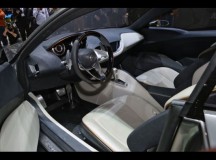
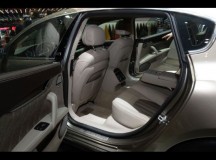
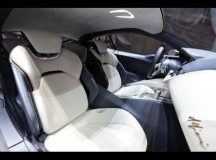
This concept car is characterized by its spacious cockpit, dominated by the colors Luna white and dark Basalt blue. Aniline leather with a natural look and feel was used for the seats, dashboard and center console. Copper discreetly highlights the car’s main characteristic lines, giving a retro feel to its futuristic ambience.
The interior features a classic 2+2 configuration and open luggage space. The backrests of the rear seats have a distinctive elongated design. Clearly visible from the outside, they add a dynamic note to the cabin. They can be tilted forward by 90 degrees and act as a divider with the luggage compartment.
The inserts in the seat profiles, the gearshift and the oval clock on the center console are made from milled aluminum. These components are hand-finished, then anodized in natural copper color. All other aluminum components, such as the pedals, gearshift paddles and steering wheel spokes, are also hand-finished and anodized in Palladium color.
The seats recall the enveloping shape typical of those in racing cars from the 50s, but with a futuristic look and modern structure. The headrests are semi-integrated, their curved profiles serving as structural elements of the seat. The oval clock with its red-blue dial and two smaller hands is inspired by a classic chronograph.
Sporty DNA
The Alfieri is based on the chassis of the GranTurismo MC Stradale with a shorter wheelbase, 24 centimetres shorter. Its proportions are those of a true supercar.
The Alfieri is 4,590 mm long with a wheelbase of 2,700 mm, 1,930 mm wide and 1,280 mm high. Compared to the Maserati GranTurismo, the equally aggressive Alfieri is somewhat different: 29.1 cm shorter, 7.3 cm lower and slightly wider than the current Maserati four-seater.
Under the elegant body is the Maserati GranTurismo platform. The driving force behind the Alfieri is the naturally-aspirated 4.7-liter V8 engine Made in Maranello, which delivers 460 hp at 7,000 rpm and 520 Nm at 4,750 rpm. Thanks to the special configuration of the exhaust system, the V8 emits a breathtaking roar.
The six-speed robotized gearbox (MC Shift) is fitted with a limited-slip rear differential and is connected to the engine by a rigid driveshaft. Thanks to its architecture, the Alfieri Maserati offers a front-to-rear weight distribution of 47/53.
The brake discs are made of carbon-ceramic, a direct inheritance from the GranTurismo MC Stradale, and are combined with Brembo brake calipers.
Cette publication est également disponible en :

