
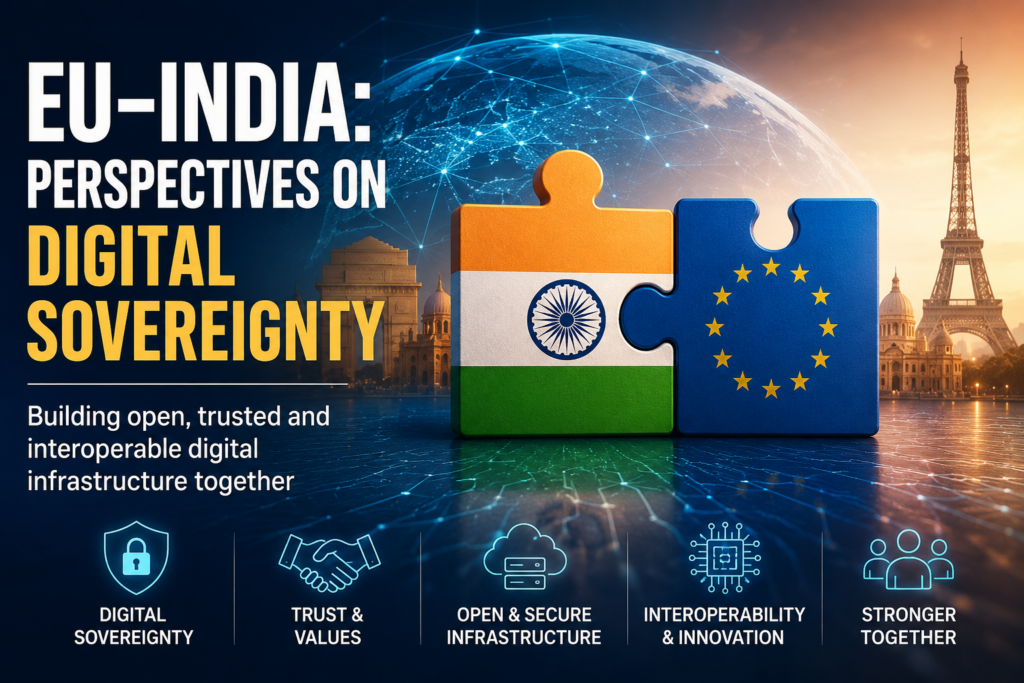
VivaTech 2026 – Digital sovereignty, public digital infrastructure, AI: behind the technical debates lies a much more political question. Can Europe and India work together to build a credible alternative to U.S. technological dominance and China’s state-led approach?
In the halls of VivaTech, the term “digital sovereignty” has become ubiquitous. Yet rarely has a panel gone to such lengths to deconstruct its oversimplifications. Faced with rising geopolitical tensions, the concentration of global digital infrastructure, and growing dependence on major American AI models, several speakers advocated for a more nuanced perspective: sovereignty does not mean isolating oneself, but rather preserving one’s ability to make choices.
The discussion brought together representatives from Orange Business, Zoho Europe, Ashoka University, and the India Trade Promotion Organization (ITPO), among others, around a shared observation: digital self-sufficiency has become impossible.
Total sovereignty no longer exists
For Aliette Mousnier-Lompré, CEO of Orange Business, the very concept of digital sovereignty deserves to be reinterpreted.
Technology supply chains are now so intertwined that no country can claim to have full control over its entire digital infrastructure. The real issue, then, is resilience.
In fact, in businesses, decisions are not made in the name of sovereignty but based on three much more pragmatic criteria: cost, innovation, and trust.
This concept is becoming increasingly important—not because it guarantees absolute independence, but because it helps prevent technological lock-in to a single platform or provider.
This concern has become particularly acute with the rise of generative artificial intelligence. When access to a strategic technology depends on decisions made in a foreign jurisdiction, the risk is no longer merely theoretical.
From Sovereignty to Freedom of Choice
Throughout the discussion, a shift in terminology took place. Several speakers preferred to talk about interoperability, trust, or resilience rather than sovereignty.
For businesses, the key question is not whether a solution is domestic or foreign, but whether it can be replaced.
The key issue, then, is reversibility.
Is it possible to switch cloud providers without rebuilding your entire information system? Is it possible to switch from one AI model to another without having to overhaul all of your applications?
In a market dominated by a few global platforms, this ability to keep several options open is becoming a modern form of autonomy.
India: A Global Testing Ground for Public Digital Infrastructure
It is precisely in this area that India’s experience is now attracting growing interest in Europe.
For more than a decade, India has been developing what it callsthe India Stack, a set of open digital infrastructure that enables hundreds of millions of citizens to access essential services.
The principle is relatively simple: the government establishes common protocols—digital identity, payments, healthcare, and secure data sharing—and then allows private companies, banks, and startups to build their services on top of this common layer.
The most iconic example remains UPI, the instant payment system that has become the backbone of India’s digital transactions.
Unlike the dominant private platforms in the West, UPI operates as an open public infrastructure. Banks, fintech companies, and tech giants can connect to it under common rules.
The result is spectacular: billions of transactions are now processed each month on this architecture.
A philosophy similar to Europe’s
The value of the Indian model lies not only in its technical performance.
Several speakers highlighted the growing convergence between European and Indian philosophies.
Europe has historically placed a strong emphasis on the protection of personal data, particularly through the GDPR. India, for its part, has sought to maintain this standard while developing more flexible mechanisms to foster innovation.
This approach has led, in particular, to the creation of the Data Empowerment and Protection Architecture (DEPA), an infrastructure that enables individuals to share their data in a controlled and secure manner.
The goal is ambitious: to enable the flow of information necessary for innovation and artificial intelligence without compromising citizens’ privacy.
Several European pilot projects are now exploring this approach.
AI Is Accelerating Strategic Concerns
The rise of artificial intelligence serves as a wake-up call.
Today, virtually all European companies use models developed in the United States. This reality is not only an economic problem; it also raises questions about technological dependence.
For the participants, the solution does not necessarily lie in replicating U.S. infrastructure exactly.
The challenge is more about building credible alternatives at every level of the value chain: computing, cloud, models, data, and applications.
The recent success of European AI, exemplified in particular by Mistral AI, shows that another path remains possible.
But several speakers emphasized a point that is often overlooked: not all problems require large-scale models.
More specialized, lighter, and less expensive models can meet a wide range of industrial and administrative needs.
A Third Way Between Washington and Beijing
Behind the technical discussions, a broader ambition ultimately emerges.
Europe and India are seeking to avoid a binary choice between two dominant models:
- a highly centralized, government-led approach;
- an ecosystem largely controlled by a few global private entities.
Rather, the goal would be to build open, interoperable infrastructure based on common standards.
This vision is based on a simple principle: cooperation can strengthen sovereignty rather than undermine it.
Sharing infrastructure, protocols, and standards would allow each stakeholder to retain more control than in a situation of unilateral dependence.
The Real Challenge: Keeping Our Options Open
Beyond diplomatic concepts and statements, one idea ran through the entire discussion.
Digital sovereignty in the 21st century is no longer measured by the ability to produce everything on one’s own.
It is measured by one’s ability to make choices.
Choose your infrastructure. Choose your partners. Choose your artificial intelligence models. Choose your governance rules.
In a world where a handful of companies control a growing share of the strategic layers of the digital realm, freedom may well become less a matter of ownership and more a matter of available options.
And it is precisely in this area that closer ties between Europe and India seem to make sense today.
Cette publication est également disponible en :

