
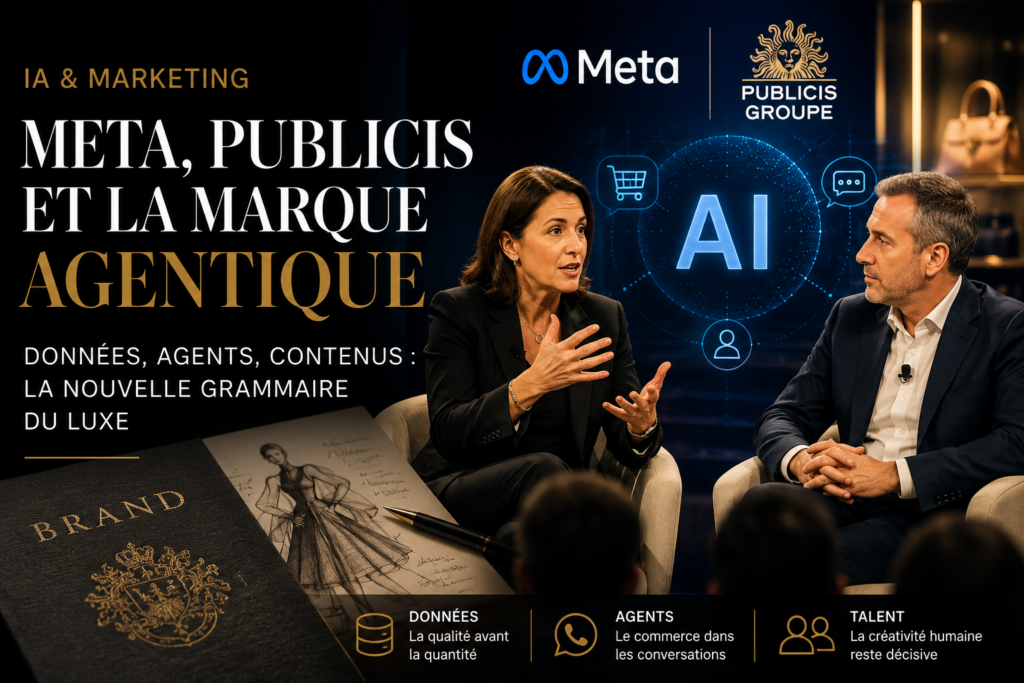
At VivaTech, Meta and Publicis reiterated a truth that is often overlooked: artificial intelligence is not valued for its promises, but for the quality of the data, the context, and the teams that support it.
There are those who predict the demise of marketing. And then there’s the reality, which is far more demanding: catalogs to organize, data to link, agents to train, creative content to adapt, and teams to develop. On stage, Nicola Mendelsohn, head of Meta’s global business, and Arthur Sadoun, Chairman and CEO of Publicis Groupe, took a rare stance amid the current buzz surrounding AI: less fascination, more execution.
Meta now claims to have more than 3.5 billion daily active users across its apps and services. On the advertising side, Nicola Mendelsohn cites a specific figure: in Europe, every euro invested on Meta’s platforms generates approximately 3.79 euros in advertising return. More than 8 million advertisers are already using Meta’s generative AI tools to diversify their creative content, adapt it to different languages, or produce more variations.
But the challenge isn’t just about producing more. That’s actually where the risk begins. Arthur Sadoun puts it bluntly: brands don’t need much more content; they need the right content. This nuance is crucial for the Houses. In the luxury sector, an abundance of variations can quickly lead to dilution. AI makes it possible to reach more audiences, faster, and with greater precision. However, it’s essential that each communication retains a recognizable style.
The brand will need to speak to people, but also to machines
The most interesting part of the discussion concerns agent-based commerce. Meta claims that one million businesses are already using its business agents. The concept is simple: a user can chat with a company, a service, or a brand directly in WhatsApp, Messenger, or Instagram Direct, receiving a personalized response based on the available product catalog, chat history, and preferences.
For Arthur Sadoun, three factors are crucial: data, context, and people. Data, because an agent trained on generic material will deliver a generic experience. Context, because an agent does not sell in the same way in a private chat, on a website, or in an app. People, finally, because marketing remains a matter of taste, intuition, and desirability.
This equation directly impacts the luxury sector. In the future, a luxury brand will no longer cater solely to an aesthete, but also to their AI assistant. An Instagram post may captivate the human eye yet remain invisible to the systems that recommend, compare, or make decisions. Conversely, a dense, unspectacular document may feed a luxury brand’s machine learning more effectively than a highly viewed campaign.
Marketing thus splits into two forms: one for human attention, the other for algorithmic interpretation. The luxury industry will have to learn to master both without sacrificing its voice.
Details
Meta reports that more than a billion messages are exchanged every day between people and businesses on WhatsApp. In an agent-based world, this conversation becomes a commercial, relational, and cultural interface. For a company, the question is no longer just, “What does our website say?” but rather, “What does our agent know, what does it understand, and in what language does it speak?”
The Return of the Human Factor
The paradox of this conversation lies in its conclusion: the more AI advances, the more the human factor becomes strategic once again. Publicis, which is celebrating its 100th anniversary, prides itself on a track record built on investing in talent rather than on mechanically downsizing teams. Sadoun emphasizes that in service-oriented industries, technology is only half the equation. The other half lies in relationships, emotion, taste, and the ability to guide a transformation.
Nicola Mendelsohn shares this conviction. The professionals who will matter are those who can imagine, communicate, and make decisions, while using AI to free themselves from peripheral tasks. For young talent, the two executives offer a fairly clear roadmap: curiosity, resilience, daily practice with the tools, an understanding of data, and a refusal to become too quickly tied to a single platform.
This advice also applies to companies. It would be dangerous to confuse the speed of adoption with true maturity. Test quickly, yes. But testing without brand equity, without safeguards, and without proprietary data is like entrusting your accent to a machine that doesn’t yet know the language.
AI doesn’t replace strategy. It lays it bare. It reveals which organizations have a clear framework, clean data, a point of view, and a culture that can be passed on. The others will produce more. Perhaps faster. But with a weakness that luxury rarely forgives: the absence of necessity.
Cette publication est également disponible en :

