
A design fair held four times a year, across three continents, with formats that vary depending on the city and local culture—it’s no longer really a fair. It’s a living institution. By announcing its full annual program on June 11, 2026, Design Miami confirms a transformation that began several years ago: that of a Florida-based annual event into a permanent international platform for collectible design.
The year 2026 is divided into four phases. In July, in Aspen, Design Miami will take over the Aspen Art Museum’s ArtCrush and AIR programs with a two-day initiative for collectors, developed in partnership with Range Rover. Private tours of artists’ studios, small-group gatherings, and bespoke cultural experiences: the format is intentionally intimate, almost exclusive, tailored for a community that doesn’t need crowds to thrive.
In late August and early September, the event returns to Seoul for the second edition of Design Miami Seoul at the Dongdaemun Design Plaza (DDP), in partnership with the Seoul Design Foundation. The first edition, held in 2025 in a so-called “In Situ” format, surprised attendees with its strong local focus. This edition expands to include international galleries, partner exhibitions, “In Situ” projects, and a cultural program centered on the theme “Resonance.” Curatorial Director Hyeyoung Cho explores how design “transmits memories, knowledge, and emotions across time and space.” In Seoul, this question is far from abstract: the city exists in a productive tension between Joseon heritage and global pop culture, making it one of the most fertile grounds for contemporary design.
In October (October 20–25), Design Miami Paris returns for its fourth edition at the Hôtel de Maisons in the Marais. The list of participating galleries sets the tone: Galerie Patrick Seguin, Nilufar (Milan), Salon 94 Design (New York), Galerie kreo (Paris), Hostler Burrows (Los Angeles-New York), Side Gallery (Barcelona), among others—twenty-eight galleries in total, from Monaco to New Jersey. With “Design at Large” exhibitions, lectures, and a VIP program, Paris remains the European hub, but the fair is now firmly established there and no longer needs to prove its legitimacy.
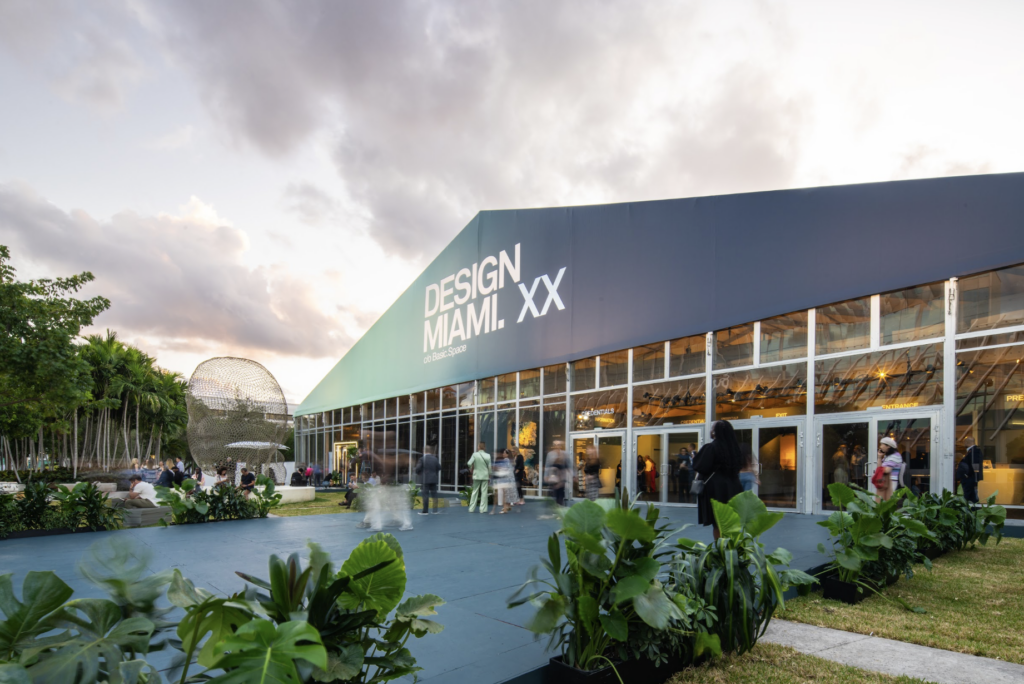
The flagship Miami Beach event (December 1–6) wraps up the year under the theme “Unveiling,” conceived by curatorial director Charlene Prempeh. To unveil, discover, and celebrate contemporary innovations—the word has been carefully chosen and speaks to the state of the collectible design market, which, after a period of post-pandemic euphoria, is seeking to redefine what is worth showcasing. Bank of America is renewing its title sponsorship, a commitment that began last year to mark Design Miami’s 20th anniversary.
What the announcement doesn’t say, but what the program’s geography reveals: the path of contemporary collection design now runs through specific cultural hubs—Aspen for discreet wealth, Seoul for creative Asia, Paris for historical legitimacy, and Miami for scale and celebration. Jennifer Roberts, CEO of Design Miami, speaks of “the diversity of conversations currently shaping the sector.” A diplomatic way of saying that collectible design no longer has a single center—and that Design Miami has chosen to capitalize on this rather than lament it.

Cette publication est également disponible en :

