
On Avenue de Champagne, champagne is never just about the glass. It’s also about geography, setting, and social customs. By kicking off the sixth season of Belle Epoque Society at its historic site in Épernay, Perrier-Jouët is pursuing an idea that has become central to the contemporary wine industry: transforming the tasting experience into a place, and that place into a cultural narrative.
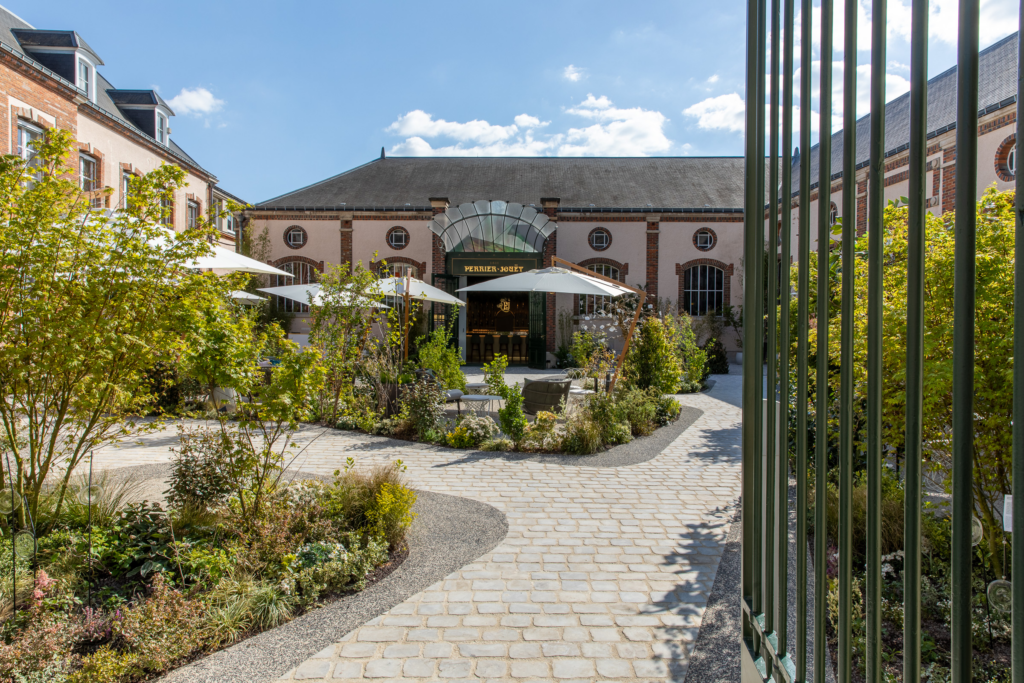
The complex brings together several spaces—the Cellier Belle Epoque, the Maison Belle Epoque, the Boutique, and the Atelier—all united by a common theme: art, nature, and champagne. The complex is rooted in the legacy of Pierre-Nicolas Perrier and Rose-Adélaïde Jouët, founders of Maison Perrier-Jouët in 1811, and in a tradition where Chardonnay—chosen very early on as the signature grape variety—has shaped a style recognizable by its floral vibrancy. This connection to the plant world is not a decorative motif added as an afterthought; it has become one of the key themes of the House, dating back to the white Japanese anemone designed by Émile Gallé in 1902 for the Belle Epoque cuvée.
The Belle Epoque Society functions less as a simple wine tourism destination than as a carefully curated showcase of Champagne hospitality. The Cellier Belle Epoque offers a menu of dishes to share—asparagus and burrata from Puglia, smoked salmon and house-made blinis, fresh goat cheese with candied citrus—as well as a four-course tasting menu created by Sébastien Morellon, the House Chef, in collaboration with Séverine Frerson, Cellar Master. Three non-vintage cuvées form the backbone of this culinary symphony: Perrier-Jouët Grand Brut, Perrier-Jouët Blanc de Blancs, and Perrier-Jouët Blason Rosé. The menu features smoked salmon tartare with green asparagus and dashi jelly; roasted Champagne-style chicken with coconut milk poulette sauce and spring vegetables; and a strawberry millefeuille with chamomile cream, sesame tuile, and tagetes.
What is happening here is indicative of a broader shift: Champagne houses are no longer content simply to open their cellars; they are creating entire environments. The 2015 UNESCO inscription of the Slopes, Houses, and Cellars of Champagne reinforced this heritage-based interpretation of the region, notably including the Avenue de Champagne and Fort Chabrol in Épernay among the sites representative of champagne production and marketing. A visit thus becomes an act of understanding: visitors no longer come merely to drink wine, but to interpret the economic, agricultural, and cultural architecture of a region.
Across from the Cellier, the Maison Belle Epoque embodies this commitment to heritage. It houses one of Europe’s largest private collections of French Art Nouveau, featuring works by Hector Guimard, Louis Majorelle, and Émile Gallé. The choice is fitting: Art Nouveau, with its emphasis on organic lines, stems, curves, and the living world, offers Perrier-Jouët a visual language that extends its connection to nature. In this context, the cuisine does not distract from the setting; rather, it becomes an extension of it.
Lunch at Maison Belle Epoque unfolds in five courses, created by Pierre Gagnaire, a three-Michelin-starred chef, and Sébastien Morellon, in collaboration with Séverine Frerson. Non-vintage Perrier-Jouët Blanc de Blancs pairs with white asparagus and kohlrabi cannelloni; Belle Epoque Blanc de Blancs 2018 pairs with a thick-cut sea bass fillet; Belle Epoque 2016 complements a 64°C egg and a miso hollandaise sauce. Later, Belle Epoque Rosé 2014 is served with a veal chop, before being paired, in another iteration, with a Sicilian pistachio ice cream parfait. The approach is not one of accumulation, but of precise pairing: acidity, texture, aroma, and finish.
The Boutique and the Atelier extend this exploration through objects and experiences. The Atelier Belle Epoque hosts tastings centered on Perrier-Jouët’s cuvées and history. The Boutique, which opens onto the Cour Jardin, offers limited editions, collectible books, and personalization services. Among the featured items is Perrier-Jouët Belle Epoque Florescence, a rosé champagne long reserved for the Japanese market before being introduced to a more international audience. This limited edition features the work of artist, architect, and designer Garance Vallée, whose design reinterprets the floral motif in a contemporary graphic style.
Another collaboration is with Polish designer Marcin Rusak, whose work has for several years explored botanical materials, plant memory, and the transformation of living things. For Perrier-Jouët, he has created a limited-edition set featuring a gift box and flutes, reinterpreting the herbarium through a botanical drawing dedicated to three plants from the House’s vineyard. Here again, the intent is clear: to bring nature from the vineyard to the table, and then from the table to the object.
The Belle Epoque Society truly comes into its own when it avoids the trap of mere decoration. In Épernay, the anemone is not merely an emblem, the garden is not an accessory, and Art Nouveau is not just a stylistic reference. Everything is rooted in continuity: the grapes, the flower, the glass, the plate, the furniture, the courtyard, the cellar. In a Champagne region shaped as much by cultural tourism as by market pressures, Perrier-Jouët has chosen the long-term approach here: to transform its historic site into a destination where visitors come to understand that champagne is also an art of composition.
Alcohol abuse is harmful to your health; please drink in moderation.
Cette publication est également disponible en :

