
Neroli hasn’t always had a good reputation. Prized at the court of Louis XIV for scenting gloves and baths, it was extracted at the time without any rigorous method, depending on the availability of the harvest. Three centuries later, Maison Parfums de Marly has made it the centerpiece of a new eau de parfum—and it is in the precision of its sourcing, rather than in its historical evocation, that the appeal of this approach lies.
Athénaïs opens with Orpur™ neroli, derived from fresh bitter orange blossoms harvested at dawn in Tunisia and Morocco, handpicked in the spring, and then processed by hydrodistillation. UEBT certification—Union for Ethical BioTrade—guarantees the traceability of cultivation and harvesting conditions, from biodiversity to trade. This is no trivial detail: in a niche perfume market where the language of “natural” has become mere rhetoric, third-party certification changes the nature of the promise.
Technical detail: two tonka beans in the same bottle
In the base notes of the composition, tonka bean appears in two distinct forms. The resinoid, obtained through maceration, preserves the raw density of the material—woody, honeyed, and reminiscent of leather. The absolute, produced through molecular distillation, strips the bean of its heaviest elements, retaining only an airy, subtly almond-like facet. The two coexist within the same formula. It is this tension—the same origin, two treatments, two sensory outcomes—that founder Julien Sprecher describes as follows: “I wanted these two contrasting notes to come together, weaving a link between history and a certain facet of today’s femininity.”
The full fragrance profile features bergamot and yuzu at the top, orange blossom and sambac jasmine at the heart—the latter, more heady than grandiflorum jasmine, adds a roundness that tempers the citrus notes’ acidity—to which is added Mahonial, a synthetic molecule with a woody-milky sillage, which is not well documented in the file but is listed in the official declaration.
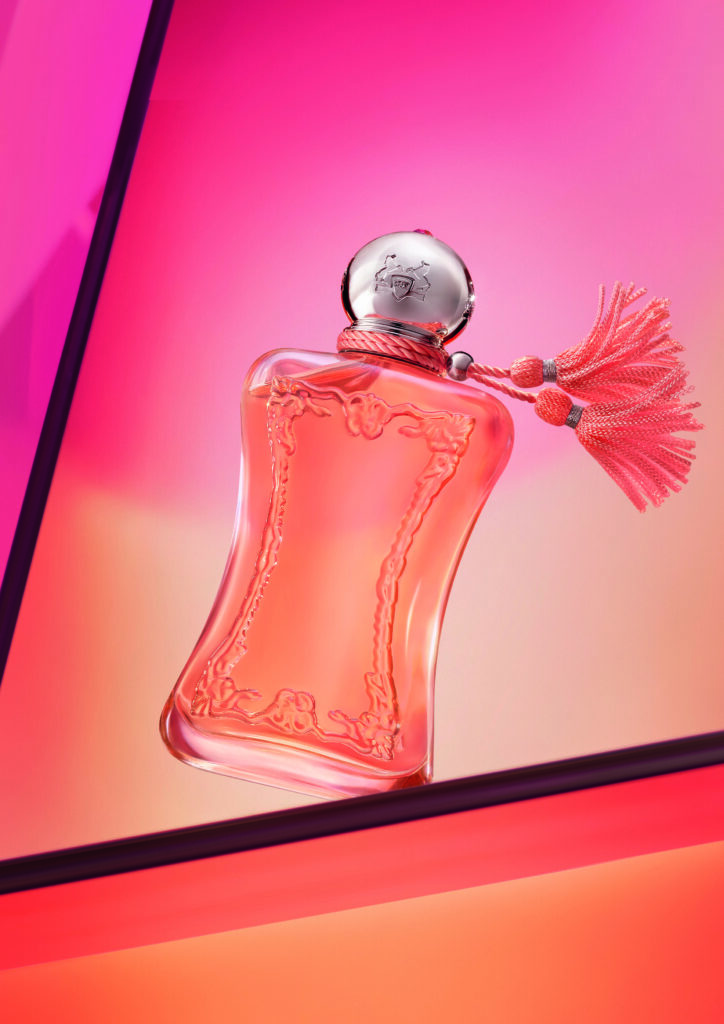
The bottle, made of glass tinted in shades of pink and orange, echoes the rocaille style of the brand’s existing collections: a molded, embossed frame, an identically braided pompom, and a metallic sphere. The visual campaign—entrusted to the Argentine duo Sofia Sanchez & Mauro Mongiello, who previously created the Palatine universe—plays on the mini-maxi effect between the human figure and the enlarged bottle. This pop-inspired aesthetic marks a shift in the Les Signatures collection, which until now had maintained a more understated tone.
Founded by Julien Sprecher in reference to the Château de Marly—a summer residence built by Jules Hardouin-Mansart in 1679 for Louis XIV, distinguished from Versailles by its private nature— Parfums de Marly has built its brand around the use of premium raw materials in highly concentrated formulas. Athénaïs, available in a 75 ml size since March 23, 2026, following a week of exclusivity in its own boutiques—signals less a shift than a reaffirmation: that of a House that knows the most enduring selling point is not the name chosen for a fragrance, but the care taken in crafting its ingredients.
Cette publication est également disponible en :

