
There are dresses that go beyond mere couture. They embody protocol, political symbolism, textile art, and sometimes even geography. At the Musée des Arts Décoratifs, the exhibition “Fashion in Majesty. Haute Couture and Tradition at the Thai Court” invites visitors to view the Thai royal wardrobe not as a series of ceremonial outfits, but as a language—a language woven from silk, brocade, metallic threads, drapery, French tailoring, and Siamese heritage.
On view from May 13 to November 1, 2026, in Paris, the exhibition coincides with a specific diplomatic milestone: the 340th anniversary of the first diplomatic contact between France and Siam, and the 170th anniversary of the establishment of Franco-Thai diplomatic relations in 1856. Organized by the Musée des Arts Décoratifs in collaboration with the Queen Sirikit Museum of Textiles and the Sustainable Arts and Crafts Institute of Thailand, it brings together nearly 200 pieces—including dresses, accessories, objects, textiles, and photographs—drawn primarily from the royal collections.
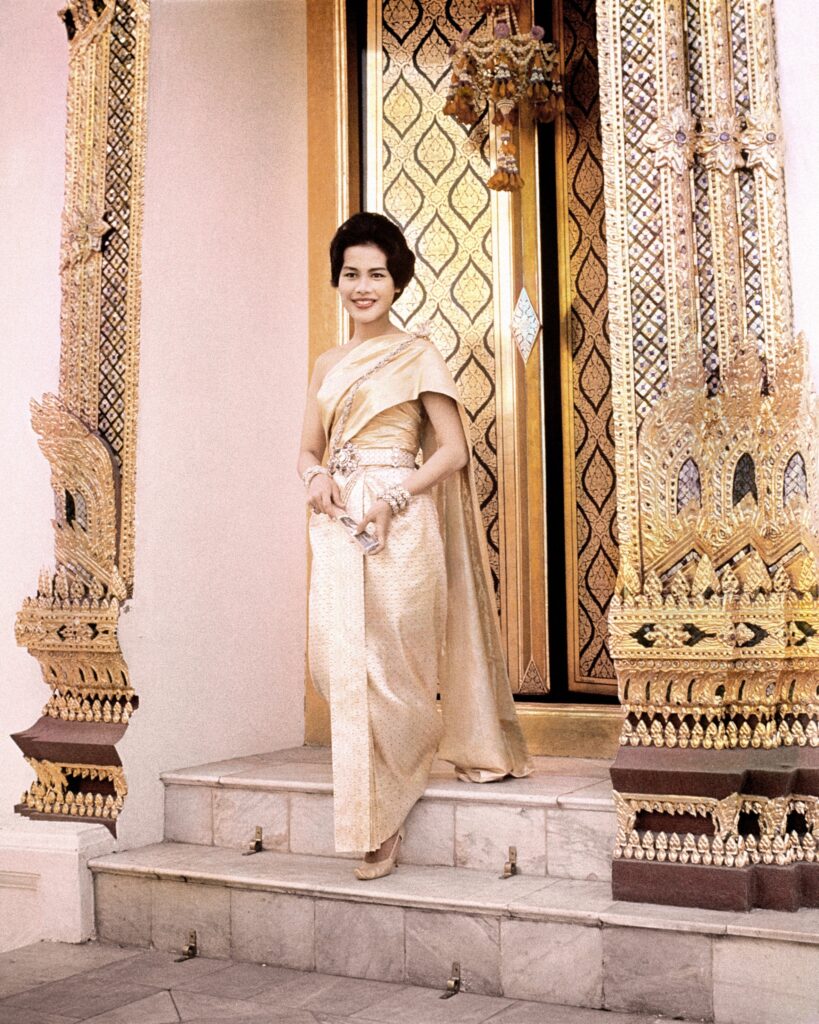
The exhibition focuses on the 1960s, when Her Majesty Queen Sirikit accompanied King Bhumibol Adulyadej, Rama IX, on a series of official trips to Europe and the United States. The press release notes that in 1960, these trips covered fourteen European countries as well as the United States. This was a pivotal moment: postwar Thailand was reaffirming its place on the international stage, and the queen’s image became one of the key elements of this reaffirmation. Clothing was no longer merely a form of representation; it became a cultural strategy.
This is where Pierre Balmain comes in. For her state visits, Queen Sirikit entrusted the French fashion designer with designing a wardrobe that would translate Thai heritage into the artistry of Parisian haute couture. Balmain works with Thai silk, brocade, mat mii—a form of ikat—and embroidery, while studying the shapes, proportions, and textile logic of a tradition rooted more in wrapping and draping than in Western tailoring. Detail is essential: the goal is not to dress a sovereign “in the French style,” but to create a hybrid aesthetic that is appropriate for official international settings without obscuring the garment’s Thai origins.
The images in this feature illustrate the scope of this translation project. On page two, a photograph shows Her Majesty Queen Sirikit in Paris, visiting Maison Balmain at 44 rue François-Ier on October 12, 1960. On the same page, a 1981 Thai Chakraphat combines plain silk, silk brocade, metallic threads, pearls, sequins, and a ceremonial structure. On page three, a 1982 Thai Chakri designed by Pierre Balmain presents a variation on the chong kraben, crafted from silk brocade and metallic threads, plain silk, pearls, and sequins. Here, the garment functions as a flexible architectural form: it frames the body without forcing it into a fully Westernized silhouette.
This interpretation is all the more interesting because it highlights a diplomatic role of haute couture that is rarely examined. Parisian couture contributes its expertise in cutting, construction, and finishing; Thai textiles bring their cultural richness, their brilliance, and their heritage of craftsmanship. The exhibition also features sketches, fabric swatches, and embroidery to shed light on the collaborative process between Queen Sirikit, the House of Balmain, the House of Lesage, and the SUPPORT Foundation. In this triangular relationship, Paris is not merely a center that absorbs; it becomes a temporary workshop, a place where a national language is made visible on the international stage.
The hand plays a pivotal role in this story. In 1976, Queen Sirikit established the SUPPORT Foundation to preserve textile arts and crafts. The Queen Sirikit Museum of Textiles notes that this foundation also aimed to provide farmers and rural villagers—particularly women—with a steady source of supplementary income, while preserving endangered textile traditions. The exhibition thus devotes special attention to lipao weaving, folding fan painting, niello work, gold damascening, and Bencharong ceramic painting, all of which are viewed as living traditions.
This aspect prevents the exhibition from becoming merely a fascination with court attire. What we see here is a cultural economy of transmission: training, preservation, market development, and support for rural artisans. The SUPPORT Foundation appears less as a heritage appendage than as a slow-moving infrastructure, designed to ensure the longevity of material practices. In the vocabulary of contemporary luxury, one might readily speak of sustainability. Here, the term takes on a more concrete meaning: maintaining traditions, compensating artisans for their skills, and preventing a pattern or technique from becoming merely an archival artifact.
The exhibition continues with a look at contemporary Thai art. Alongside historic pieces associated with Queen Sirikit, the exhibition features outfits worn or commissioned by Her Majesty Queen Suthida and Her Royal Highness Princess Sirivannavari Nariratana Rajakanya. It also showcases contemporary Thai designers, including SIRIVANNAVARI, ASAVA, VATIT ITTHI, WISHARAWISH, TIRAPAN, and MESHMUSEUM. On page five, a two-piece ensemble inspired by Chud Thai, designed by SIRIVANNAVARI in 2025, combines silk beads, glass, crystal, cotton thread, flat metal strips, and recycled plastic, with embroidery reminiscent of Cape jasmine. The past is thus not presented as a static backdrop; it becomes a matrix.
The appeal of “La Mode en majesté” lies precisely in this interplay: showing how a royal wardrobe can become an instrument of identity, representation, and soft power. Clothing serves here as protocol, a textile archive, a couture laboratory, and a diplomatic manifesto. In this respect, the exhibition goes beyond the story of personal elegance. It shows how a sovereign, a French fashion designer, embroidery workshops, rural artisans, and contemporary designers have all contributed to the construction of a national image.
At a time when fashion institutions often seek to trace the flow of influences, this exhibition seems to pose a more nuanced question: what becomes of a tradition when it embraces the international stage without dissolving into it? The answer may lie in these silhouettes, where Thai draping meets the Balmain aesthetic, where brocade engages in a dialogue with Lesage, where the court becomes a workshop, and where diplomacy is revealed in a single fold.
Cette publication est également disponible en :

