
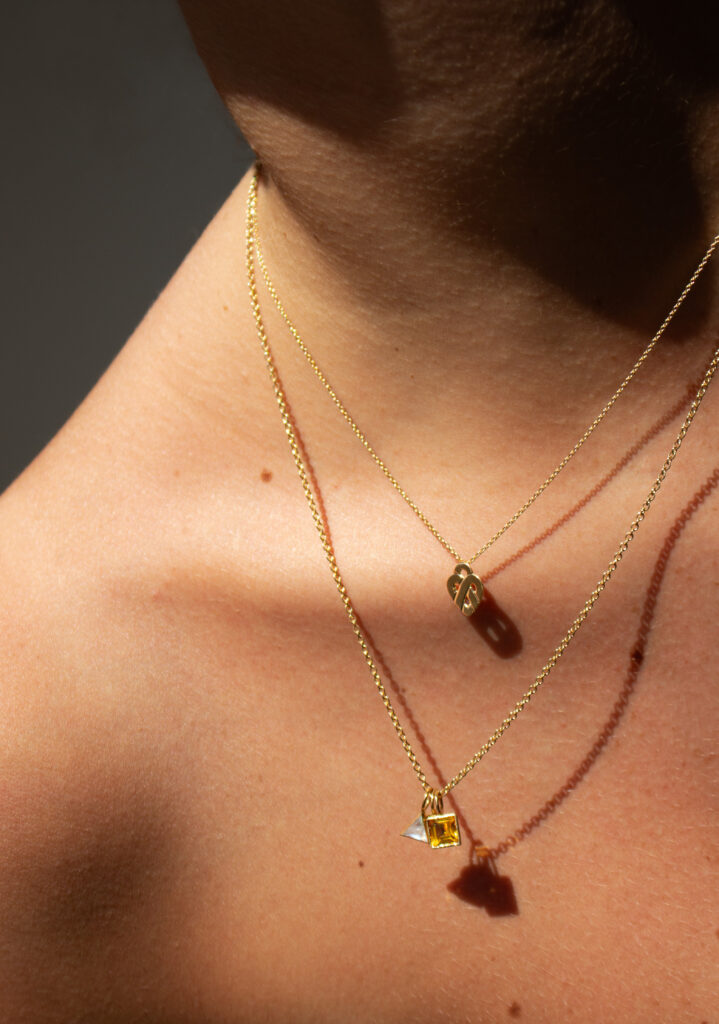
In contemporary jewelry, the question is no longer just one of motif, but of scale. With Cœur Entrelacé Mini, the challenge is not to introduce a new form – the heart has long been part of the vocabulary – but to constrain it. To reduce, here, is to specify.
The interlaced motif is based on an apparently simple construction: two curves that intersect, overlap and respond to each other. However, this type of assembly imposes a particular rigor. Each line must retain its legibility while accepting the interference of the other. Too much volume, and the shape blurs. Too little, and it disappears.
The choice of the “mini” format acts as a structural constraint.
At this scale, the question of setting becomes central. The integration of stones – when present – can no longer be based on accumulation. It requires a precise distribution, often in a tight paving pattern, to maintain the continuity of the line without creating a visual break. Metal, for its part, must remain sufficiently present to support the structure without weighing it down.
This dialogue between full and empty forms the balance of the piece.
The interlaced heart motif also introduces a kinetic dimension. Depending on the angle of view, the curves are read differently: sometimes as a single continuous form, sometimes as two distinct entities. This controlled visual instability produces an evolving reading of the object.
You don’t look at the room once – you walk through it.
In this context, the finish plays a decisive role. Whether mirror-polished to catch the light or more satin-finished to diffuse it, each treatment modifies the perception of volumes. On a small scale, these variations are amplified. An edge that’s too sharp, a polish that’s too pronounced, and the whole thing falls apart.
The “mini” therefore requires greater precision.
Beyond the technical, this reduction is part of a broader movement in jewelry today: that of everyday wearability. Pieces are no longer designed solely for specific occasions, but to accompany ongoing use. Jewelry becomes a punctuation mark rather than a statement.
The intertwined heart, historically associated with emotional symbolism, now shifts. It ceases to be an explicit sign and becomes an abstract, almost graphic structure.
This shift is discreet, but revealing.
In a market saturated with recognizable motifs, differentiation is no longer achieved through formal invention, but through mastery of scale and detail. The piece isn’t meant to be seen from afar – it’s meant to be seen close up.
That’s where its value lies.
Reducing, after all, is not impoverishing.
It’s concentrating.
Cette publication est également disponible en :

