
Twenty-five years after its first appearance, the B.zero1 spiral doesn’t just persist – it adapts. In 2026, the House of Bvlgari is not reinventing its motif, it’s moving it. From an architectural symbol to a mobile structure, designed to follow contemporary gestures.
The issue is no longer the icon. It’s usage.
Born in 1999, the B.zero1 ring is directly inspired by the volumes of Roman columns – stacking, rhythm, vertical tension. A construction reduced to the essentials: geometric lines, spiral repetition, and that rare ability to exist without superfluous ornamentation.
This formal base has not changed. What has evolved, however, is his way of inhabiting the body.
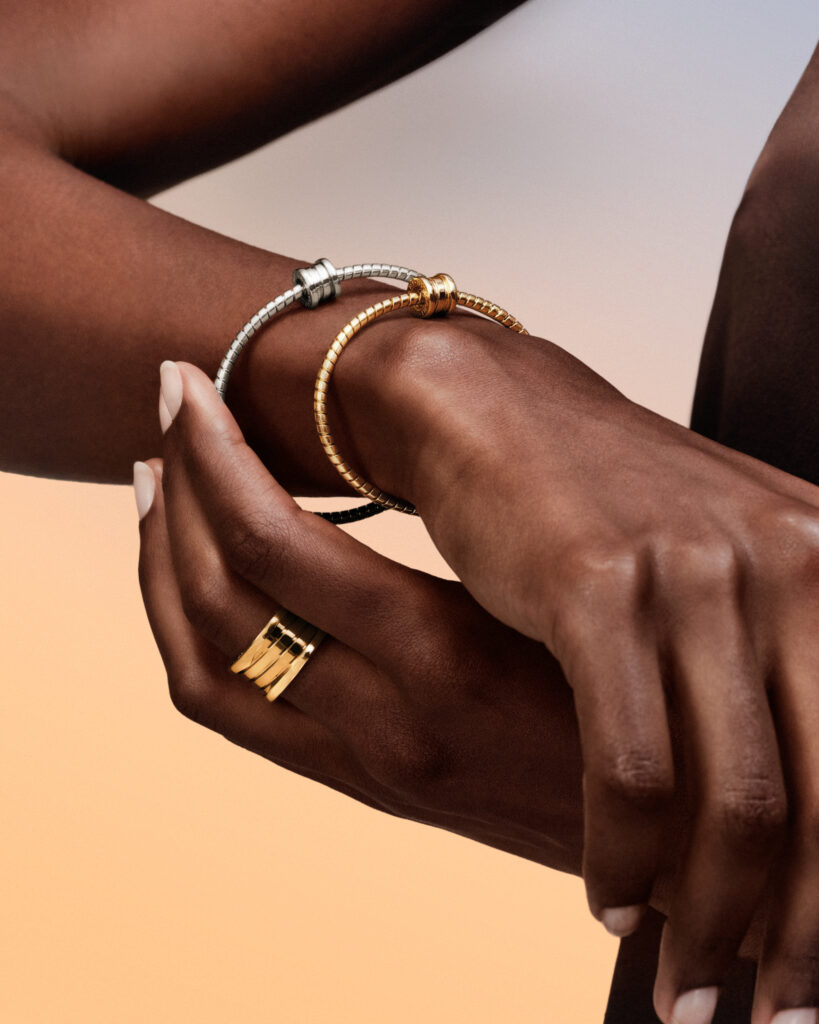
In 2026, nine new pieces extend this grammar, including a bangle bracelet, a semi-pavé pendant and creoles. The common thread is not aesthetic – it’s structural: the fusion of the B.zero1 spiral and the Tubogas technique.
Tubogas, historically used by Bvlgari since the 1940s, is based on a seamless assembly. Metal strips are wound around themselves to create a flexible structure, able to follow movements without rigidity. Here, this technique is not just for comfort. It transforms the spiral into a mechanism.
The bangle bracelet is the clearest expression of this. The spiral is no longer merely visible – it becomes functional. An invisible closing system is integrated into the central motif, acting simultaneously as a graphic element and as a clasp.
The shift is discreet, but decisive: décor becomes structure.
Another, quieter evolution: the question of scale. The necklace adopts more restrained dimensions, favoring superimposition. The pendant, meanwhile, works on proportions – reduced volume, diamond-paved edges – to introduce a diffusion of light rather than a focal point.
Créoles extend this logic. Their design takes up the codes of the spiral, but stretches them into a continuous circular shape, designed to be worn singly or in pairs. A modular design.
White, yellow or pink gold: the palette remains classic. But it’s not so much the material as the combination that’s important. Each piece is designed to coexist with the others – accumulation, dissociation, personal rhythm.
What B.zero1 formalizes here goes beyond jewelry. It’s a way of thinking about the object as an open system.
In a context where uses are fragmenting – hybrid days, constant mobility – the piece must adapt without transforming itself. Hence the idea of structural versatility: a stable form, but multiple uses.
Bvlgari does not seek to renew its icon by breaking away from it. The strategy is slower. It consists of injecting flexibility into a rigid architecture, and allowing movement to flow into a form designed to last.
A spiral is never closed. It moves forward.

Cette publication est également disponible en :

