
Three hours from Milan, the former capital of the Duchy of Parma and Piacenza sets a singular pace, far removed from the hustle and bustle of Lombardy. Here, elegance doesn’t come from brilliance, but from the precision of pink Verona marble or the acoustics of a 17th-century wooden theater. Between imperial heritage and rigorous craftsmanship, the Emilian city can be explored like an open-air library.
Architecture as sedimentation
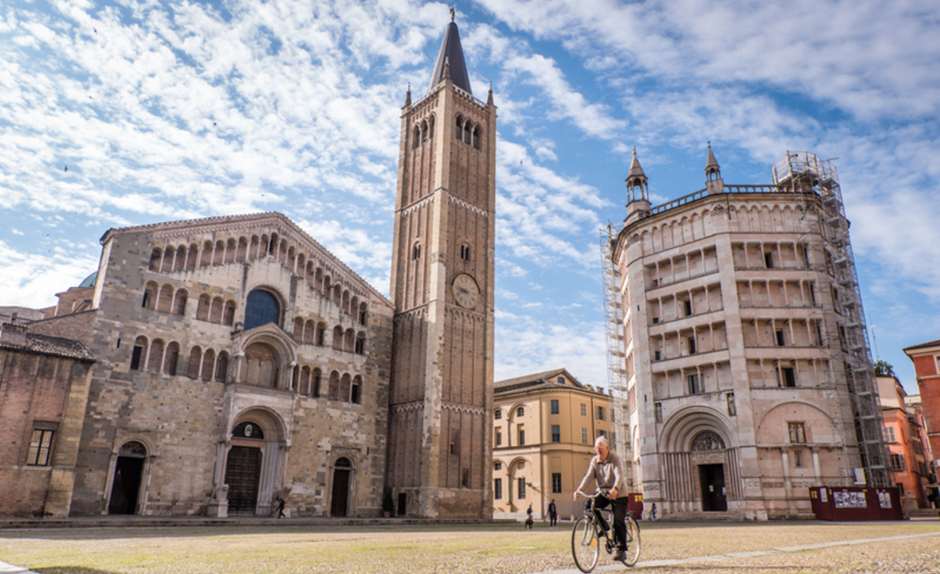
The Parmesan experience begins in Piazza Duomo, where the verticality of the Baptistery marks a clean break from the hustle and bustle of contemporary life. Built of pink marble, this monument crystallizes the transition from Romanesque to Gothic, offering a lesson in medieval geometry. A few steps away, the Palazzo della Pilotta imposes its brick mass, housing one of the rarest jewels of European architecture: the Teatro Farnese. Built entirely of wood in 1618, this Baroque theater is a reminder that luxury in Parma is first and foremost a question of material and resonance.
This requirement is reflected in the Camera di San Paolo, where Correggio’s frescoes move away from simple devotion to embrace a refined humanist culture. The city, nicknamed “Little Paris” under the influence of Marie-Louise of Austria, has preserved its urban structure from this period, with historic gardens such as the Parco Ducale providing the breathing space needed to observe its heritage.
Product rigor
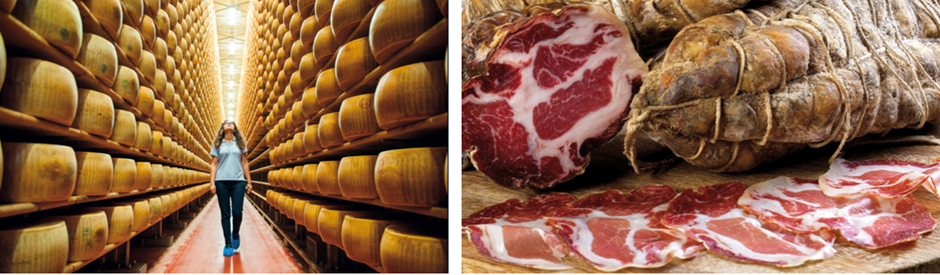
In Parma, gastronomy is not simply a matter of the mouth, but a discipline of patience. Parmigiano Reggiano and Prosciutto di Parma are not commodities, but cultural objects governed by age-old protocols. In the province’s maturing cellars, time is the principal artisan. The traceability of each wheel and each piece of meat goes beyond the commercial sphere to become part of a living heritage.
This precision of gesture extends to the olfactory world. Spurred on by Duchess Marie-Louise in the 19th century, the cultivation of violets gave rise to a perfume industry spearheaded by the Lodovico Borsari factory. The “Violetta di Parma” is no longer just a fragrance; it has become an identity code, a retinal and sensory persistence that still infuses local literature and imagery today.
The labyrinth of the mind
The influence of Parmesan luxury extends beyond the city walls. In Fontanellato, the Labirinto della Masone embodies the radical vision of art publisher Franco Maria Ricci. This seven-hectare labyrinth, composed entirely of bamboo, surrounds a cultural complex housing a private art collection and a reference library. It’s here, between the wooden stalks and bound volumes, that the true nature of the region becomes clear: an aesthetic quest where the detour is more precious than the destination.
Technical details: The structure of Teatro Farnese
Constructed of fir wood and covered with stucco painted to imitate marble, the Teatro Farnese illustrates 17th-century Baroque engineering. Its structure was designed to host naumachia (naval battles), allowing the stage to be flooded thanks to a system of underground reservoirs, a rare technical feat for the time.
Parma’s future seems to lie in its ability to maintain its craft traditions – from violin making linked to the legacy of Giuseppe Verdi to the preservation of culinary skills – while integrating contemporary projects of international scope.
Cette publication est également disponible en :

