
Symbols of the evolution of advertising and commerce, “animated” bearers of the values of the first major brands, often imbued with a form of quirky poetry capable of provoking curiosity and wonder, advertising automata had their moment of glory between the second half of the 19th century and the end of the 1940s.
From July 12, 2013, with the AUTOMATES exhibition, La Maison de La vache qui rit in Lons-le-Saunier (Jura) presents a selection of 42 large advertising automatons, objects that have today become rare, even rarities. They will be presented according to the major themes they could illustrate or personify: “animal automatons”, “therapeutic automatons”, automatons for “eating and drinking”, automatons that “bathe” or that “dress”, automatons that “write”, and so on.
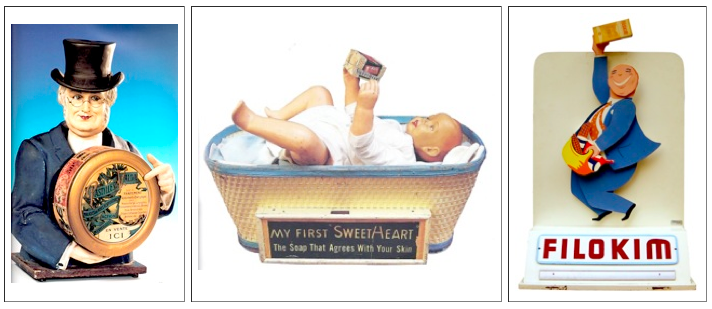
These objects, often atypical in the world of advertising objects, appeared at the same time as department stores (Le Bon Marché was created in 1852, followed by La Samaritaine, Le Printemps, etc.). The aim was to capture the attention, gaze and desire of passers-by on the new – and grand – boulevards of Haussmann’s Paris. Symbols of progress and “modern” commerce, emblematic objects of “advertising”, more effective than posters, advertising automatons made their mark and imprinted their presence on the urban spectacle, as noted by the painter of the modern city Fernand Léger, for whom “the show window has become a major concern in the retailer’s activity. Unbridled competition presides over it: to be seen more than one’s neighbor is the violent desire that drives our streets”. This “violent desire” was to give birth to objects capable of making consumers dream, marvel and be fascinated by their mechanical illusion.
Michel Taeckens, General Delegate for the Musée de Plein Air de Villeneuve d’Ascq and curator of the exhibition, has selected 42 of the most representative automata of the period from private collections, rarely if ever presented to the public. Highlights of the exhibition include: a unique set of nine Valda automata (the brand that used automata the most), a beautiful 1930 Cadum automaton, “Pour l’hygiène et la beauté de la peau”, and a highly technical Danone automaton. Also worth noting are the retro-style vending machines from Idéal-Bibliothèque Hachette, Lessive Dinamo and Lait Mont Blanc.
The exhibition’s scenography has been entrusted to the Portuguese architectural collective “petit cabanon”, who will develop a playful and amusing evocation of a “street” with shop windows filled with automatons. Following on from the REWIND (2010), Même Pas Vielle (2011) and Au Lait! (2012), Automates marks the 4th collaboration between La Maison de La vache qui rit and “petit cabanon”.
Cette publication est également disponible en :

