
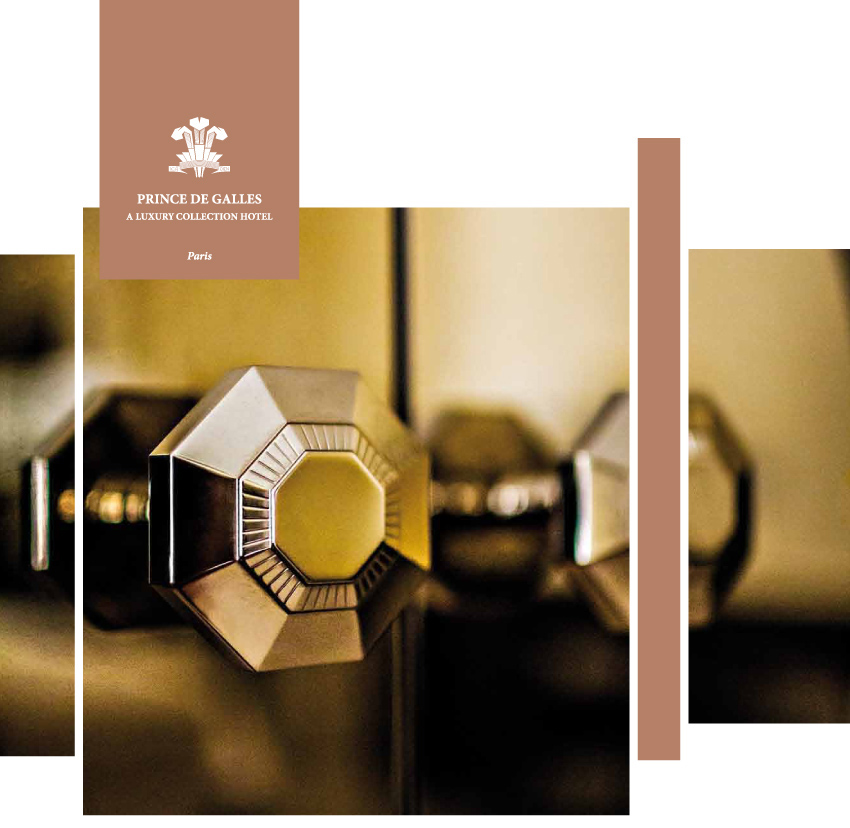
 The Prince de Galles, a Luxury Collection hotel, is about to reopen its doors following a two-year restoration by ERTIM Architectes SA in collaboration with two internationally renowned decorators, Pierre-Yves Rochon and Bruno Borrione. Unveiling a
mosaic of Parisian elegance, the Prince de Galles aims to establish itself as the place to be for a discerning clientele seeking the discretion of a luxurious address in the sophisticated setting of an Art Deco jewel.
This project is part of a major strategy by Starwood Hotels & Resorts and its owners, who have decided to invest over 150 million euros in restoring the most emblematic European hotels in the Luxury Collection.
The Alfonso XIII in Seville and the Maria Cristina in San Sebastian reopened in 2012, while the Gritti Palace in Venice was inaugurated on February 1, 2013 after a 15-month renovation.
ENLIGHTENING A MOSAIC OF PARISIAN ELEGANCE
Inaugurated in 1929, in the heart of the Art Deco period and designed by architect André Arfvidson, the legendary Prince de Galles hotel remains one of the most singular addresses in the Paris hotel industry, appreciated by travelers seeking an intimate and elegant stay close to the Champs-Elysées, in the most sought-after district of the French capital: the Golden Triangle.
Attention to the smallest detail characterizes the work of Pierre-Yves Rochon, who has redesigned the hotel’s 115 rooms and 44 suites, lobby and wellness area. Uncompromising in the quality of his workmanship, the interior designer has carefully selected leading names in craftsmanship and savoir-faire to sublimate demanding materials such as Saint-Laurent Noir marble and Macassar ebony. These include Mobil Project and Craman Lagarde (furniture), Collection Pierre and JNL (armchairs), Delisle (lighting), Pierre Frey and Zimmer and Rohde (fabrics), Orient Impex and Parsua (rugs).
The welcoming entrance and lobby evoke the intimacy of a living room, usually reserved for a private residence. The luminous lobby is adorned with a spectacular chandelier by Delisle, based on an archive dating back to 1929, which incorporates the three feathers of the famous plume, emblematic of the Prince of Wales. The lobby’s warm, exotic lounge features a macassar ebony console, a Parsua rug and elegant
leather-upholstered armchairs, enhancing the splendour and intimacy of this unique lobby. Pierre-Yves Rochon’s sense of surprise begins at the main door, which is adorned with two majestic bronze lighting fixtures made by Maison Delisle and designed by Pierre-Yves Rochon as two emblems of the Prince of Wales: “Most hotels put trees in front of their doors. I wanted to break with this habit by designing these two trees in gilded bronze. It’s an unexpected signature that will support the Prince of Wales’ identity.
A PRIVATE RESIDENCE, A JOY OF ART DÉCO
The decoration of the rooms, conceived as so many rooms in a private home, revives the Art Déco style in vogue in the early 1930s. As Pierre-Yves Rochon explains: “Art Deco is a decorative style very characteristic of Parisian interiors, but strangely enough, it had completely disappeared from the capital’s hotel landscape. It was very important for the Prince de Galles to rediscover its original style and become the only Art Deco hotel in Paris.”
Delicate, warm alcoves, the 115 rooms seduce with their modernity and comfort, without compromising the charms of their “haute couture” decor in silky, orange or celadon fabrics. In the bathrooms, mirrors, fixtures and mosaics revive the combinatorial and graphic games so dear to Art Deco interiors. In the suites (23 Mosaïque and 18 Macassar), the dreamy veins of black “Saint Laurent” marble outline the contours of a privileged space. A decor woven from silk, linen and cotton, where armchairs, sofas and meridiennes invite reverie. Like the arabesques of the carpet, which echo the graceful volutes of the patio mosaic seen from the windows. These cocoons will be appreciated by studious travelers – a macassar wood secretary provides a beautiful workspace – or romantics, whose sycamore dressing room will make them feel immediately at home.
On the seventh floor of the hotel, where two royal suites (Gold and Sapphire) are located, the Parisian atmosphere is illuminated by gold and black. Ribbed marble, dark leather, leopard-print armchairs and lacquered furniture blossom in a luminous atmosphere. In the Gold suite, artist Manuela Paul-Cavallier’s measured gesture transforms the alcove at the head of the bed into a wall decor conducive to dreams of a golden night, while in the Saphir suite, dotted with blue details, a large macassar bookcase holds the memories and stories of the hotel’s famous guests. Lifted by the glow of these illustrious icons, we discover L’Appartement Parisien, the key to which opens much more than just a suite. A piece of Paris nestled beneath the rooftops, where the journey unfolds over two floors and an 85 m2 private terrace opening onto the Golden Triangle. A true jewel with Art Deco facets, whose more contemporary decor and sophisticated lines – such as those of the graphic Nourison carpets or the magnificent mosaics in the bathrooms – are arranged around a masterly iron and gilded staircase. In this private apartment, Paris is even present on the walls, which are hung with an Edmond Petit canvas featuring antique maps of the capital. Equipped with a kitchenette, separate dining room, two lounges, interior elevator and two bedrooms, this 245 m2 apartment will be the setting for an unforgettable stay, with
as its only backdrop, the Eiel Tower.
A UNIVERSE DEDICATED TO GASTRONOMY AND THE ART OF LIVING
Working closely with chef Stéphanie Le Quellec, Bruno Borrione has applied his contemporary, dreamlike touch to the dining areas.
– La Scène, the hotel’s signature restaurant, where the ethereal white of the marble in the open kitchen contrasts with the dark lines of the wood.
– Les Heures, his bar of choice, sounds like a mix of materials and colors, where macassar ebony, a leitmotif of the 1920s, highlights the modernity of a décor tinged with green, brown and beige.
– The famous Mosaic patio, meticulously restored, is a restful place where travelers can meet for a coffee or an old-fashioned cocktail like the famous “Champs-Elysées”.
A gourmet scene that comes to life as the hours tick by, around the patio’s mosaic, and which illustrates an approach described in these words by Bruno Borrione: “By preserving the balance between the history of the place and its functionality, I wanted the Prince de Galles to rediscover its sense of hospitality without becoming a museum. I wanted the first floor to become an open, lively, luminous space… and to be once again in phase with the offervescence of Parisian life.”
Cette publication est également disponible en :

