
Joana Vasconcelos has moved to Versailles. To the detractors of contemporary art in these parts, we need only point out the words of Catherine Pégard, Curator of the Château de Versailles Museum: ‘There is no incongruity in the presence of Joana Vasconcelos at Versailles’.
Joana Vasconcelos is a Franco-Portuguese artist who likes to challenge aesthetic and cultural achievements. Through her various questionings, she interrogates and attempts to plead the cause of women. Some of her earlier works, such as La Mariée (2001/2005) and Burka (2002), took the subject very far, and can be seen as demanding. From OB tampons to the full veil, from plastic cutlery to stainless steel saucepans, the artist focuses on the female condition through a contemporary prism.
15 works create a unique artistic journey. The Escalier Gabriel, Galerie des Glaces, Salons de la Guerre et de la Paix, Chambre de la Reine and a number of other prestigious spaces are home to these works. Some of them can be seen in the garden. 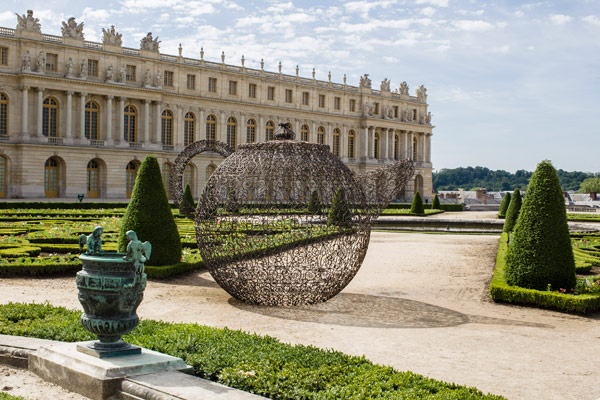 Some pieces were created specifically for this presentation. La Perruque, Le Dauphin et la Dauphine, Les Gardes, Lilicoptère, … are all in this vein.
 The first female contemporary artist to display her dreamlike style, she assumes her choices. Enthusiastic, she has mobilized various private and public sponsors in France and Portugal.
From piece to piece, from the Valkyries, a recurring element in the work of Joana Vasconcelos, to Marilyn’s Shoes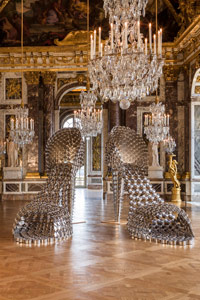 the young woman confronts her definition of luxury with that of Louis XIV. Far, far removed from the gold leaf highlights on the stucco and the precious materials used to decorate the building, she plays with convention, giving free rein to a variety of utensils of little value. Stainless-steel saucepans and plastic forks gain in consideration after passing through the hands of Joana Vasconcelos.
Isn’t real luxury that of the creative artist, capable of transfiguring the elements? Poetry of the suburbs confronted with that of the palaces, the set is open.
Underneath it all, the status of women. Versailles was a straitjacket for some of its great tenants. Marie Antoinette frantically sought to “escape”. From subterfuge to amusement, didn’t she remain a prisoner of her prerogatives and the contingencies of materiality?
Le Dauphin et La Dauphine captures this perfectly. Two lobsters face each other, languishing on a set table. They embody the royal successors. They are reclusive in two ways. By their very nature, their being is encased in their shells. By the creator’s will, they are also sheathed in lace. Protective but also constraining, lace highlights the loss of real free will.
By choosing this lace, which is implicitly linked to Portugal, the designer is also interested in the daily lives of these workers, whose existence is restricted. Women of the nobility, lace-makers, how to escape the exiguity of an existence?
The guards, sculptural lions carved from Port Laurent marble, underpin the message. 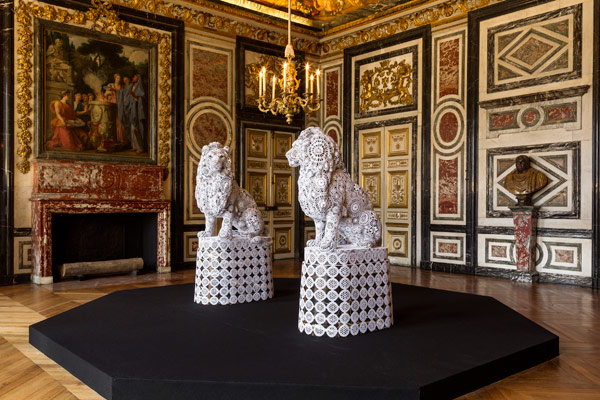 Absolute symbols of power, which is very often masculine, they find themselves imprisoned by the sinuous lines of lace. This sudden aesthetic and symbolic hold of the feminine over the masculine is edifying. Do women deliberately seek power, and have they always done so?
Further afield, the Lilicopthère (2012), a Bell 47 helicopter, has been feminized.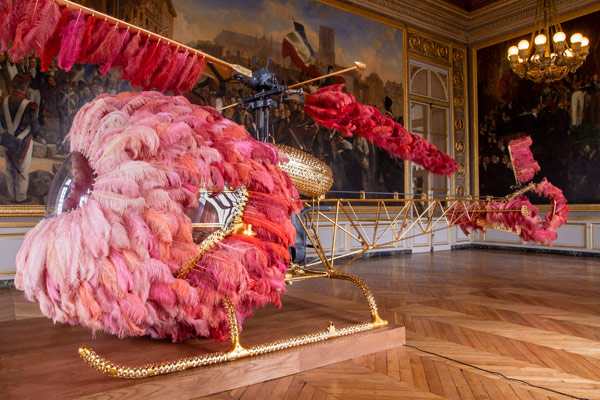 Ostrich feathers, Swarowski crystals, gold leaf applats, dyed leather delicately chased with gold, the machine is almost unrecognizable.
Talking about luxury, redefining luxury and the feminine possibilities: these are the issues at stake in this exhibition.
A few words exchanged with Joana Vasconcelos
How do you feel about exhibiting at this legendary venue?
I feel like I’m confronting history. I wanted to create works specifically for this space, but to emphasize the notion of contemporaneity.
I also wanted very strong pieces, made for Versailles but produced in Portugal. It’s a way of proposing other links between two countries, two countries that are dear to me.
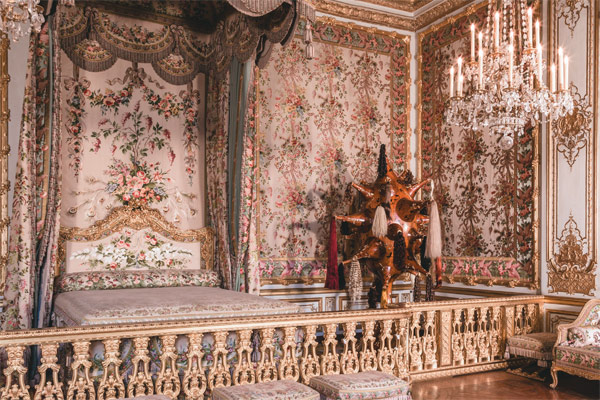
Does La Perruque, the sculpture-object in the Queen’s chamber, seem to have a particular symbolism? Do the nineteen different-colored wigs and egg-shaped body have any connotations for you?
In fact, these wigs are a reminder that several queens have lived here. Nineteen children were born here. The ovoid shape echoes this.
How long did it take to put this exhibition together?
A year and a half.
I see many fashion-related elements in your work. Are you interested in fashion? Are you thinking of developing a project in which fashion has a central place?
Indeed, I am sensitive to Fashion, to various materials such as Feather, Lace etc ….
I might be interested in such a project.
At the same time, it seems like a game. These wigs are a reminder of the period’s interest in this type of accessory. Can you imagine a Queen wearing one, hesitating, trying on another? You also indirectly evoked the games of feminine seduction in a completely different era?
That’s right. I like to build bridges between another historical period and now.
Is fantasizing about the idea of choice for a woman under the Ancien Régime a way of giving her back some of her freedom?
Yes, that’s part of my approach.
To discover or rediscover at the Château de Versailles until September 30. www.chateauversailles.fr
Cette publication est également disponible en :

