

As part of the 2012 year dedicated to Aviator Watches, IWC Schaffhausen is offering new additions to its highly sought-after Spitfire collection. Whether in terms of design, machining, choice of materials or, of course, watchmaking technology, the new Spitfire models are taking off at full power. The most spectacular innovation is the digital date display on the perpetual calendar, a design inspired by on-board instruments such as the altimeter.

Southern England, March 5, 1936. The first Spitfire prototype makes its maiden flight. The Ministry of Aeronautics is enthusiastic: “A true aeronautical thoroughbred”, the new aircraft is a thoroughbred of the air. At the same time, in the Swiss town of Schaffhausen, some 800 kilometers away as the crow flies, watchmakers are working on a prototype of a completely different kind, the IWC Special Watch for Aviators. The first IWC Aviator’s Watch is launched that same year.
The plane and the timepiece have more than just their year of birth in common. These two original models revolutionized their respective fields with elaborate mechanics and functional design. The Spitfire, a technical and aerodynamic masterpiece, became a veritable myth. Of the 24 versions built during its career, over 20,000 were built, a number hitherto unmatched in Great Britain. With its first Aviator’s Watch in the mid-1930s, IWC Schaffhausen responded to the demands of the time for measuring time in flight. The movement was regulated to withstand extreme temperatures, and the escapement was non-magnetic due to the strong magnetic fields in the cockpit. The black dial with contrasting luminescent hands still marks the instrument-style design of classic aviator watches.
Innovative technology and sophisticated design
In 2003, IWC Schaffhausen launched a range of Aviator Watches that borrow their name not only from the legendary Spitfire single-engine aircraft, but also from their elegance and innovative technology. This time, designers and manufacturers have subjected Spitfire watches to a thorough general inspection. The result is spectacular: with their modernized design, new functions and new manufacture movements developed at IWC, these time-traveling machines are ready for a dazzling vertical dis- collage.
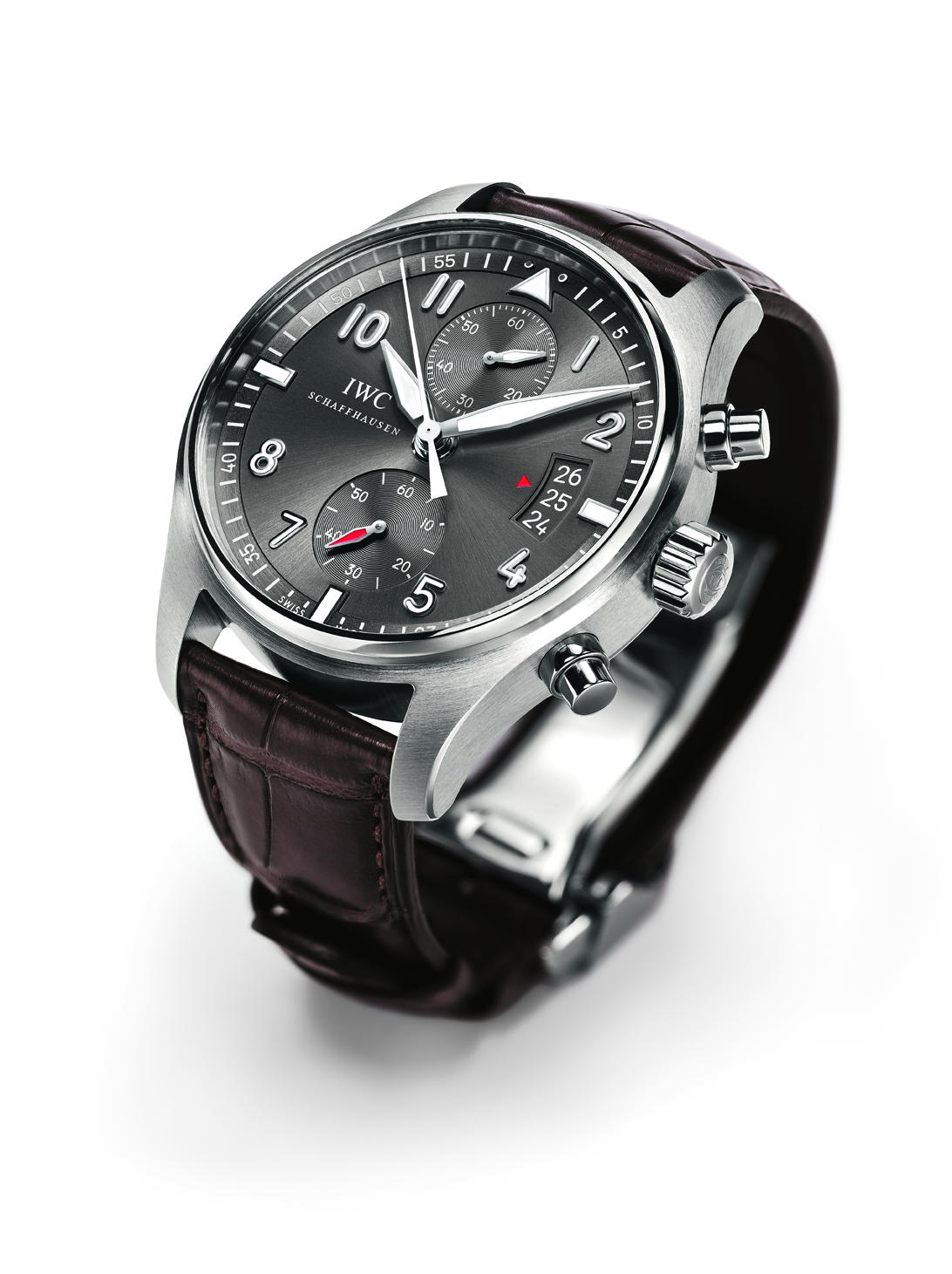
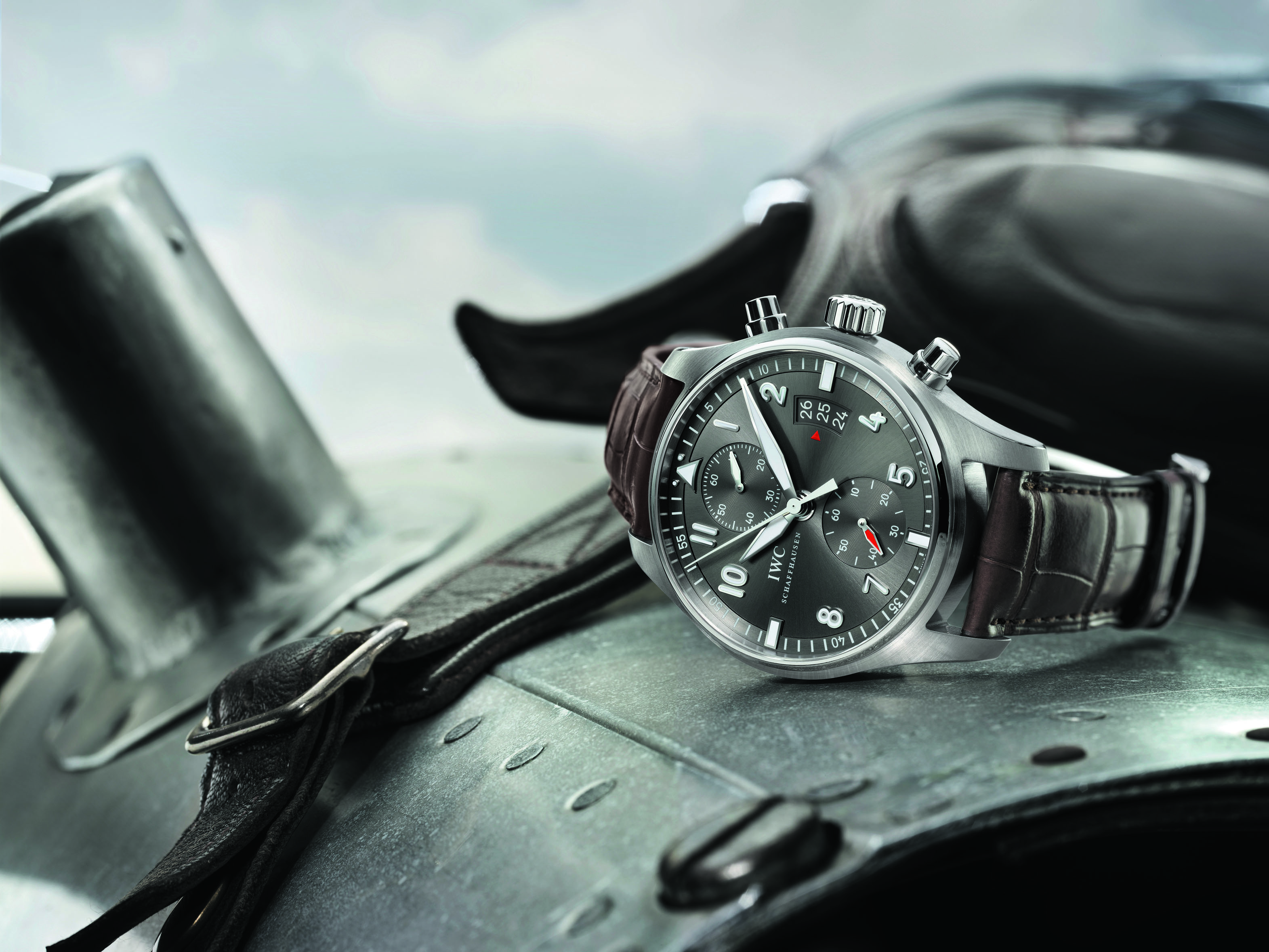
Elegance and class have always been the hallmarks of Spitfire Aviator Watches. A character that the two new models in stainless steel and 18-carat red gold embody, also in the choice of case material. The cases are hand-ground, polished or satin-finished to give them shiny, satin-finished and structured surfaces, creating a new dynamic resulting from the metallic sheen, reminiscent of that of the legendary aircraft. The sunburst finish of the slate dial gives the illusion that if the angle of incidence of the light changes, the light reflected by the polished surface rotates in the circle when the watch is turned.
Digital meets analog
The Spitfire Calendrier Perpétuel Digital Date et Mois (ref. 379103), equipped with the 89800 manufacture movement, bears witness to the tireless pioneering spirit of IWC’s watchmakers. The perpetual calendar, mechanically programmed to 2100, is in itself a horological feat. As for the digital display of the day and month, it not only catches the eye with its oversized numerals, but also represents a masterpiece of Haute Horlogerie from the IWC Manufacture. Not without reason: it requires an intricately engineered “powerhouse” to ensure the synchronized drive of up to four display discs at the end of the month, and five discs at the end of the year to advance the leap-year display. And without the slightest impact on running accuracy, even when the movement’s spring is almost at the end or the chronograph is running simultaneously.
Four years of development
An IWC team of watchmakers and constructors worked for four years to master this technical challenge. The specialists developed an energy accumulator called the jumping mechanism, which takes a little energy each time the hand passes midnight, holds it in reserve and releases it just as the date and month discs at the end of the month and the leap year disc at the end of the year are brought forward. A digital experience to be admired on the dial of the Spitfire Calendrier Perpétuel Digital Date et Mois at the beginning of each month and on New Year’s Eve. It goes without saying that the calendar of this refined mechanism, programmed to March 1, 2100, takes into account February 29 of every leap year.
The digital date display is one of IWC’s great innovations
The perpetual calendar with large digital date and month display is one of a series of technical innovations that have marked the history of IWC Schaffhausen, along with the Pallweber system, protection against magnetic fields, Pellaton winding, the seven-day power reserve and the introduction of titanium and ceramics into watchmaking. As early as 1885, the Schaffhausen factory developed the Pallweber system for the first watches with digital hour and minute displays. After the golden age of quartz watches, many people once again prefer an analogue time display. For the date, the numeric display has become the preferred choice. It’s very clear and easy to read, and shows a certain modesty on the part of the Spitfire Calen- drier Perpétuel Digital Date et Mois: who would suspect the presence of a mechanical perpetual calendar beneath the large numerals on the dial?
Another of IWC’s most remarkable innovations is the analog display of chronometer times between 1 minute and 12 hours. They are grouped together in an aperture and can be read as if they were a normal hour. The oscillating weight in the form of an elegant Spitfire silhouette, which can be admired through the sapphire crystal caseback, also represents a first in this watch range.
IWC Manufacture movement
for chronographs
The Spitfire Chronograph in red gold (ref. 387803) and stainless steel (ref. 387802, 387804) is equipped with the manual chronograph caliber 89365. This increases the watch’s running time to 68 hours and, in addition to the stop minute and seconds functions, features an integrated flyback function. IWC’s designers drew inspiration for the date window from the design of on-board instruments. The vertical arrangement of numerals refers to the shape of an altimeter. The current date is indicated by a bright red triangular marker, an element that has since become emblematic of IWC Aviator Watch design, inspired by the red elements of aircraft instrument panels.
The metal bracelet for reference 387804 features a new precision clasp mechanism. It enables the length of the bracelet to be easily, quickly and precisely adapted to the wrist. Simply press the push-button with the IWC logo in the folding clasp to increase the length of the bracelet by up to six millimeters in 6 steps, and to decrease it, compress it to the desired length. The design of all pin buckles and folding clasps is now slightly more pronounced to better match the watch’s imposing case.
Cette publication est également disponible en :

