
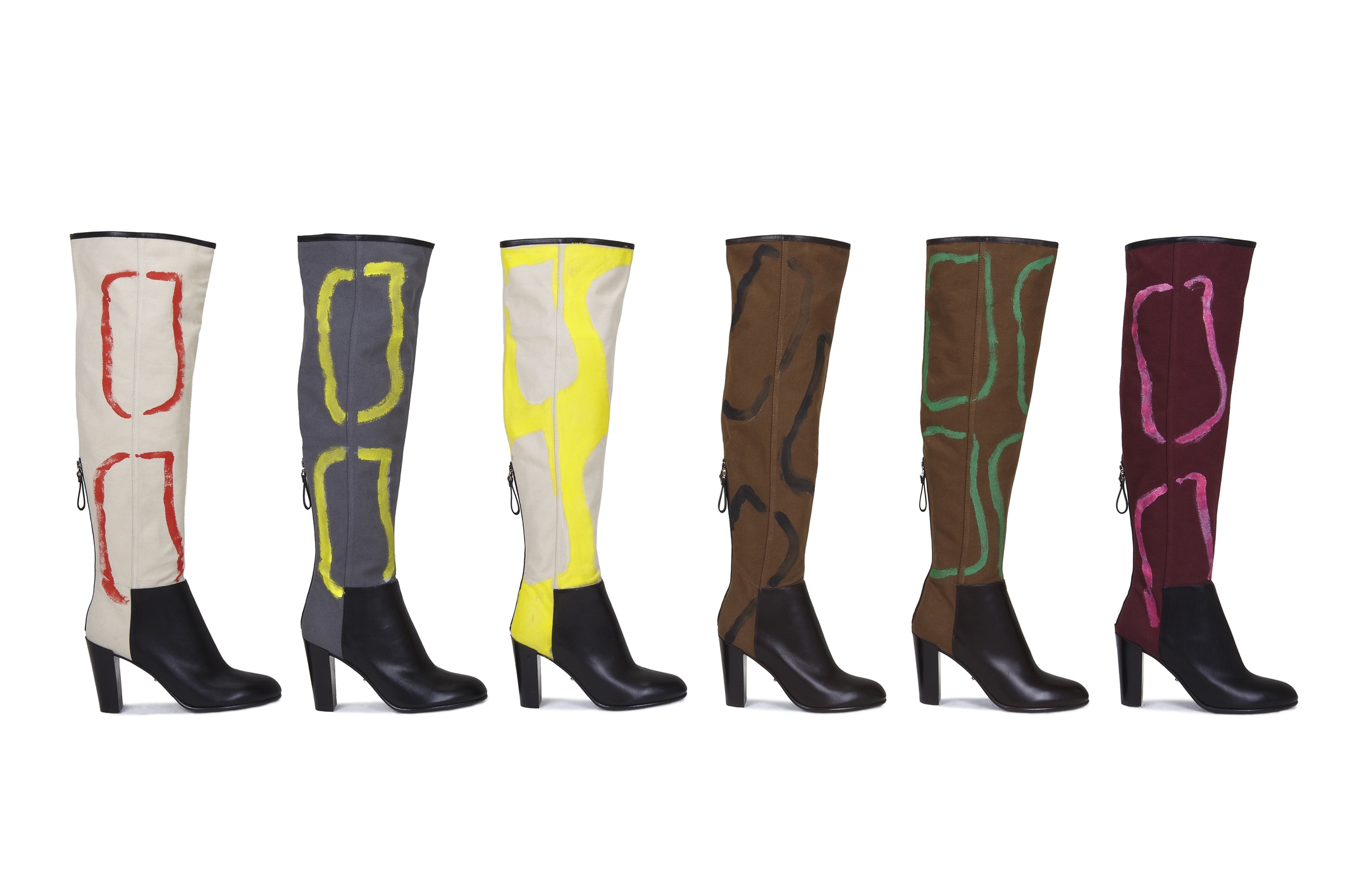
Presented at Milan Fashion Week on September 22, 2010, the repainted boots were exhibited at Galerie Bernard Ceysson as part of the Foire International d’Art Contemporain (FIAC) from October 21 to 24, 2010.
Renowned shoemaker Sergio Rossi came up with the idea of collaborating with French artist Claude Viallat on an original collection of eighteen boots. A major artist of the Supports/Surfaces movement, Claude Viallat likes to use a variety of supports (tarpaulins, canvas sails, parasols, tents, etc.). Favoring loose canvas supports that distort once paint has been added, his work is a work of experimentation and research.
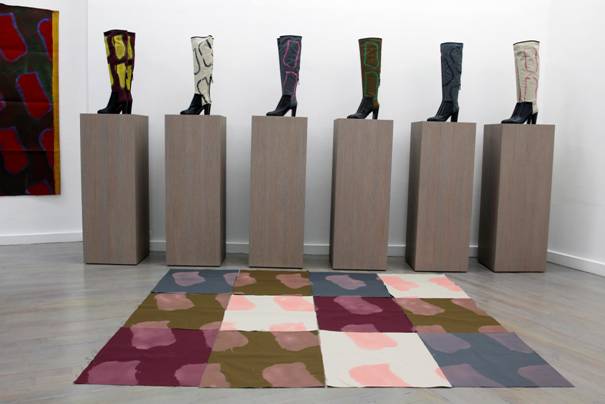
Innovative and inspired, the artist immediately accepted this collaboration: “These boots are bottles in the sea. They will be loved or hated. I imagine them as much on pedestals as on women’s legs. There’s nothing to stop them being worn. I haven’t destroyed them. I don’t feel I’ve strayed from my job as a painter. I’ve done my job.
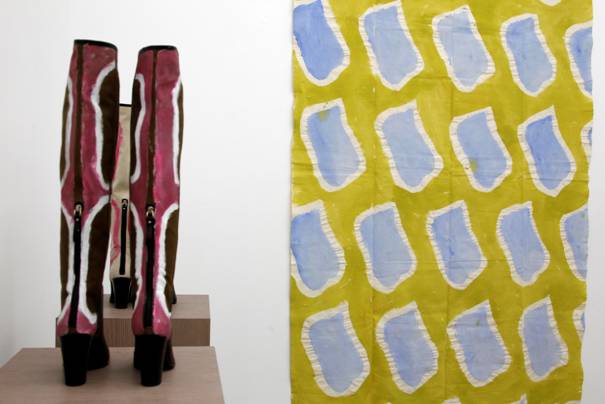
Although he used a variety of supports, Claude Viallat had never before painted on boots. Here, there’s no “raboutage” (the butting together of two fabrics), but a vertical seam around which the artist has modulated his shapes, in a chromatic interplay that has become his master signature: ” What counts is the way the colors play with the colors underneath… “For the occasion, Claude Viallat first drew the shapes, then “filled” them in with a fine brush, where he usually favors an “intuitive, unintended” approach.
Covered with a motif reproduced in several colors like an imprint, Claude Viallat has turned these boots into a new canvas for his art. However, the boots are not denatured – on the contrary, they become unique. Isn’t that what art is all about?
Marie-Odile Radom
Cette publication est également disponible en :

