
What is our relationship with images? What if every image we see were in fact a double image, as if reality were not entirely certain and unique? This is the question that artist Rashid Rana addresses through his art. But it’s definitely up to us to try and answer it in full.
Until November 15, 2010, the Musée Guimet is presenting the exhibition “Perpétuel Paradoxe”, featuring for the first time in France some twenty disconcerting works by contemporary artist Rashid Rana, considered to be Pakistan’s greatest contemporary artist: montages of digital photographs, sculptures and video installations. These works are scattered throughout the museum’s permanent collection, offering an exceptional opportunity to confront contemporary art with the Musée Guimet’s age-old Asian works, questioning tradition and its “illusions of permanence”, deep-rooted times and contemporary times.
This Perpétuel Paradoxe exhibition is part of the Musée Guimet’s current focus on Pakistan, whose exhibition“Pakistan – Terre de rencontre-(Ier-VI ème siècles) les arts du Gandhara” on view until August 16, 2010, is a unique opportunity in France to discover 200 Greco-Buddhist works characteristic of Gandhara, blending classical Greek and Indian art in a fusion of genres and styles. The dual focus on Pakistan offers a unique opportunity for a confrontation between ancient heritage and the contemporary creation of an art form that is still little known in France – a confrontation that is oh so interesting, as Buddhas, ancient books and traditional garments blend with modernity in a thousand-year-old dance.
Sites_1
A trained painter with a passion for photography, Rashid Rana’s mission is to document the paradoxes of everyday life and the clash of civilizations. For the past ten years, the 42-year-old artist has chosen to work with digital images, enabling him to combine opposing elements in the same work by micro-incrusting photographic details and pixelating the image. By associating the seen and the unseen, the artist underlines the antagonisms at play between cultures, and points to the responsibility of those who make today’s images, playing a part in building tomorrow’s traditions…”. In these uncertain times, we have lost the privilege of having an unequivocal worldview. Today, every image, every idea and every truth simultaneously includes its opposite “explains the artist.
Red Carpet
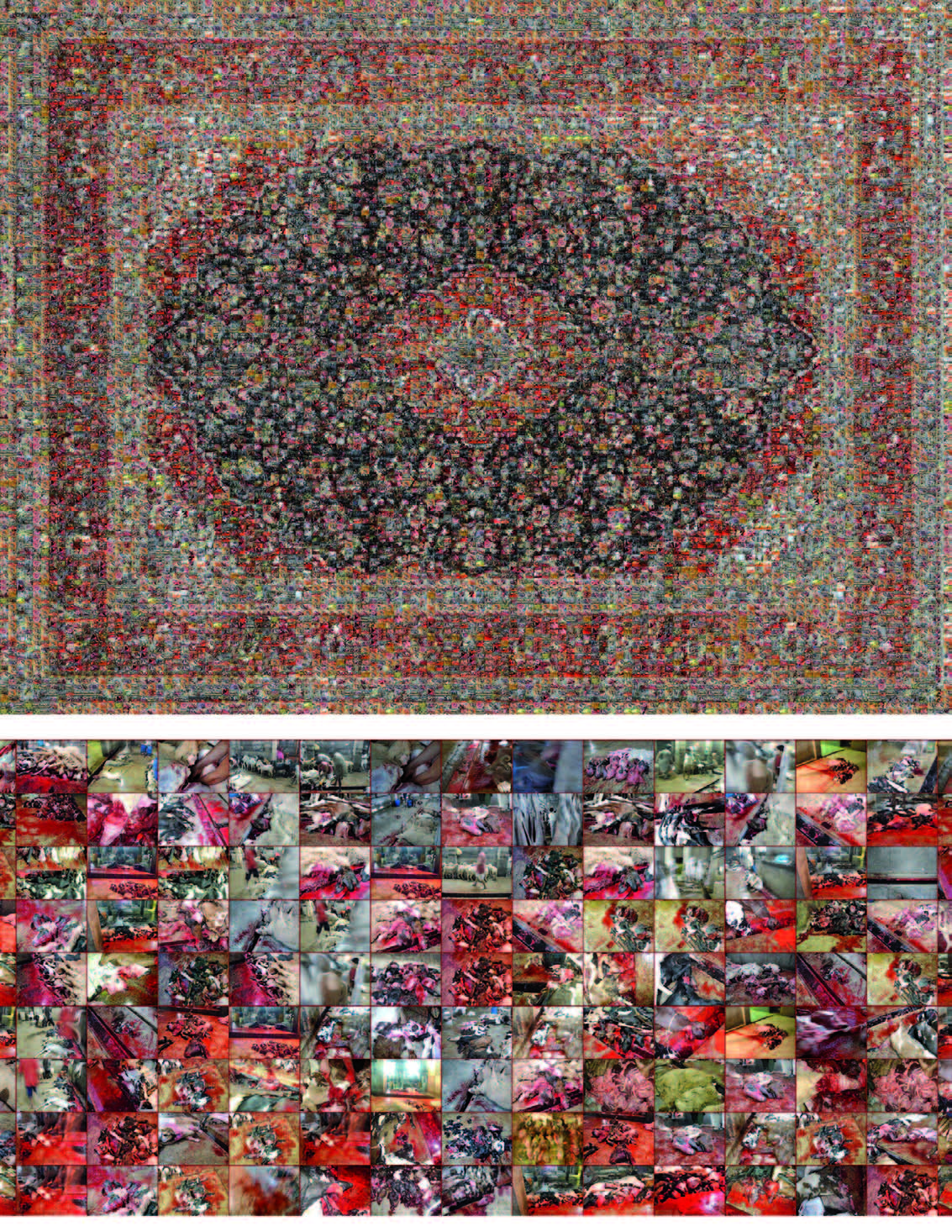
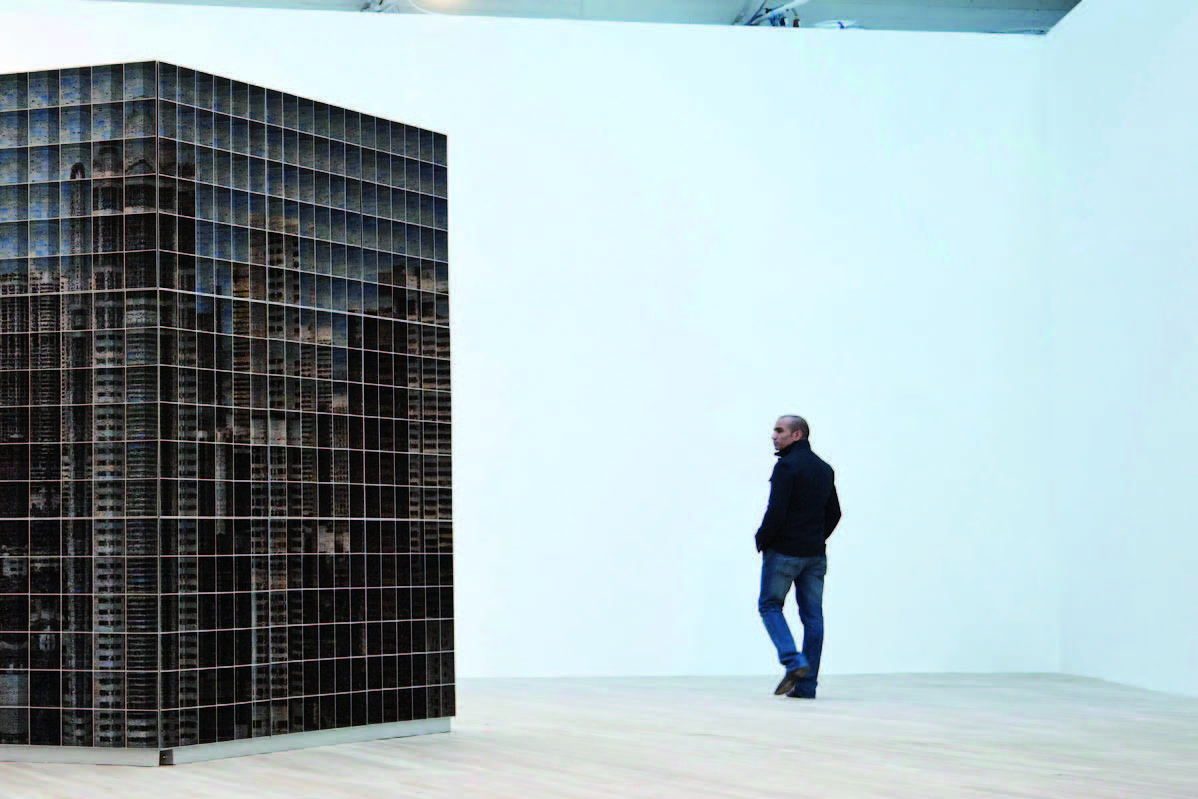
Rashid Rana has chosen to construct one reality from another. By assembling a multitude of images to create a new one, the artist challenges our perceptions. He almost forces us to go towards his work, to want to see beyond the first image, which may seem banal at first glance. And there, dazzled and sometimes frightened, the viewer sees another reality emerge, stronger, even more disturbing. In this way, a montage of photo miniatures becomes the image of a precious oriental carpet, with its usual figures and subtle variations of red and black. But as you get closer, you realize that the multitude of photos that make up the image are shots of slaughterhouses in full operation, violent scenes in which flocks of sheep spend a final bad quarter of an hour. These are scenes stolen from the slaughterhouse in Lahore, Pakistan, where Rashid Rana was born, lives and works. Similarly, the work “Twin”, a distant evocation of the twin towers of the World Trade Center, is in fact composed of a mosaic of tiny photos illustrating daily life in Lahore, when two worlds so different meet and speak to each other.
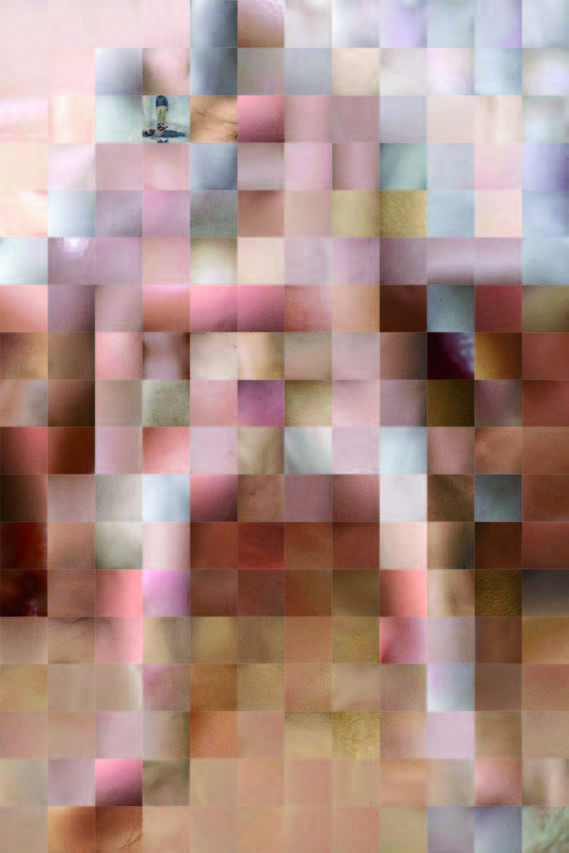
Rashid Rana also pays homage to Western art with a reproduction of Gustave Courbet’s famous canvas“L’Origine du monde“, composed of a multitude of photos, the nature of which I’ll leave to you to guess. The artist wanted to show the innovative aspect of framing this canvas:“While his contemporaries always represented scenes in their entirety, Courbet,” he says, ” was the first artist to use the zoom technique“. What’s more, when we know that this canvas was actually hidden beneath another, this wink proves to be very powerful, as it alone represents the idea behind his works: the detail and truth behind the image.
Desperately Seeking Paradise photo ©Vipul Sangoi
Through these changes in perception, Rashid Rana aims above all to appeal to our critical faculties. There are always two dimensions to things, like two visions of the same aspect that are constructed according to the viewer’s background and context too. It’s enough to see how an image taken out of context can be used in a completely different way, and this is also what the artist wants to highlight. The artist tackles themes such as violence, sex, fear and memory, always using the same process: the image becomes the pixel of another image. But very often, the strongest image is not the most obvious. It’s drowned out by so many others, but remains visible all the same.
The art of an era seeks to reflect its reality. What remains of ancient civilizations is undoubtedly the expression of what they wanted to leave behind. But it’s also true that the reality of our time is riddled with contradictions, contrasts and conflicts that mark our very existence. The clash of civilizations, the confrontation of cultures and the collision of interests shape our world. As a result, our reality is shaped and smoothed, sometimes to the point of being bland, sometimes even more frightening. The news constantly reminds us of this, but Rashid Rana’s art calls us to vigilance. Let’s keep our eyes open to see beyond the reality of our times. Mission accomplished for me.
Musée Guimet:
6, place d’Iéna- 75116 Paris
Tel: 01 56 52 53 00 – www.guimet.fr
Open daily except Tuesday, from 10 am to 6 pm.
Some works may offend the senses.
Admission €7.50 / €5.50
Marie-Odile Radom
Cette publication est également disponible en :

