
In January 2025, Cynthia Fossier becomes the tenth person to hold the post of Chef de Caves at Canard-Duchêne. She is also the first woman to do so since Léonie Duchêne, who founded the house in 1868. The event would almost go unnoticed were it not coming at the end of three years of overhaul in which the House of Ludes chose to rename its flagship cuvée after that same founder.
Léonie Duchêne, a winegrower, and Victor Canard, a cooper, joined their names on an equal footing in 1868 in Ludes, a Premier Cru village of the Montagne de Reims — an uncommon arrangement for the time, which the House today claims as foundational to its identity. Canard-Duchêne remains one of the few Champagne houses still based at the heart of its vineyard, between hillsides, a wooded park and six kilometres of cellars dug into the chalk; it was the first ambassador of the UNESCO mission Champagne Hillsides, Houses and Cellars as early as 2023.
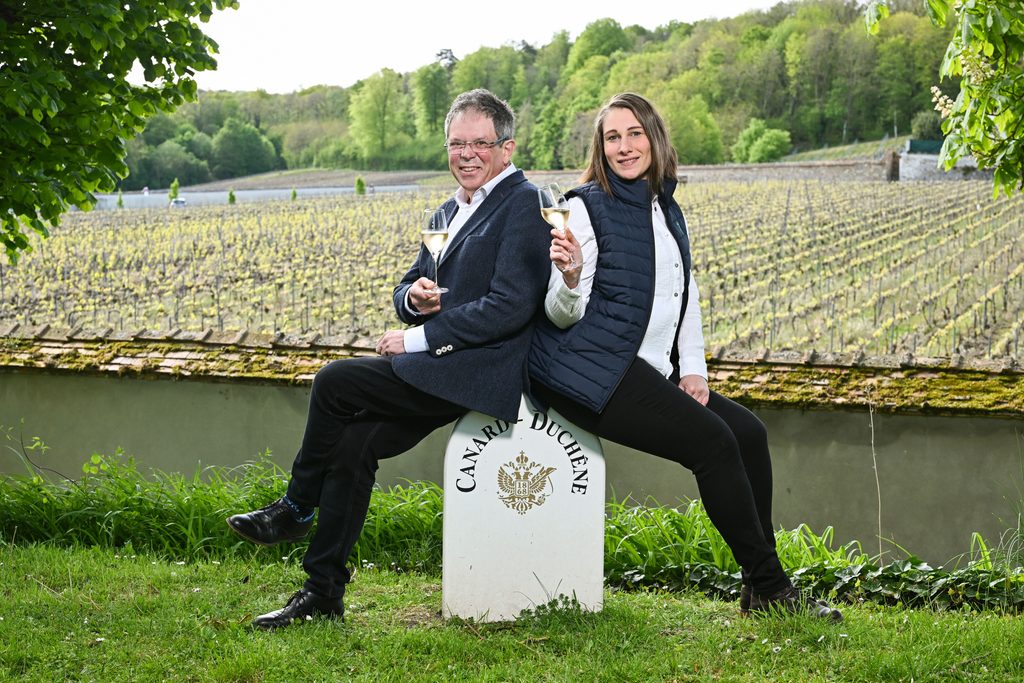
Cynthia Fossier, thirty-five, worked for five years alongside Laurent Fédou, who had held the post for twenty years, before succeeding him. The transition was built on the shared definition of the blends rather than on a break in style. It comes in a house which, since its purchase by the Champagne family Thiénot in 2003, has undertaken a methodical restructuring of its vineyard: selection of crus through long-term partnerships with two hundred winegrowing families, sustainable viticulture, organic certification on the ZE 181 plot. The technical choices follow the same logic of precision — the saignée method for the Rosé Iconic, cask vinification for the P.181 cuvée, use of perpetual reserves in the Léonie Iconic and Blanc de Noirs Iconic cuvées, blind dosage. The result: champagnes dosed at under seven grams per litre.
It is in this context that the House chose, in 2024, to rebuild its communication platform around the signature “Crafting Connections Since 1868”, a revised visual identity and an assumed brand colour, a green it calls “iconic”. The Iconic collection, carried by the flagship cuvée Léonie Iconic, has become its commercial emblem — dedicated to wine merchants, hotels and restaurants, it brings together a non-vintage brut, a blanc de noirs, a blanc de blancs and a saignée rosé. Naming the flagship cuvée after the founder, at the moment a woman takes over responsibility for the wines for the first time since her, is no accident of timing: it is the way the House chooses to tell its own continuity.
“In an increasingly virtual world where everything is accelerating, it is to these deep bonds that the House pays tribute with boldness, through the renewal carried out over the past 3 years,” sums up Jérôme Durand, Managing Director.
This momentum can also be read in the distribution figures. Canard-Duchêne is today present in more than fifty countries, listed in Lagardère Travel Retail shops, and the cuvée Léonie Iconic was selected in 2025 by Air France — a choice led by Xavier Thuizat, Best Sommelier of France — for long-haul flights in Economy and Premium classes. International competitions followed: a Master medal at The Drinks Business Champagne Masters for the V2012 vintage, 92 points from Decanter for the Blanc de Noirs Iconic, 92 points from Wine Enthusiast for the P.181, 17.5/20 from Jacques Dupont for Le Point on the 2018 vintage. In 2025, the Sommeliers Choice Awards named Canard-Duchêne “Winery of the Year France”.
The House is also pursuing work begun in 2009 with the P.181 Bio Extra-Brut cuvée, named after the plot from which it partly comes, and has partnered with Reforest’Action to replant more than fifty thousand trees in the Champagne forests. A full carbon assessment carried out in 2024 notably informed the 13% lightening of the bottle created for the House’s centenary in 1968 — a bottle with a fine neck line and a full base, today the lightest of its category on the market.
It remains to be seen whether this reorganisation, which affects the cellar as much as hospitality — a first “Champagne Drive” opened on the Ludes estate in 2026 — will go the distance beyond the communication cycle that carried it. A house a hundred and fifty-seven years old is judged over several generations of Chef de Caves, not over just one.
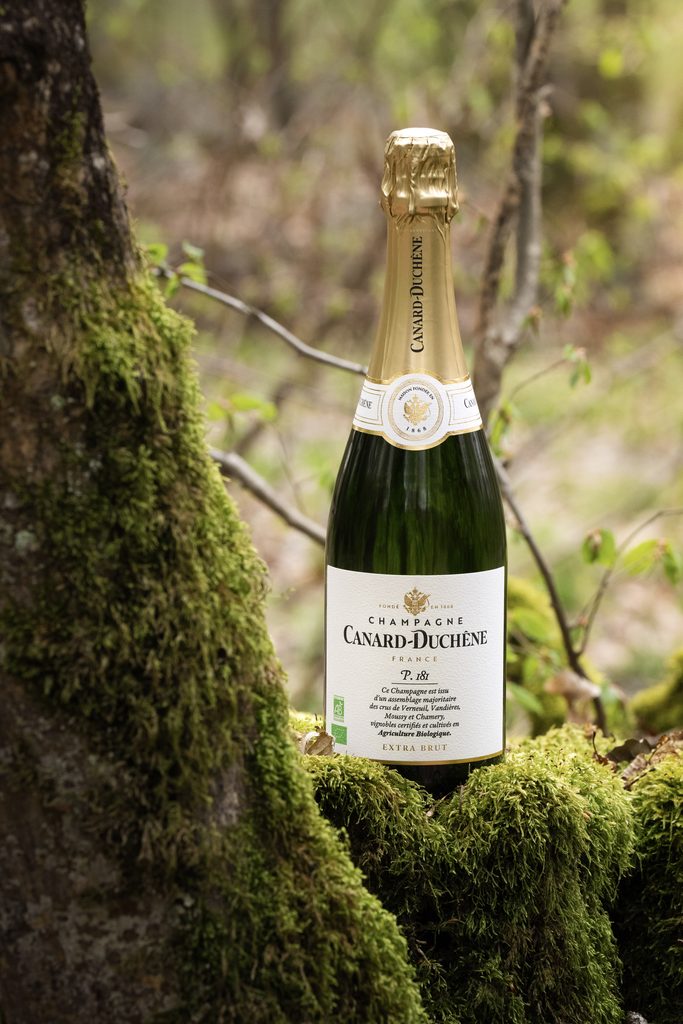
The bottle of the Iconic collection, launched in 1968 for the House’s centenary, follows a precise oenological logic: the fine line of the neck regulates the entry of oxygen and slows the development of the wine’s aromas, while the full base of the bottle offers an enlarged space on the lees, favouring the evolution of the champagne during ageing. Its lightened version, developed nearly sixty years after the model’s creation, weighs 832 grams against 835 grams for a classic Champagne bottle — making it the lightest special bottle currently marketed in the sector.
Also on Luxsure: Canard-Duchêne P181: A Hymn to Nature and Champagne Elegance · Canard-Duchêne Reinvents Its Iconic Cuvée Léonie: A New Era for a House… · Canard-Duchêne V 2012: The Quintessence of an Exceptional Vintage · Canard-Duchêne and the Triumph of Vintage: The Quintessence of 2012 in the Cuvée V
Cette publication est également disponible en :


