
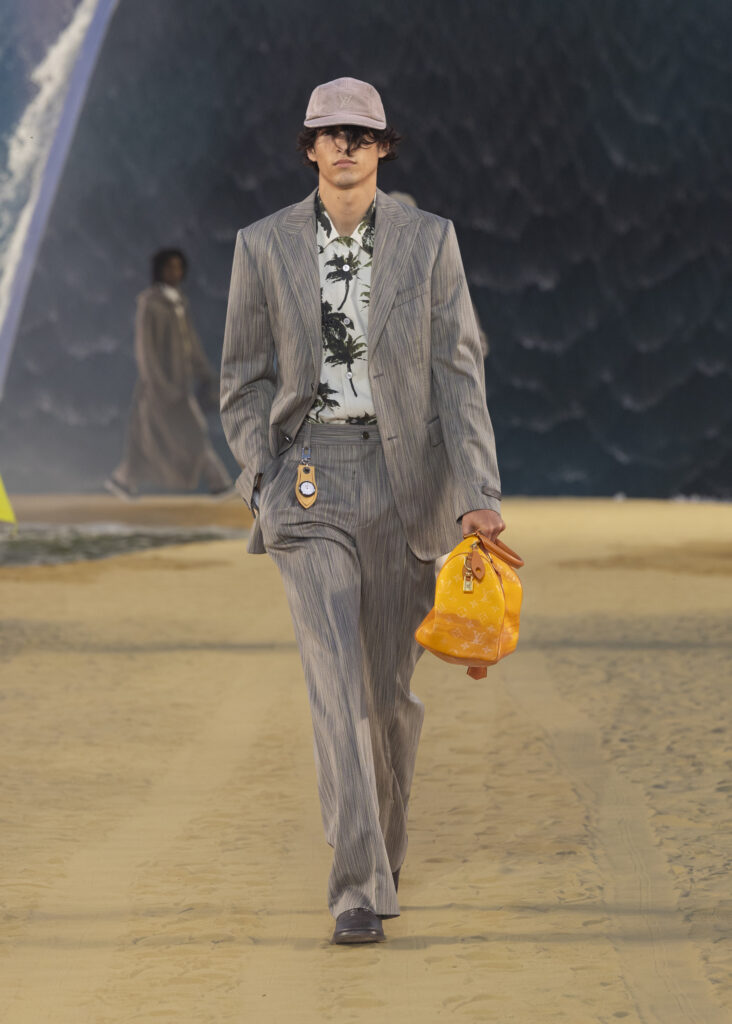
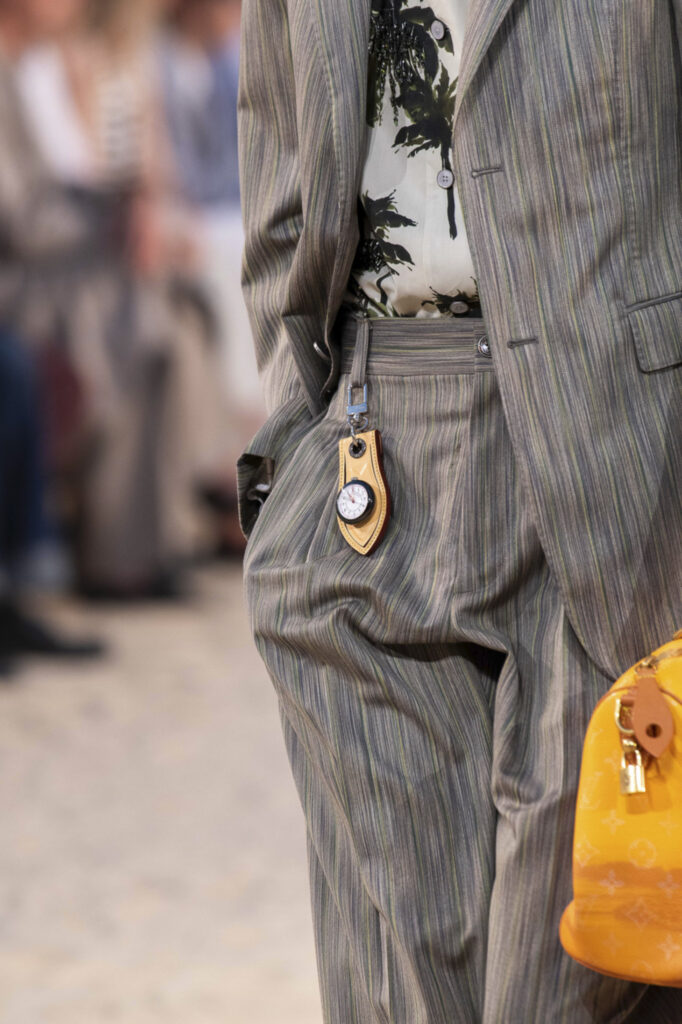
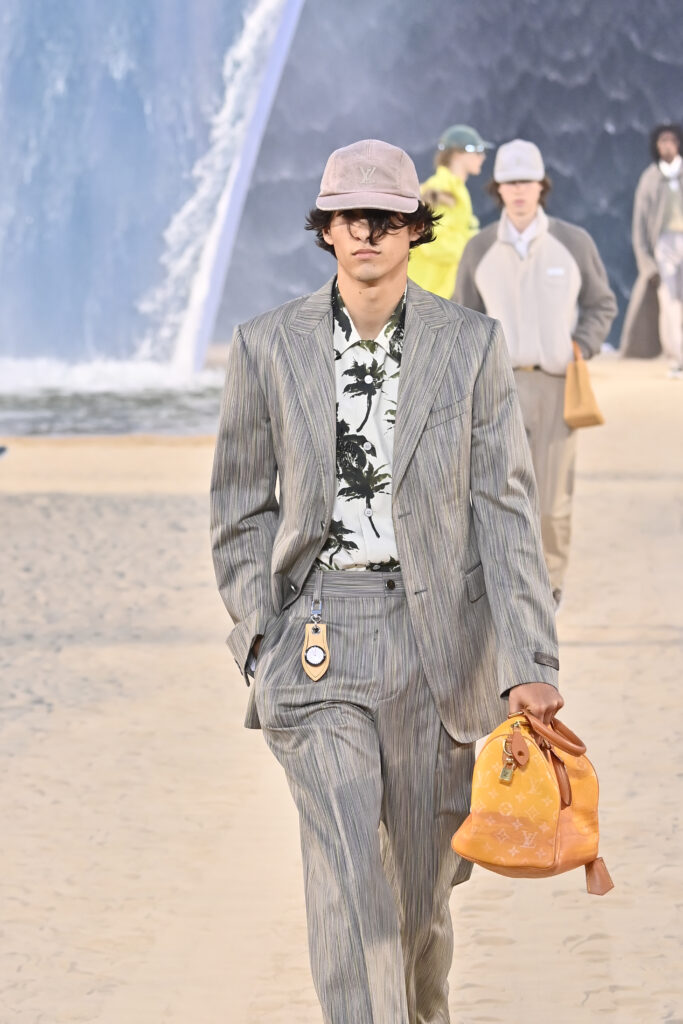
You don’t notice them right away. They are “charms”—the term chosen by the House to describe them—slipped onto two looks from the Men’s Spring/Summer 2027 runway show. Watches worn just as one would wear a discreet piece of jewelry—an accessory that doesn’t seek to dominate, but that subtly alters the overall look.
And yet, behind the understated gesture lies a considerable watchmaking ambition.
The Louis Vuitton Monterey has been around since 2025, when the House reissued it in yellow gold, drawing inspiration from the very first LV wristwatch: the LV I, with its Grand Feu enamel dial and in-house automatic movement. But the Monterey has an even richer history. Its nickname comes from collectors, who christened it in reference to the 1988 LV II—a watch designed in collaboration with Gae Aulenti. This architect, who designed the Musée d’Orsay and the National Gallery of Modern Art in Rome, had envisioned a pebble-shaped case: organic, warm, and a departure from the rectangular or round constraints that dominated watchmaking at the time.
The new ceramic interpretation preserves this formal legacy. Two versions: a bold green—a color that is difficult to achieve in ceramic, a capricious material that few manufacturers have mastered—and a glossy black of supreme elegance. The movement is in-house, LFTMA01.02, and automatic. The watch is produced by La Fabrique du Temps Louis Vuitton, the House’s watchmaking workshop based in Meyrin.
What’s interesting here is not so much the watch itself as the act of showcasing it. Over the past few seasons, the line between watchmaking and fashion has become increasingly blurred. Major fashion houses are now showcasing their timepieces at fashion shows, rather than in the air-conditioned temples of Geneva’s haute horlogerie. This is a way of saying that time—the measurement of time, its connection to the skin, and its role in everyday gestures—is as much a part of style as a jacket or a pair of shoes.
The story of the LV II was already rooted in this intuition: an architect invited to design a watch. Gae Aulenti was not a watchmaker. She conceived spaces inhabited by the body. The watch she designed was a space to be inhabited on the wrist.
The Monterey Céramique will be available starting September 26. It will then be in stores, having left behind the runway that served as its debut stage. But it was there, on the runway—worn as a charm on the wrist of a moving model—that it truly made its debut—in that precise moment when the boundaries between fashion and watchmaking dissolved.



Cette publication est également disponible en :

