
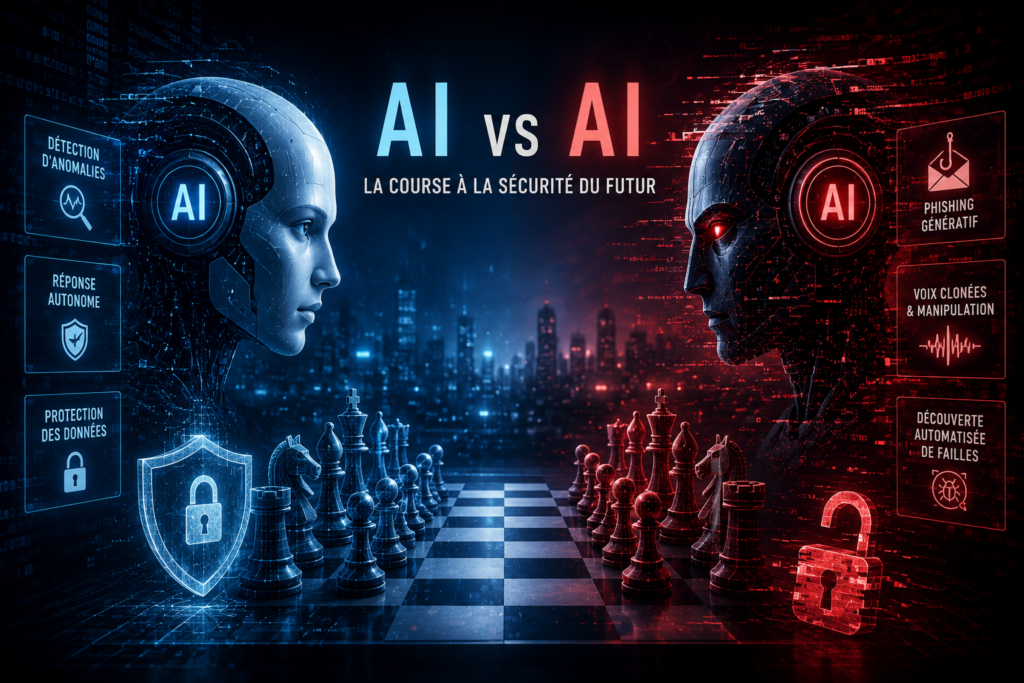
Cybersecurity is entering a phase in which attackers and defenders now share the same raw material: autonomy. For businesses, the challenge is no longer just to protect their systems, but to govern the agents they allow to act on their behalf.
Until recently, artificial intelligence applied to cybersecurity was mostly about potential: detecting threats faster, filtering them more effectively, and reducing the workload on teams. The nature of the issue has changed. The same methods capable of identifying a vulnerability in a complex environment can now be used to exploit it. It’s no longer just the attacker who’s speeding up. It’s the attack itself that’s learning to adapt.
The traditional distinction between defensive and offensive tools is becoming blurred. A tool designed to identify vulnerabilities in an infrastructure can also be used to map a target system. An agent tasked with automating an internal task can, if poorly managed, become a new exposure surface. An assistant connected to a company’s data is never neutral: it carries with it permissions, access rights, working memory, and sometimes the ability to take action.
This is where the luxury industry should pay close attention to developments in cybersecurity. Not because fashion houses have suddenly become software developers, but because their value rests on extremely sensitive intangible assets: sketches, launch schedules, customer files, collection archives, press communications, internal know-how, and distribution data. As AI makes its way into design studios, marketing departments, customer service teams, and e-commerce divisions, it does more than just boost productivity. It introduces a new form of technical intimacy with the fashion house.
The risk is no longer just around the corner—it’s right here in the workshop
For a long time, cybersecurity has viewed intrusions as a boundary to be defended. This view is no longer sufficient. AI agents do more than just answer questions; some can search, classify, extract, recommend, send, correct, and trigger actions. As a result, they must be treated as technical collaborators with a limited mandate, rather than as mere interfaces.
The critical issue lies in their probabilistic behavior. A traditional system carries out what it has been programmed to do. An agent-based system interprets an intention, chooses a sequence of actions, and adapts to what it discovers. This flexibility is what makes it valuable. It is also what makes it dangerous.
In a luxury environment, the risk isn’t just a spectacular data leak. It can be more subtle: a collection brief copied to an external service, a CRM file uploaded to an unapproved tool, a strategic memo summarized by a personal assistant, or a confidential image used to generate variations. What used to be called “shadow IT” has now taken on a more diffuse form: “shadow AI.” It no longer necessarily involves software installed without authorization; rather, it stems from a daily habit—often in good faith—of asking an AI to work faster.
Details
One statistic sums up the fragility of the current situation: 38% of employees admit to having shared critical company information with external AI providers. At the same time, only 15% of companies are reported to have implemented a comprehensive framework for AI adoption. The gap between actual usage and formal governance is not merely an operational detail. It is now one of the primary security vulnerabilities.
The defense can no longer wait for humans
In the face of increasing attacks, a human response alone is becoming too slow. Security teams remain essential, but their role is changing. They can no longer be the final decision-makers for every incident. They must design the rules, define the thresholds, assess the risks, validate the architectures, and then let certain mechanisms respond at machine speed.
This represents a major cultural shift. In many organizations, automated responses are still perceived as a loss of control. In reality, the danger lies more in ungoverned automation. A well-managed autonomous response can isolate an anomaly, contain its spread, and halt a suspicious action. A human then steps in to decide on remediation, communication, and accountability.
This distinction between immediate response and strategic decision-making is likely to become one of the future standards for AI security. It applies to the Houses as well. The goal is not to let AI do everything, but to know precisely what it can do immediately, what it can suggest, and what it must never decide on its own.
The Home as a Living System
Luxury possesses an intuition that technology often overlooks: all autonomy must be guided by a culture. A workshop does not entrust a critical task without first passing on the necessary knowledge. A Manufacture does not allow a Master Watchmaker to improvise without following established rules. A House does not protect its heritage solely with passwords; it protects it through collective discipline.
This discipline must now incorporate AI—not in the form of a vague policy, but as an operational framework: which tools are authorized, for what data, with what access rights, in what use cases, under what supervision, and with what level of traceability. This issue is not the sole responsibility of the CIO, the CISO, or the legal department. It involves senior management, because it affects the very rhythm of the organization.
The idea of the executive as a “chief AI adoption officer” is not just a catchphrase. It reflects a reality: AI cannot be adopted piecemeal, department by department, without a common strategy. In an organization, the absence of a strategy always ends up creating two forms of AI: the official AI, which is cautious and sometimes slow; and the “under-the-radar” AI, which is fast, uncontrolled, and used simply because it gets the job done.
The new elegance will be defensive
The good news is that defense tools are also advancing. Behavioral analysis, anomaly detection, specialized agents, real-time forensic data collection, and the sharing of cyber intelligence between public and private actors are shaping a more nuanced response than simply piling up barriers. Cybersecurity is becoming less of a wall and more of a nervous system.
But this defense will only be effective if it is based on an intimate understanding of the organization. AI can only effectively protect what it is taught to recognize. In the luxury industry, this means understanding the hierarchy of secrets: a supplier file does not have the same value as a prototype; a backstage image does not have the same status as an embargoed visual; and a heritage archive is not as sensitive as a social media post.
AI security for a home should therefore not be viewed as a technical layer added as an afterthought. It should become an extension of the culture of privacy, just like controlling access to workshops, managing press invitations, or protecting exhibits before they are displayed.
AI will not make companies vulnerable simply because it is intelligent. It will make them vulnerable if it acts without memory, without a mandate, and without a risk hierarchy. The future of cybersecurity will not be decided solely by the battle between attackers and defenders. It will be decided by the organizations capable of teaching their machines their limits, and those that have confused speed with mastery.
In the luxury sector, autonomy will be acceptable only on one condition: that it remains guided by the brand’s invisible hand.
Cette publication est également disponible en :

