
“What we’re given to see is much more than beauty: it’s money, it’s comfort, it’s happiness, it’s almost a certain kind of ideal. (…) But we don’t live in these bright, carpeted spaces. This difference between what we can dream, what we’re given to dream and what we’ve given ourselves to dream, and the much more petty, shrunken reality, are at the root of vertigo” (…)”.The disappointment of the quest for happiness drives us mad, gets us drunk, and maintains a kind of frenzy of vertigo and hypnosis” Georges Perec writes his novel The things in 1965. In it, he describes the vertigo of everyday life. He speaks poetically of those who look behind shop windows with envy. Of those who, once at home, leafing through catalogs, realize that the price barrier is a far more real obstacle than the glass of the shop window. Perec’s novel is not a solution to this problem. He simply seeks to capture the splendor of this eternal thwarted desire. Fashion, as a magical system, is based on the same principle. By offering vertigo, it draws us relentlessly towards itself. But is vertigo the same for everyone? Doesn’t vertigo end up becoming violence? 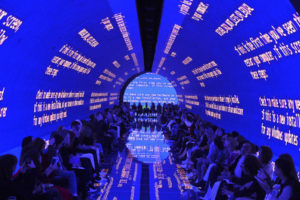
For some : everything is accessible. So what intoxicates? The Balenciaga show simulates the loss of gravity with a tunnel filled with LED screens. A whirlwind of chaotic chaos, in which Gvesalia presents a more streamlined show. Fewer Ikea and Tati bags: the time for recuperating popular culture to make the rich dream is coming to an end? Instead, this show pays homage to the modern spirit of Cristobal Balenciaga, who invented the Gazar. A luxury reserved for the elite.
In 2018, does the inaccessibility of luxury still provoke vertigo? Are magazines and films like so many simulacra that trap people in impossible fantasies?
Between underwater backdrops, prosperous nature, Victorian dresses in fields of golden straw, and sherbet colors – this season counterbalances the overflow of sweet macaroons with raw materials (from linen to denim), shoulder-baring cuts and black ankle boots that prevent us from concluding with a discourse of the ideal. The magic of fashion lies in its ambivalence.
JOHN GALLIANO: Beauty and torment
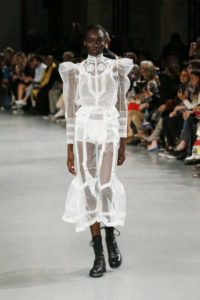
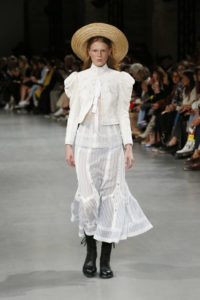
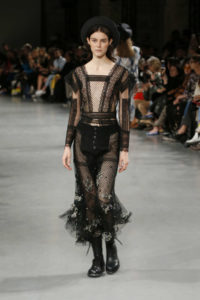
“Picnic at Hanging Rock”: a book by Joan Lindsay that gave way in 1975 to a film by Peter Weir. The story: that of young girls with enigmatic beauty and incomprehensible spleen. An existence where illusions are lost, and meaning has gone out the window. Stuck in ideals, these are the girls in Coppola’s films. Dressed in pastel colors, with empty eyes: they attract, but are attracted by emptiness. For Galliano, Gaytten delivers a collection of white dresses, full of delicate embroidery. Yet he doesn’t drown in the silliness of a flowery offering: the military boots and punk dose remind us that ideals are only ideals, and that fashion isn’t there to have a polished discourse. The torment behind beauty: a fine tribute to Galliano.
VALENTINO: Excess and illusion
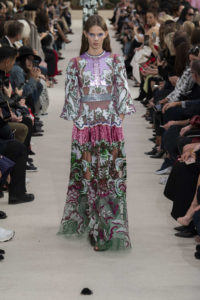
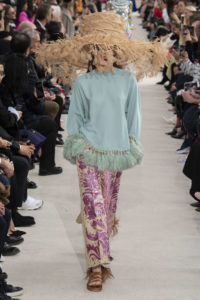
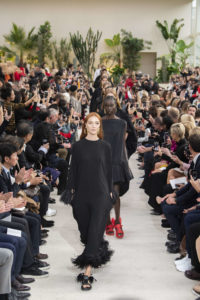
Sequin-embroidered dresses, lace, prints and feathers: the elegant woman goes out for the ball. A fashion series that would print perfectly in a ’60s Vogue. The celebration of glamour drives Valentino, whose many models are more couture than ready-to-wear. A dive into the windows of a lost time. Nostalgia: here’s a component that’s sure to make you dizzy. A collection where hats are no longer made of feathers, but of straw. A collection that opens with magnificent BLACK dresses. In 2018, clothes are no longer viewed from behind the same glass cases, but in slideshows that load slowly on our slow computers – or quickly on the latest iPhone. But another collection is already online. That’s the tragedy of these pretty feathers: they fly away.
THOM BROWNE: A response to McQueen
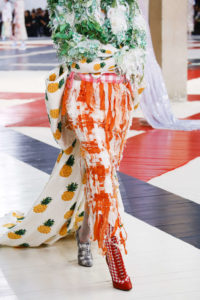
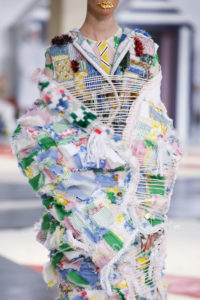
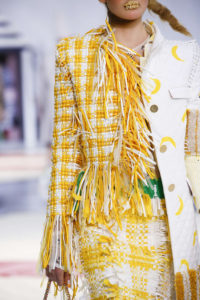
Sewn mouths. Women are no longer just the mannequins they used to look at. Thom Browne shows seem to follow in the footsteps of McQueen. In the case of the latest show, we can detect a response to the Winter 2008-2009 “Horn Of Plenty” show, that of the insanity of post-crisis capitalism. Accumulating houndstooth dresses and outrageously blood-red lipstick, the models circle around a dump of objects. An acerbic and beautiful critique. 2018: Thom Browne. Ten years on, women remain shackled in jackets with extreme proposals and some are veritable fruit salads. Ready to be devoured. Set against a backdrop of dwarfs, whales and small dogs, the Little Mermaid threw up Disney’s illusions. She emerges from the film as a bourgeoise whose mismatched, vertiginous shoes bear witness to a comfort that is no longer an illusion. Magazine beauty is no longer enough to generate the illusion of vertigo. The philosophy of emptiness, counterbalanced by overloaded outfits. A contrast that makes for a spectacular fashion show.
Cette publication est également disponible en :

