
The performance laboratory
The automotive industry has its “tuners”, dedicated to reworking engines to achieve superior performance. With the Breitling Chronoworks® department, watchmaking now also has its “exceptional motorists”, responsible for developing and testing technical advances that can then be introduced on production models. Working on the Breitling Manufacture Calibre 01, the Chronoworks® specialists have already integrated five major innovations, increasing its power reserve from 70 to 100 hours. The fruit of these efforts is showcased in a Chronoworks® Superocean Héritage limited series, with a look and feats beyond the ordinary.
As a chronograph specialist, Breitling has played a key role in the technical development of this type of instrument – thanks to inventions such as the first independent pusher at 2 o’clock (1915), the second independent pusher (1934) and the automatic chronograph (1969). The company is one of the few watchmakers to have its own mechanical chronograph movements, entirely designed and manufactured in the ultra-modern Breitling Chronométrie complex in La Chaux-de-Fonds. To develop these manufacture calibres, Breitling brought together the best engineers and watchmakers under its roof. The result is a whole range of high-performance, intelligent motors with useful, easy-to-use functions, all certified chronometers by the COSC (Contrôle Officiel Suisse des Chronomètres), the ultimate in reliability and precision.



-

- Superocean Héritage Chronoworks

-
- Superocean Héritage Chronoworks


The test bed for tomorrow’s technologies
For Breitling, performance is an obsession. As a privileged partner of the aerospace industry, where safety and reliability are of vital importance, the company is constantly improving the quality of its movements. It was in this spirit that the Chronoworks® department was created. To go ever further. To push back the limits, at the service of professionals. Bringing together the best specialists, and boasting one of the best-equipped laboratories in the entire watchmaking industry, this cutting-edge unit aims to find innovative solutions that will enhance movement performance and test avant-garde concepts that can be introduced into current production. A laboratory of ideas. A test bed for tomorrow’s technologies – like those innovations developed in Formula 1, and later integrated into production cars.
A reworked Breitling Calibre 01
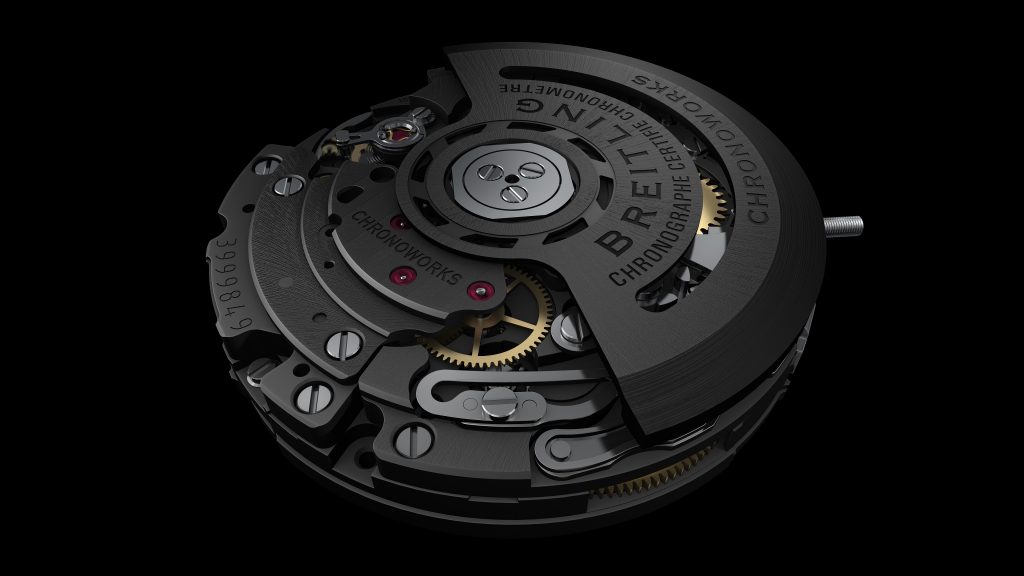
Passionate about their mission, the experts at Chronoworks® have completely redesigned Breitling’s flagship engine, the Manufacture Calibre 01, an automatic chronograph movement with a modern architecture, column wheel, vertical clutch and a power reserve of over 70 hours. The aim is to increase efficiency wherever possible. Engineers and watchmakers re-examined all the movement’s components, looking for the slightest loss of energy, the slightest useless friction, the slightest “extra weight” to increase inertia. They have thus developed five technical advances (choice of materials, geometry of parts, etc.) to reduce friction and dynamic forces at all stages – for the benefit of greater “energy efficiency”.
– Ceramic plate and gear bridges
The first optimization involved the movement chassis (mainplate and gear bridges). To reduce friction caused by the pivoting of the axles, these components were manufactured in a high-tech ceramic (hexagonal boron nitride) already used as a solid lubricant additive in high-performance engines, but used for the first time in mechanical watchmaking applications. Thanks to the very low coefficient of friction, the axles can pivot directly in the holes of the plate and bridges, without wear or loss of energy, and without any lubrication – thus eliminating 11 out of 47 rubies.
– Silicon wheels
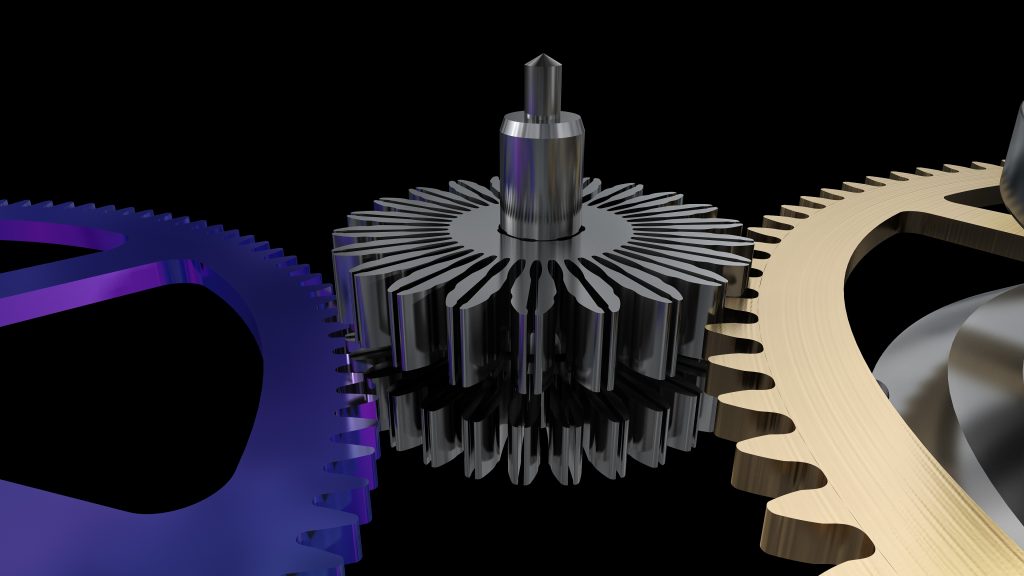
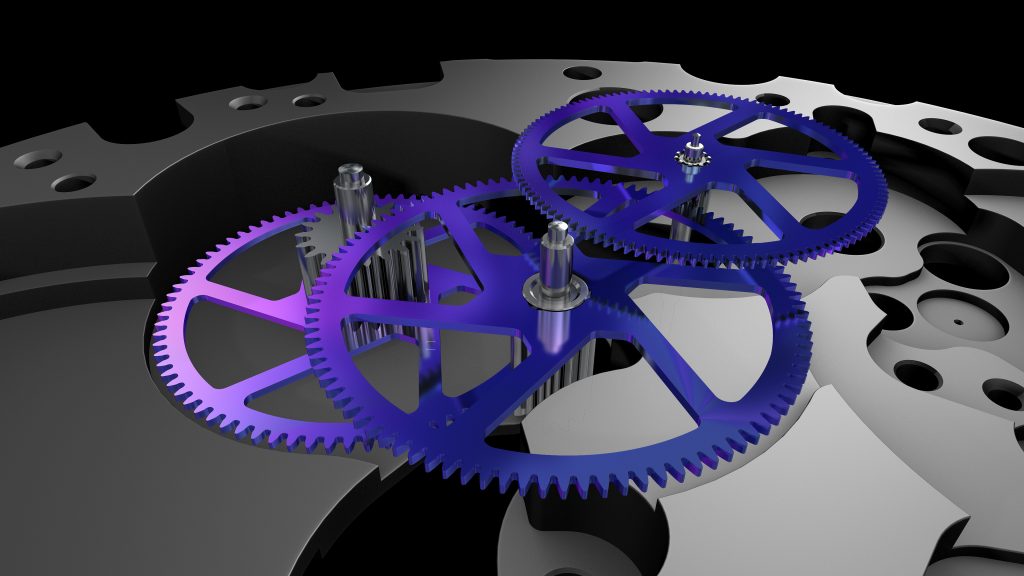
Contrary to what you might think, a watch movement is at a standstill 95% of the time, and each “restart” entails a certain loss of energy. To combat this inertia, the caliber has been fitted with three wheels (center wheel, middle wheel, seconds wheel) made of silicon, a material twice as light as normal – and therefore easier to “restart”. The geometry of these wheels, manufactured by ion etching (DRIE), has been reworked to make the structure more rigid and avoid any deformation of the arms.
– Silicon escapement
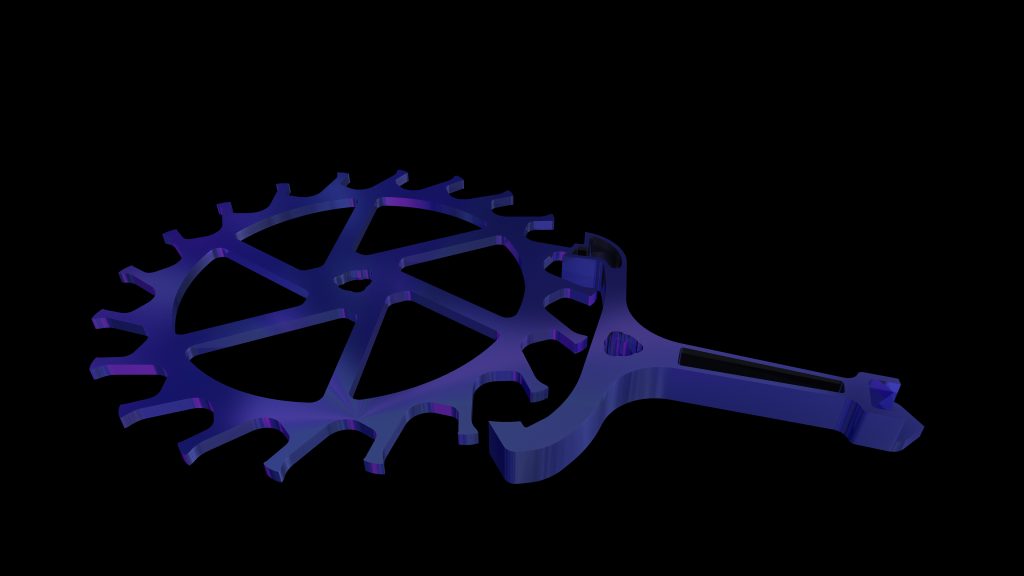
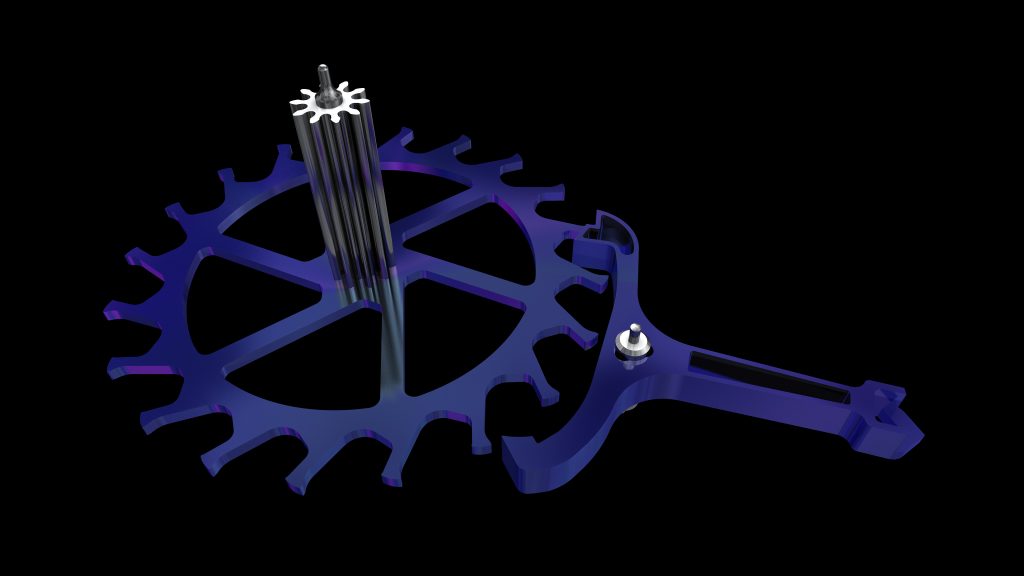
Attention was also focused on the “distributing” organ, the escapement, where a large proportion of energy is traditionally lost. The Swiss lever escapement has been retained, but with a silicon wheel and lever to reduce weight and thus inertia, and to eliminate the need for ruby lifts, resulting in greater precision in terms of shape. To ensure more efficient transmission of energy from the barrel, the geometry of the two parts has also been revised (cutting of the teeth and lifts). The angular limitation of the anchor without stops also contributes to increased reliability. The result is a 42% efficiency gain on this vital component, while ensuring optimum safety – an essential aspect of performance.
– Variable inertia balance
Adjustment of the balance’s oscillations is usually achieved by acting on the active length of the balance-spring with pins, which can disrupt chronometry. The specialists at Chronoworks® have opted for a variable inertia balance that can be adjusted by means of four small gold weights located on the periphery. To overcome temperature sensitivity and maintain the same running accuracy in all circumstances, they chose to combine a nickel serge (ring) with a brass cross (arm) – using brass expansion/shrinkage to modify inertia. When the temperature rises, the cross expands and pushes the serge outwards, increasing inertia. When the temperature drops, the cross retracts and “pulls” the serge towards the center, reducing inertia. This system thus reinterprets the principle of bimetallic balances, exploiting all the most modern manufacturing possibilities (LIGA).
– Elastic gears
Another critical point in a vertical-clutch chronograph mechanism is the tiny component that links the basic movement to the wheel carrying the second hand (chronograph mobile). This assembly, consisting of an axle and two wheels (2 mm in diameter), generally has a certain amount of play that can lead to jerking, which is eliminated by using a “friction spring” – resulting in a 15% loss of energy. Rather than compensate for this backlash by braking, the Chronoworks® specialists preferred to fit the two wheels with elastic teeth that match the shape of the opposing teeth – thanks to a nickel-phosphorus structure. The result: no loss of energy and identical autonomy whether the chronograph function is engaged or disengaged.
100-hour power reserve
By reducing friction and the inertia of moving components, while ensuring optimal operation of both the basic movement and the chronograph, these five measures combined have significantly increased the energy efficiency of the Breitling Calibre 01. It was therefore possible to fit it with a thinner – and therefore longer – spring, increasing the power reserve from 70 to 100 hours, a gain of 45%. This progress not only represents additional comfort for the user, who can leave his watch at rest for more than four days without having to reset it. It also contributes to improved precision. The higher the power reserve, the less the spring force decreases during the first 24 hours, guaranteeing a more regular movement. This technical advance, perfectly in keeping with the spirit of “instruments for professionals”, makes the Breitling Calibre 01, more than ever, the benchmark for performance and functionality.
A very exclusive limited series
To allow connoisseurs and lovers of exclusivity to benefit from these Chronoworks® technical advances, some of which will soon be found on current models, Breitling is launching a limited series of 100 pieces. The company has chosen one of its flagship models, the Superocean Héritage, available in an all-black version, with an all-new matt ceramic case. A resolutely original, powerful and contemporary look. The dial is adorned with pointed hour-markers reminiscent of the 1957 Superocean, created for diving enthusiasts and thrill-seekers. A transparent back reveals the Chronoworks® movement, with its revisited mechanics and black oscillating weight. Another exclusive feature is a braided rubber strap inspired by the original braided steel bracelet. Thanks to the Chronoworks® department and its technical advances, brought together for the first time in the Superocean Héritage Chronoworks®, Breitling is once again asserting its position as an exceptional engine manufacturer. The master of performance.
Cette publication est également disponible en :

