
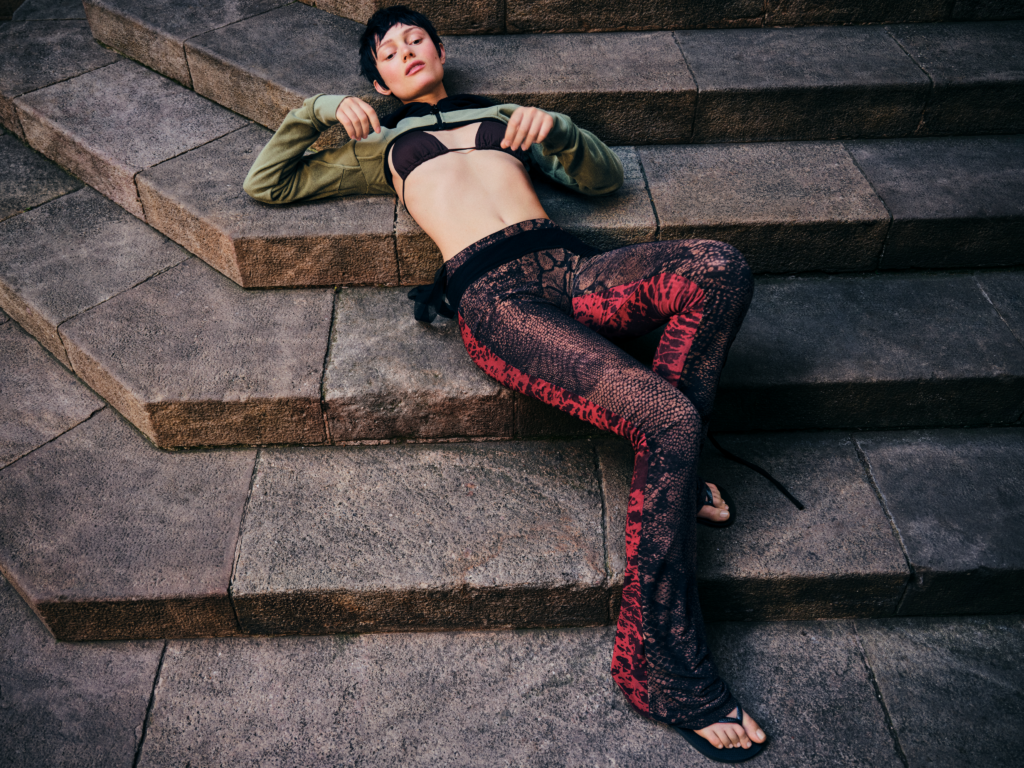
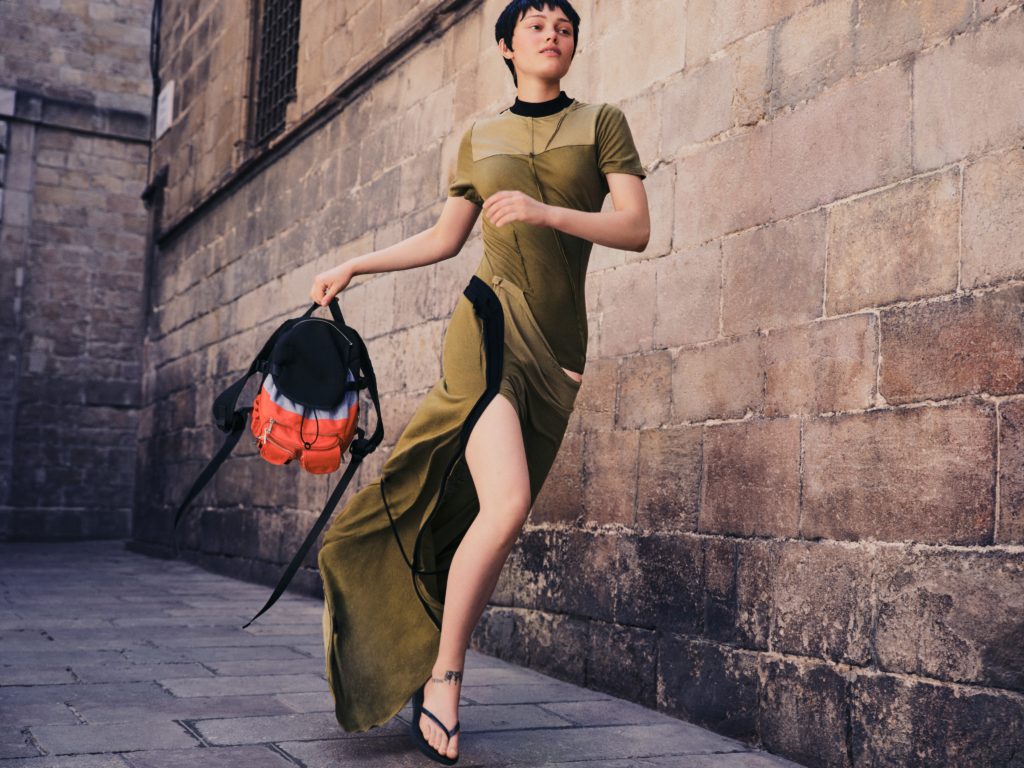
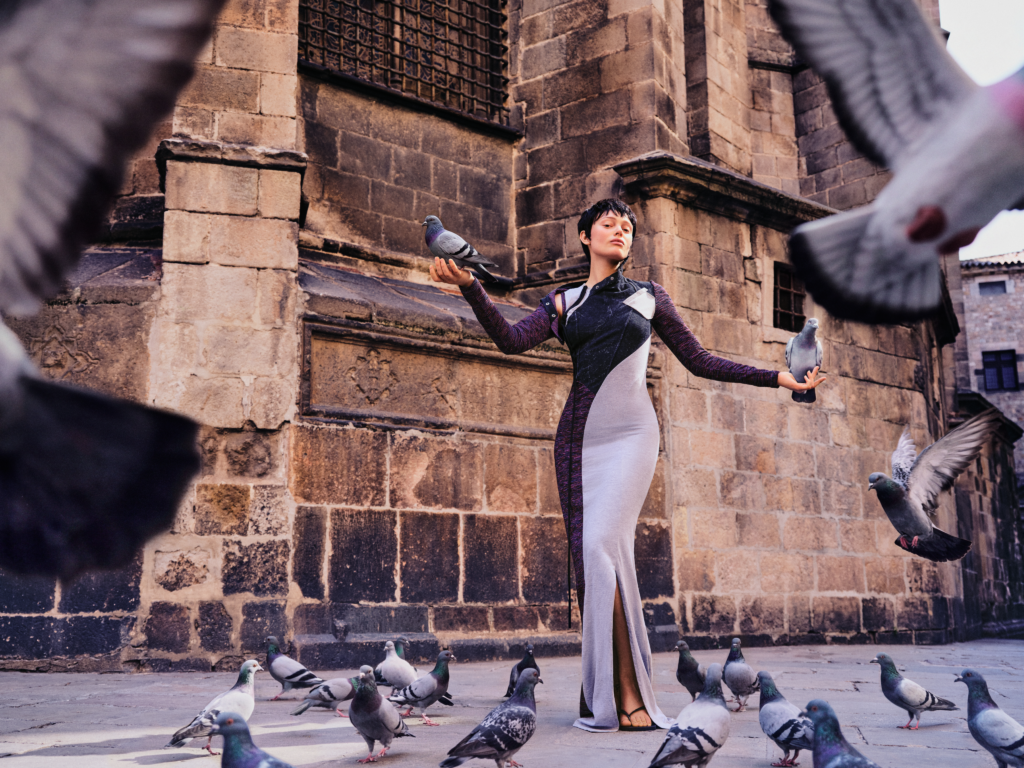
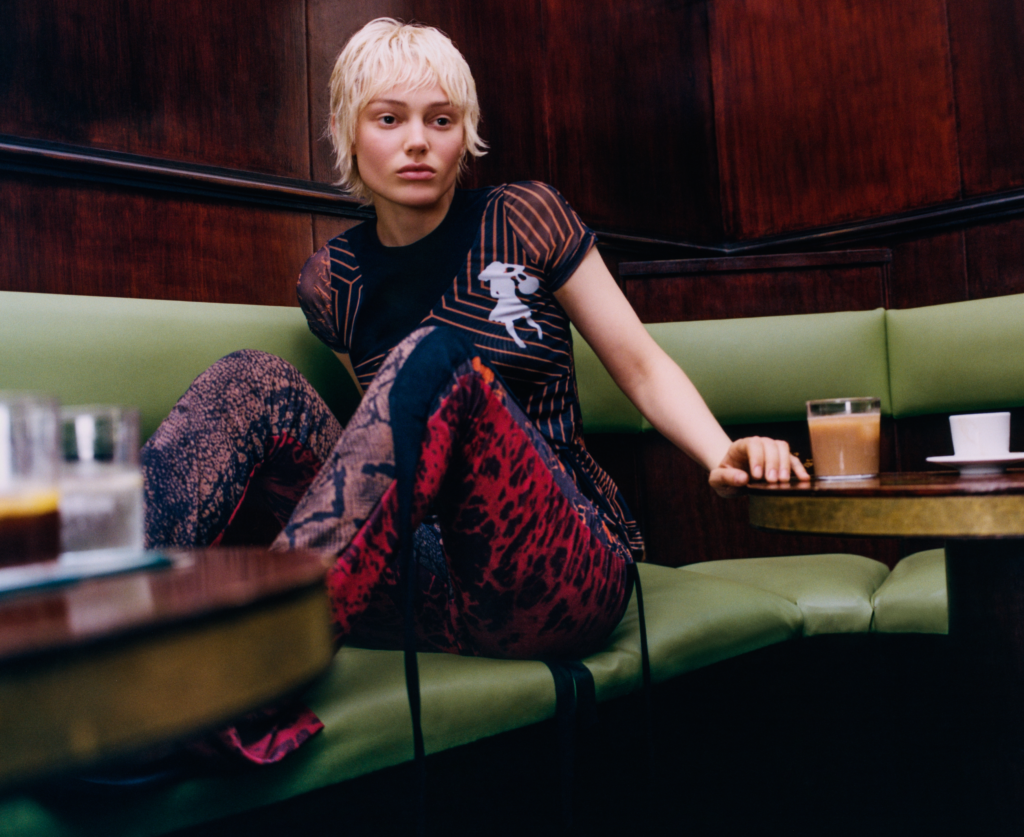
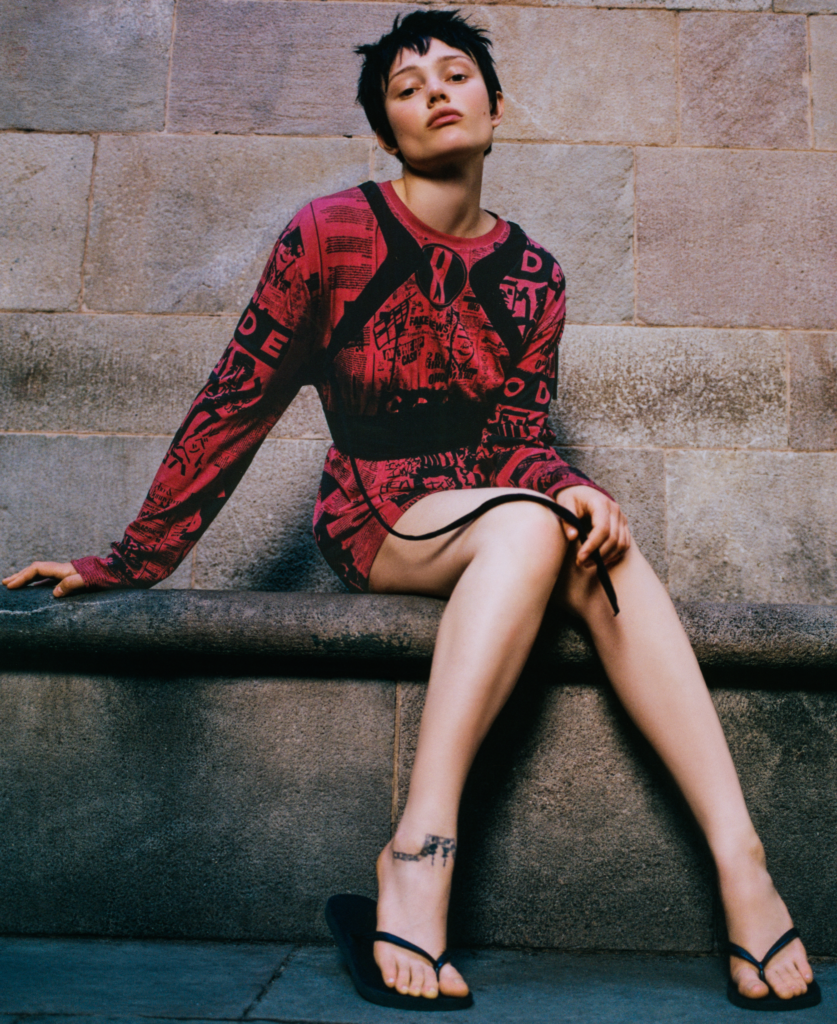
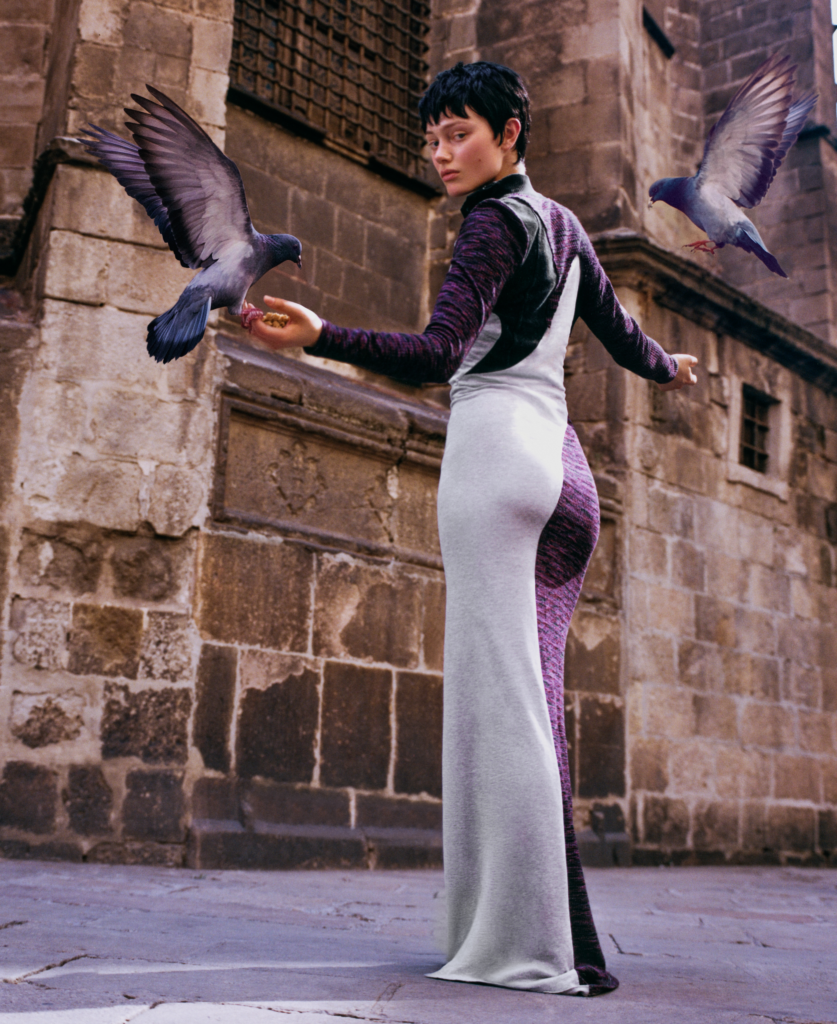
There is a delicious irony in this meeting. On one side, Desigual, a Barcelona brand founded in 1984, long associated with an openly embraced maximalism, almost claimed as an anti-minimalist manifesto. On the other, Ottolinger, a Berlin house founded by the Swiss designers Christa Bösch and Cosima Gadient, which in a decade has become a reference for contemporary deconstructivism, worn by Rihanna, Beyoncé and Rosalía. Between the two, a capsule collection called Desigual designed by Ottolinger, which does not seek to erase this distance but to work with it as a material.
The project did not begin with a marketing brief but with a long-standing fascination. For years, Ottolinger’s studio has drawn on the second-hand market to source vintage Desigual pieces, take them apart, then rebuild them within its own creative universe. This attraction to the prints, colours and highly recognisable visual identity of the Catalan brand has become, over time, the starting point of a collection built on mutual respect for design, experimentation and craftsmanship. What Desigual is now formalising with Ottolinger is therefore not a collaboration in the conventional sense, but the official narrative framing of a gesture the Berlin house had already been practising, on the margins, for several seasons.
The principle rests on a reversal in the way the archive is viewed. Far from making it a sanctuary devoted to preserving the past, Ottolinger makes it the starting point of a new creative process. Christa Bösch and Cosima Gadient went through Desigual’s archives in Barcelona to select garments from dormant stock, chosen for their colours, prints and material qualities, before transferring them directly to the studio. Each piece in the collection is then handmade in Barcelona, where Ottolinger’s deconstructivist language is grafted onto Desigual’s graphic universe, without ever seeking to efface it.
This logic of deconstructing in order to rebuild is precisely what brings the two houses together, however distant they appear. Desigual built its identity on exuberance and colour, while Ottolinger built its own on unconventional tailoring and an experimental approach to materials, regularly shown at Paris Fashion Week since its launch in 2015. The result of this meeting does not erase Desigual’s codes: the pieces remain immediately recognisable as its own, but crossed by a new tension, that of a mainstream garment requalified by the standards of an independent house.
For Desigual, which now claims more than 2,000 employees, a presence in 107 countries and more than 200 stores across five product categories, this collaboration forms part of an openly acknowledged period of renewal: image, collections, retail spaces, with the declared ambition of appealing to a new generation of consumers. Turning to a house whose designs are worn by Rihanna, Kim Kardashian, Dua Lipa or Doja Cat is not a casting accident but a positioning choice: pairing a brand’s popular memory with the rigour of a niche wardrobe.
What this capsule collection says, between the lines, goes beyond a simple exercise in style. It asks how a house can reinvent itself without denying what makes it recognisable, by entrusting its own past to an outside eye. It remains to be seen whether this rereading, born of an organic fascination rather than a commission, will convince beyond the circle already won over to Ottolinger, and whether Desigual will manage to turn this one-off gesture into a genuine brand trajectory.
Cette publication est également disponible en :


