
On the roof of the world, a Tibetan hotel collection is taking the opposite approach to high-altitude tourism: nine days to reach Everest, with the unspoken instruction to conquer nothing.
We have grown accustomed to measuring Everest in records—first ascents, climbing times, queues photographed at 8,000 metres. Songtsam, a family-owned group founded in 2000 by Baima Duoji, a former Tibetan documentary filmmaker, proposes a different unit of measure: slowness. Its new itinerary connects Lhasa to Everest’s north face in nine days, and performance is never the point. The world’s highest summit is not a goal to be reached; it is a threshold before which one pauses.
A geography that sets its own pace
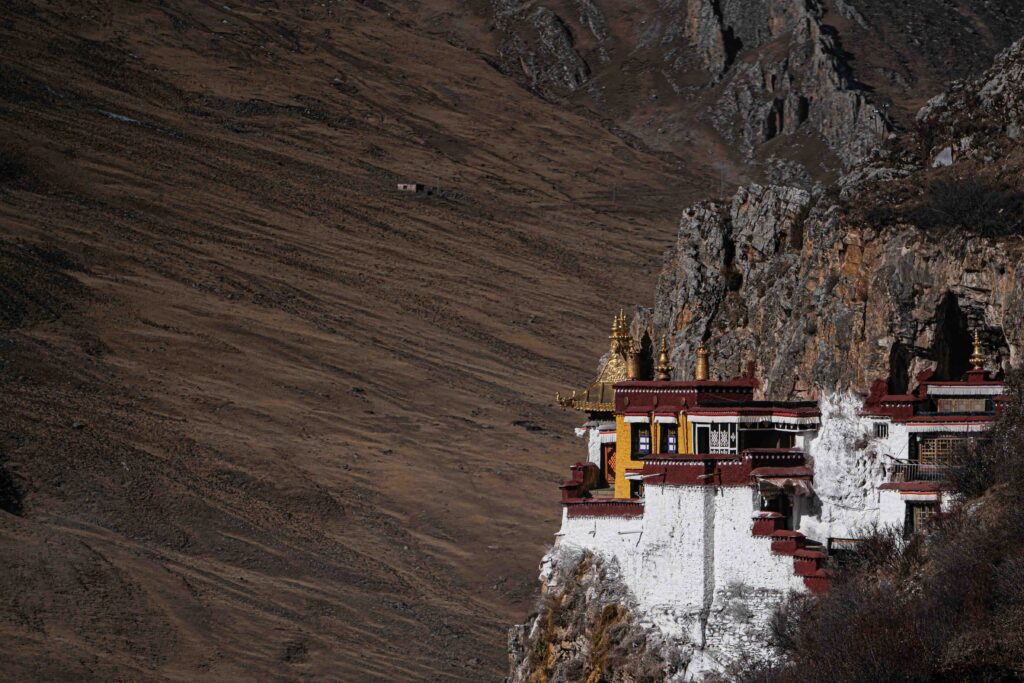
The journey begins in Lhasa, the “Place of the Gods”, where the Potala, the Jokhang Temple and Barkhor’s lanes remain centres of pilgrimage life. From there, the road climbs towards the high plateau, crosses Sakya and Tingri, and runs along windswept passes before reaching Rongbuk, the last inhabited outpost before the north face. The return is via Shigatse and the Yarlung Tsangpo valley, cradle of Tibetan civilisation.
Part of this circuit follows the old Tea Horse Road, a thousand-year-old trade route between Yunnan and Tibet along which Songtsam has established its eighteen properties. The itinerary therefore invents no path: it revives an ancient logistics—that of the caravans—and turns it into a discipline of looking. At this altitude, the body has no choice. Acclimatisation dictates the pace, and the traveller learns despite themselves that a mountain is not crossed; it is climbed in stages of patience.
Two ways to sleep at the foot of Everest
It is near Rongbuk that the itinerary reveals its real question, the one the programme does not put into words. Two overnight options are available: a heated partner hotel in Baiba, sheltered from the wind; or a tented bivouac at the foot of the face. Comfort versus exposure. A wall of canvas versus a wall of ice.
This choice amounts to a declaration of intent. The cosy bed promises a restorative night, with the mountain held at a distance behind glass. The tent restores the cold, the mineral silence, the closeness of prayer flags and a sky free from light pollution. Songtsam does not decide—and that is precisely where the idea lies: contemporary luxury is no longer the addition of a service, but the freedom to choose one’s degree of discomfort. One pays for the right to be cold.
Sunrise rather than the summit photograph
The programme identifies an emotional summit, and it is not the arrival. It is dawn. When the first rays touch Everest, the peak shifts from bluish grey to clear gold, while its ridges awaken one by one. Sunset, more expected and more photographed, does not offer this gradual rise of light. Songtsam makes sunrise the true appointment, and that shift is anything but incidental: it asks travellers to rise before the mountain, to wait for it rather than capture it.
Here lies the coherence of a house that speaks of Tibetan meditation and renewal without turning them into a spa selling point. For thirty years, Baima Duoji has linked his properties to the protection of local cultures and the development of communities in Tibet and Yunnan. The Everest itinerary extends that line: it does not sell a summit; it proposes a face-to-face encounter. It remains to be seen whether guests accustomed to bringing back proof—the summit, the altitude, the selfie—will accept returning with nothing but light. That is the entire wager, and it is more radical than it appears.
Cette publication est également disponible en :


