
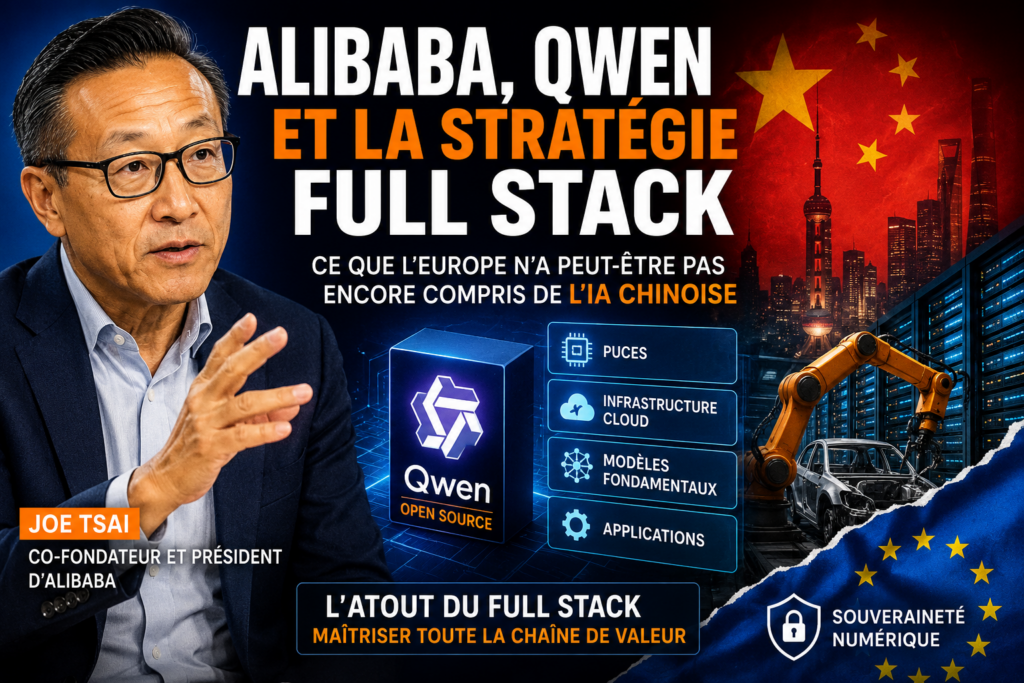
At VivaTech 2026, Joe Tsai delivered a speech that went far beyond the scope of Alibaba. Behind the promotion of Qwen, its open-source model, lies a much more ambitious vision: that of a China that no longer seeks to catch up with the United States in AI, but to build a complete alternative.
And that is precisely where the most interesting point lies.
AI is not a software market, according to Alibaba
Most Western players still evaluate AI through the traditional lens of IT: software licenses, SaaS subscriptions, and IT budgets.
Joe Tsai advocates a radically different perspective.
In his view, the true addressable market for AI is not software but human productivity itself. If half of global GDP relies on human intelligence and labor, then AI has the potential to generate tens of trillions of dollars in economic value.
This vision explains why Alibaba is simultaneously investing in:
- chips,
- cloud infrastructure,
- fundamental models,
- applications.
The company refuses to rely on a single technology stack.
The “full stack” approach
While Silicon Valley has produced a generation of specialists—chipmakers, hyperscalers, model labs, and app developers—Alibaba advocates an integrated strategy.
Joe Tsai himself acknowledges that today, no one really knows where value will be concentrated.
Machine learning models are currently the center of attention.
But what about five years from now?
Perhaps the profits will come from inference. Perhaps from infrastructure. Perhaps from industry-specific data.
For Alibaba, owning the entire value chain means avoiding reliance on a single bet.
This approach is more reminiscent of Apple’s than OpenAI’s: controlling hardware, software, and the user experience.
Qwen: Open Source as a Geopolitical Weapon
The most striking moment of the discussion, however, concerned open source.
In response to European concerns about digital sovereignty, Joe Tsai put forward a simple argument:
An open-source model downloaded to your own infrastructure no longer truly belongs to its creator.
According to this logic, Qwen is less of an Alibaba product and more of a strategic diversification tool for European companies.
It’s a clever line of reasoning.
For several years now, Europe has been concerned about its dependence on American platforms. But recent U.S. restrictions on certain AI technologies have abruptly turned a theoretical concern into an operational risk.
Tsai’s response is almost provocative:
“You can’t trust either the U.S. or China. So why put all your eggs in one basket?”
In other words, sovereignty does not necessarily mean owning your own models. It can also mean diversifying dependencies to reduce risks.
A nuance worth examining.
The real battle is being fought in the industrial sector
Contrary to the prevailing narrative focused on chatbots and productivity assistants, Alibaba seems to believe that the next wave of value will come from industry.
The examples cited are telling:
- BMW
- Bosch
- Siemens
These companies possess an asset that has become extremely valuable: decades of structured industrial data.
For Alibaba, this data is potentially more valuable than the generic datasets used to train models for the general public.
The logic is simple:
A general-purpose model can write an email.
But only a model fed by millions of hours of industrial data can optimize an automotive production line.
The next frontier of AI might therefore resemble less ChatGPT and more an invisible system capable of improving a factory’s productivity.
China Is Less Dependent Than We Imagine
Another interesting takeaway: the issue of infrastructure.
While the Western debate is dominated by the colossal investments of American hyperscalers, Joe Tsai asserts that China remains underinvested in AI infrastructure.
An apparent paradox.
But one that reveals a fundamental difference in perception.
While some analysts are already talking about a data center bubble, Alibaba believes the country does not yet have sufficient capacity to fully harness the potential of AI.
This view is consistent with China’s industrial strategy: to invest before demand fully emerges, rather than after.
The Future According to Alibaba: Less Work, More Agents
Finally, Joe Tsai offered a surprisingly optimistic vision of the future.
In his view, AI agents won’t necessarily eliminate human work.
They will simply shift it.
His analogy is simple: people sitting at a Parisian café terrace could one day have agents working for them 24 hours a day.
A vision that largely aligns with the one currently championed in Silicon Valley.
But with one notable difference.
While many American players talk about automation, Alibaba focuses more on the time freed up.
Time for leisure.
Time for family.
Time for experimentation.
This sentiment resonates particularly strongly in the luxury sectors.
For while AI does indeed reduce the cost of productivity, economic scarcity could shift toward what cannot be automated: emotions, human connections, live performances, craftsmanship, travel, and human attention.
What this speech really reveals
Joe Tsai’s most important message was probably not a technological one.
It was strategic.
While Europe is still debating sovereignty and the United States is focusing media attention on a few dominant players, China is moving forward on a different front:
- infrastructure,
- open source,
- industry,
- vertical integration.
In other words, while the West is fixated on business models, Alibaba is building the ecosystem.
And the history of technology often shows that those who control the ecosystem end up capturing more value than those who control only the product.
Cette publication est également disponible en :

