
VivaTech 2026 – Luxsure Analysis
The Paradox of Augmented Intelligence
As artificial intelligence takes on an increasing share of cognitive work—writing, summarizing, analyzing, and making recommendations—a deeper question emerges: perhaps the risk is not that AI will think for us, but that we will gradually forget how to think alongside it.
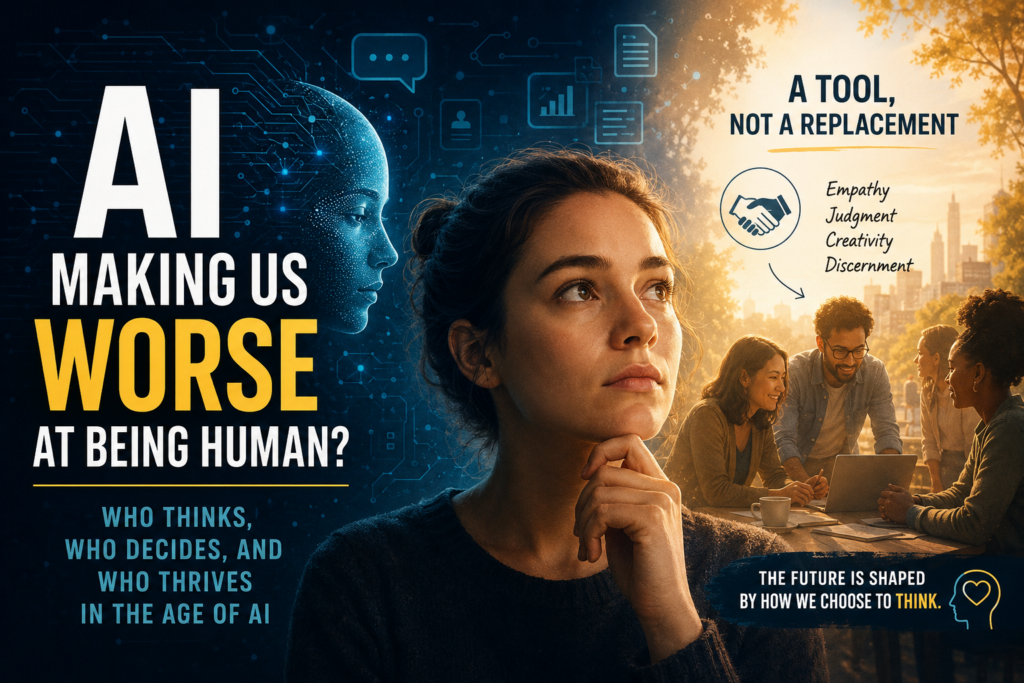
It was one of the most philosophical discussions heard at VivaTech 2026. With a deliberately provocative title— “Is AI Making Us Worse at Being Human? ”—the discussion quickly moved beyond the realm of technology to address a much more fundamental issue: the value of human judgment in an economy where knowledge is instantly accessible.
The real issue is no longer artificial intelligence. It is human attention.
The End of the Scarcity of Knowledge
For centuries, competitive advantage was based on the accumulation of information.
School, college, and then the workplace all operated according to a simple logic: learn, memorize, and reproduce.
But this equation is disappearing.
As Moira Gilchrist, Chief Global Communications Officer at Philip Morris International, pointed out, knowledge is now widely accessible. Facts, data, and information can be accessed in a matter of seconds.
Value, therefore, no longer lies in what we know.
It focuses on what we do with that knowledge.
Critical thinking, discernment, the ability to make connections between unrelated fields, emotional intelligence, and strategic intuition: these are all qualities that current models fail to replicate fully.
This distinction is essential.
AI reduces the cost of accessing information. It does not eliminate the need for judgment.
The Co-Pilot Illusion
The term “co-pilot” has become ubiquitous in the industry.
However, several speakers have questioned this metaphor.
Andra Koenig, CEO of Global Quantum Intelligence, advocates a more radical view: viewing AI as a co-pilot would, in fact, be the best way to become intellectually passive.
The problem isn’t a technological one.
It’s behavioral.
Human beings are naturally drawn to the simplest solution. If a machine can produce an analysis, write a report, or prepare a presentation in a matter of seconds, the temptation is strong to gradually delegate more and more of the thinking to it.
The phenomenon is already evident.
In some organizations, the top performers aren’t necessarily those with the most specialized expertise, but those who know how to use AI as a constant source of challenge.
In other words, a tool becomes valuable not when it confirms our ideas, but when it challenges them.
AI as a discussion partner.
Not as a substitute for thinking.
The Luxury of Tomorrow: Discernment
This discussion goes far beyond the realm of technology.
It directly affects the creative industries.
On LinkedIn, in the media, and in marketing content, signs of standardization are already becoming apparent.
Same structure.
Same tone.
Same vocabulary.
The same kind of artificial perfection.
Paradoxically, the more fluid user-generated content becomes, the more its lack of uniqueness becomes apparent.
One of the most interesting findings from the panel relates precisely to this reversal of values.
When everything seems perfect, nothing stands out anymore.
In a world saturated with user-generated content, human imperfection is once again seen as a sign of quality.
A moment’s hesitation.
A hunch.
An unexpected statement.
A real-life experience.
All of these factors are difficult to replicate on a large scale.
This phenomenon reflects a well-known trend in the luxury sector.
When mass production reaches its peak, scarcity regains its value.
Today, this scarcity is no longer merely material.
It becomes cognitive.
The Expert’s Report Is Back
Another particularly revealing topic concerns the company.
For the past two years, most of the discussion surrounding AI has focused on productivity gains.
Automate.
Speed up.
Optimize.
But several speakers emphasized a reality that is often overlooked: speed is only valuable if it improves the quality of decisions.
Tahira Zamanzada, an AI strategy consultant at SAP, advocated for an approach centered on the ” Human in the Loop.”
The principle is simple.
Even when a system automates 80% of a process, the remaining 20% must remain under human control.
Not out of mistrust.
But it is precisely within that 20% that business expertise, context, trade-offs, and nuances lie.
In other words, AI creates value when it frees up time.
Not when it takes the place of sound judgment.
This distinction is becoming particularly strategic for luxury brands.
Because their competitive advantage does not depend on access to information.
It relies on the ability to interpret weak signals, construct compelling narratives, and make decisions that cannot be justified by data alone.
Details
Perhaps the most intriguing idea in the debate came from a young employee described as an “AI native.”
What he asked his company for wasn’t a new tool.
She wanted to have a “virtual board of directors.”
A digital twin of the organization’s most experienced leaders, capable of embodying their way of thinking, their experience, and their reasoning.
Not to replace these leaders.
But to make their wisdom accessible on a large scale.
The idea opens up a fascinating prospect for family-owned businesses.
Tomorrow, data may not be the most valuable asset.
But the ability to capture and convey decades of human judgment.
A generational divide… or an opportunity?
The debate ended with a telling disagreement.
On the one hand, concern.
Technological advancement is outpacing our biological ability to adapt.
On the other hand, optimism.
Never before have so many tools been available to so many people.
For the first time, an entrepreneur in an emerging market can instantly access a translator, an advisor, a trainer, or a strategic assistant.
The potential impact is immense.
As is often the case, the truth probably lies somewhere in between.
AI does not, by its very nature, make us any smarter or any dumber.
It amplifies our existing behaviors.
Curious minds become more powerful.
Passive people become more dependent.
The real divide of the decade may not be a technological one.
It will pit those who use AI to deepen their thinking against those who use it to avoid thinking.
In a world where everyone can produce more, scarcity shifts elsewhere.
Toward Mindfulness.
Toward the Judgment.
Toward the ability to ask the right question when everyone already knows the answer.
Cette publication est également disponible en :

