
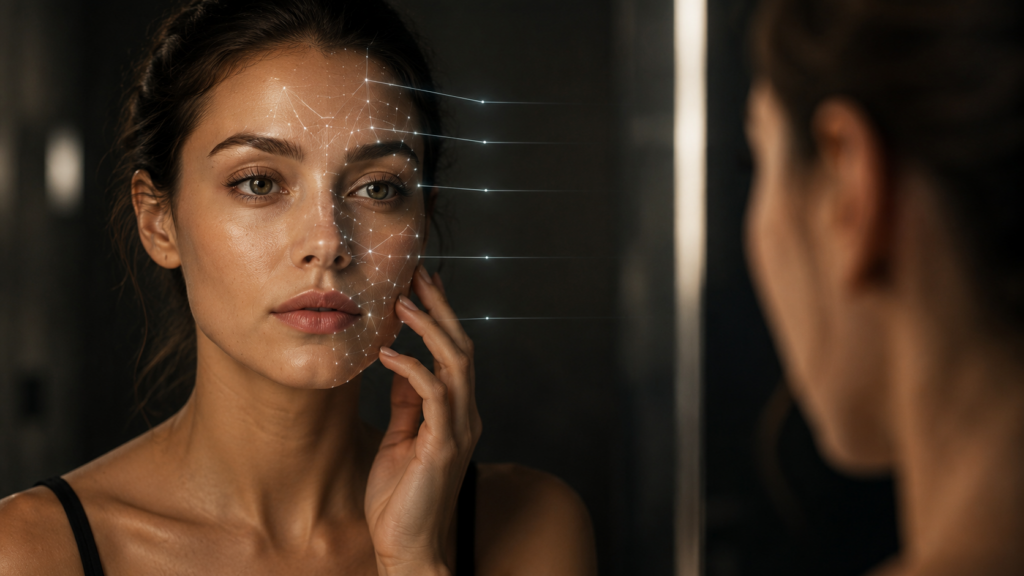
On the Black Stage at VivaTech on June 20, 2026, a L’Oréal executive stated aloud a limit that few companies articulate so clearly: a synthetic avatar can sell a dream, but never a skincare product. This distinction is not merely aesthetic. It has become a matter of governance.
The remark came almost as an aside. Sandy Moragón, Global Director of Social, Advocacy, and Influence at L’Oréal, explained why her company allows entirely virtual influencers—computer-generated creations that are openly unreal and play on the fantastical—but categorically refuses to let a digital twin that replicates the features of a real human being speak on behalf of the brand to sell a cream or shampoo. The reason can be summed up in one sentence: we don’t just sell the effectiveness of a formula; we sell the promise of an authentic sensory experience, and that promise requires that a human being has actually smelled, tested, and experienced the product on their skin or hair. A clone cannot have skin.
The Skin as the Final Piece of Evidence
What is striking about this approach taken by L’Oréal is that it does not pit artificial intelligence against human action in a binary fashion. It distinguishes between two uses that the technology itself does not spontaneously distinguish: the avatar as a prop, and the avatar as a witness. The first poses no problem—it has always existed, under other names, from mascots to glossy-magazine muses. The second calls into question the brand’s credibility, because it claims to embody a physical experience that never took place.
Ian Shepherd, co-founder and co-CEO of Electrify Video Partners—a company that has invested in eleven YouTube channel creators and built a team of more than two hundred people around them—recounts a revealing experiment conducted by one of the creators in his portfolio, Rowan Cheung, founder of The Rundown AI, the leading newsletter dedicated to artificial intelligence. Cheung tested his own digital twin to produce some of his content; few viewers noticed the substitution. But the creator himself found that the result lacked an authenticity he considered essential, and he returned to recording in person. The experiment worked technically. It failed on a human level.
Electrify now uses these digital twins for specific, stated purposes: voice-over work, language localization, and backup filming when a creator is unavailable for a scene that has already been written. Not to replace the creator’s presence, but to extend it in cases where the absence of the physical body does not alter the promise made to the audience.
Details
One minute of YouTube video, at a decent quality, costs about ten thousand dollars to produce. One minute of Netflix programming: about two hundred thousand dollars. One minute of a theatrical film costs about one million dollars. This disparity explains why three directors who cut their teeth on YouTube—Kane Parsons (Kane Pixels) with *Backrooms*, distributed by A24 and grossing over 140 million dollars worldwide; Mark Fischbach, aka Markiplier, who self-funded *Iron Lung* with a budget of about three million dollars before reaping a much higher return; and Curry Barker with *Obsession*, released by Focus Features and grossing over one hundred million dollars in the domestic market alone—have been able to bypass the Hollywood greenlight system. It’s not a matter of extra talent: it’s the removal of a financial bottleneck that, for decades, gave studios the power to decide who was entitled to a story.
Expand, not replace — and pay him fairly
This same tension between growth and replacement runs through the issue of compensation—an even more pressing concern for a fashion house. Ian Shepherd draws a parallel with the music industry, which experienced its own upheaval when streaming replaced record sales without royalty models keeping pace. Creators, he says, are now paid based on the reach of their content—views, watch time—while the platforms that pay them are seeking to influence desirability and sales. The two metrics do not align, and as long as they do not align, no relationship between a brand and a creator will be able to transcend the status of a mere transaction.
Hannah Elsakr, Vice President of New Developments in Generative Artificial Intelligence at Adobe, extends this line of reasoning to the governance of intellectual property itself. The tools her team builds for studios—including Walt Disney Imagineering, which uses them to accelerate the transition from sketch to 3D rendering in the design of its attractions—are trained only with the explicit permission of the artist or studio whose style is being replicated. She cites the example of furniture designer Norman Teague, who agreed to integrate these tools early in his own creative process, describing them as a search engine for his imagination rather than a substitute for his craftsmanship. For Elsakr, each House must now require what she calls a “nutrition label” for its artificial intelligence models: knowing precisely on which corpus they were trained and with what authorization, before entrusting them with even the smallest fragment of its intangible heritage.
This is precisely what is at stake in the agreement signed in January 2026 by creator Khaby Lame, who sold his company for 975 million dollars in exchange, among other provisions, the authorization to develop a digital twin capable of producing commercial content in multiple languages, 24 hours a day. The stated ambition was to transform a human presence—which is, by nature, limited in time and space—into continuous commercial availability. Early feedback discussed on the VivaTech stage suggests that this perpetual availability alone is not enough to replicate the trust inspired by the real person—an exact echo of what Sandy Moragón refuses, on principle, to allow at L’Oréal.
A line that assumes we can still tell the difference
L’Oréal’s position is based on a simple premise: it is still possible to distinguish, by sight or instinct, a real human being from a sufficiently accurate recreation. Rowan Cheung’s experiment has already put this premise to the test, and Khaby Lame’s partnership is set to test it on a much larger commercial scale. The day this difference can no longer be seen, the rule stated on the black stage at VivaTech will no longer hold true based on appearance—it will have to shift to a question that no one, as of yet, has publicly articulated: Who, within a House, has the right to attest that a body truly felt what it claims to have felt?
Cette publication est également disponible en :

