
At Maison Poiray, there’s a way of ensuring that stone never becomes too solemn. Color is used here as a tool, not as a statement. In celebrating the 20th anniversary of Filles Antik, the House is shining a spotlight on a collection launched in 2006 that has become one of its most recognizable jewelry lines. The focus is not merely on the anniversary of a collection, but on the enduring nature of a design language: a colored gemstone, a curve of gold, a distinct silhouette, a piece of jewelry designed to complement the hand rather than constrain it.
Poiray belongs to that generation of Parisian jewelry houses that, beginning in the 1970s, shifted the focus of jewelry toward a more everyday conception of luxury. Founded in 1975 by François Hérail and Michel Ermelin, the House has championed from the very beginning jewelry that can be worn in any setting—creative, versatile, and less intimidating than the grand ceremonial codes of the Place Vendôme. This vision remains at the heart of its official history: to make jewelry an object of elegance but also of movement, capable of adapting to one’s mood.
Filles Antik embodies this intuition. The collection is not based on the graphic tension of sharp lines, but on the softness of a curve. The press release describes pieces in 18-karat yellow, rose, or white gold, some pavé-set with diamonds and others not, featuring rose quartz, milky quartz, green prasiolite, blue topaz, Blue London topaz, citrine, or amethyst. The pieces include rings, necklaces, and earrings. In this collection, the key detail is not the accumulation of references, but the way in which the stone is highlighted through the piece’s form.
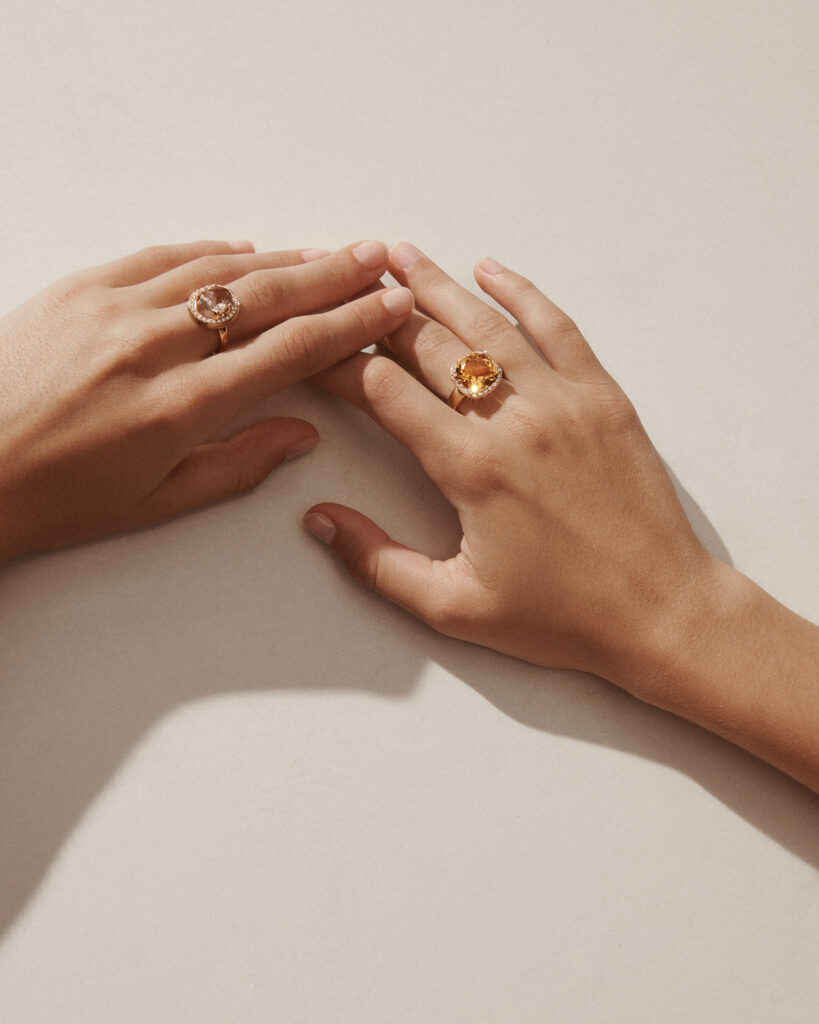
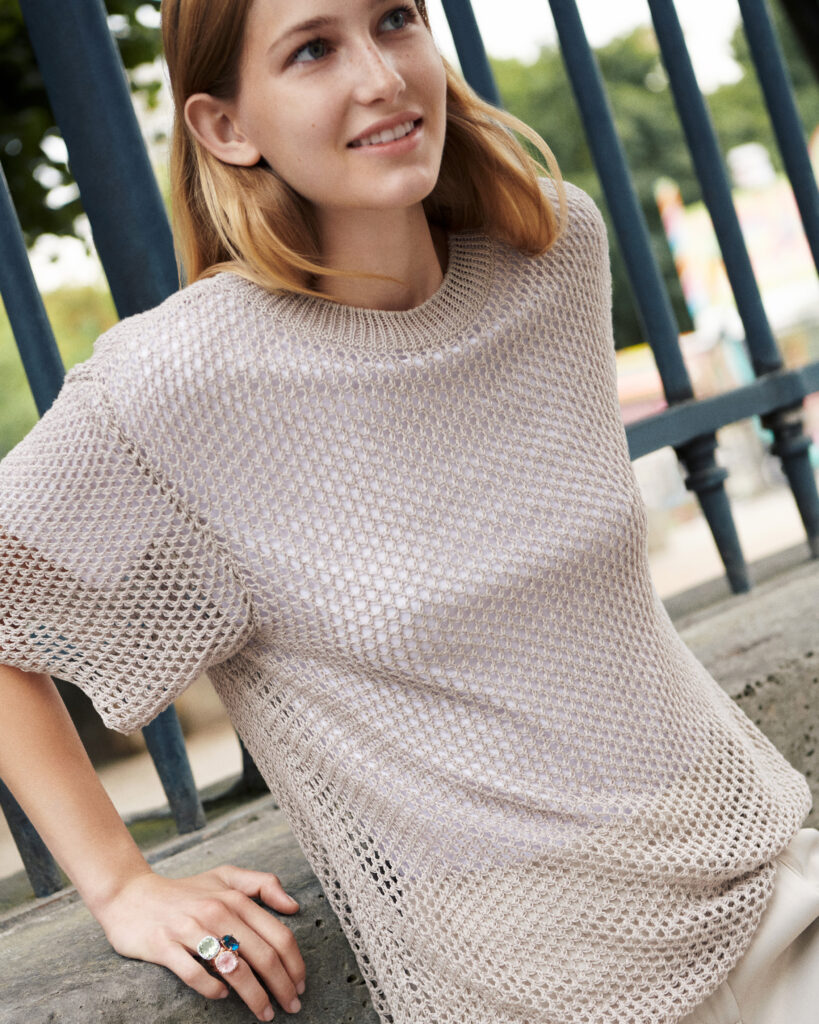
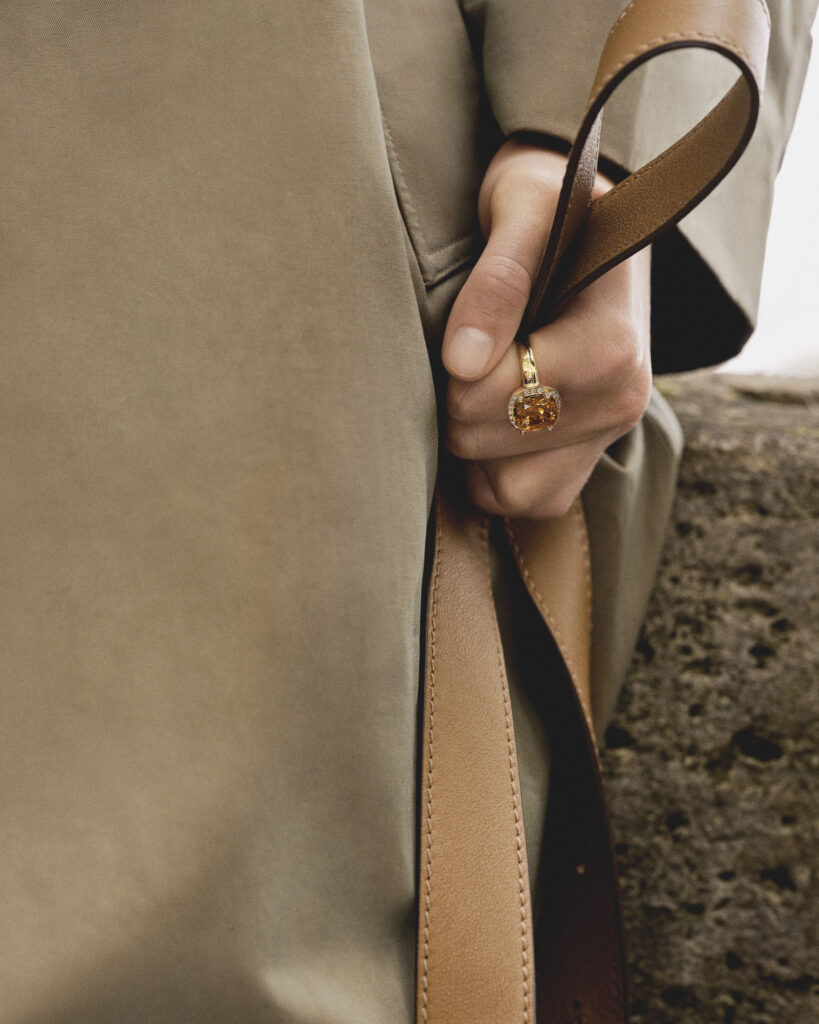
The ring, in particular, embodies the essence of the collection. On the first page of the feature, it is shown held between the fingers, almost at the height of a gesture, in an image that emphasizes not so much the jewelry’s brilliance as its closeness to the body. On the second page, the hands hold several colored stones in soft light, without excessive dramatization. The image is spot-on: Filles Antik is not a collection meant to be admired from a distance. It belongs to the realm of wearable jewelry—jewelry that stands out because it complements a silhouette rather than seeking to dominate it.
The ancient reference suggested by the name remains subtle. It evokes neither an archaeological pastiche nor historicizing decor. Rather, it is evident in the curves, in the way the stone appears to be set within a protective form. Poiray officially refers to “the softness of gold’s curves” and “the generosity of a skillfully cut colored stone” to describe the collection on its website. This phrasing, beyond its brand-specific tone, points to the true essence of the line: a balance between presence and comfort, between visible color and a softened design.
The choice of gemstones also says something about contemporary jewelry. Citrine, amethyst, topaz, and rose quartz do not evoke the same sense of status as a solitaire diamond. They establish a more personal relationship with color. A citrine does not have the same character as a Blue London topaz; a prasiolite does not convey the same sentiment as milky quartz. The collection thus allows for a kind of chromatic portrait. In an industry long dominated by the hierarchy of gemstones, this freedom of expression is no small matter.
The brand presents it as suitable for everyday wear, as a cocktail ring, or as an engagement ring. Here again, the appeal lies in its versatility. Filles Antik does not confine the piece to a single function. It can mark a special moment, but its existence does not depend on that moment. The piece finds its place in the realm that Poiray has cultivated since its inception: precious yet versatile jewelry, designed for a woman who doesn’t wait for a formal occasion to wear color.
Twenty years after its launch, the collection endures precisely because it never sought to become a manifesto. It adopted a simple, recognizable form—stable enough to withstand changing trends, yet flexible enough to accommodate various gemstones, metals, and uses. In jewelry, longevity does not always come from breaking with tradition. It sometimes comes from a well-placed curve, a stone chosen for its light, and a design that still leaves the wearer free to decide its meaning.
Cette publication est également disponible en :

