
In fine watchmaking, there is a difference between showcasing complexity and making it legible. The new Master Hybris Mechanica Ultra Thin Minute Repeater Tourbillon from Jaeger-LeCoultre Master Watchmaking precisely explores this fine line: that of a watch that reveals almost everything, without turning its movement into a noisy spectacle.
The watch features the Caliber 362, introduced in 2014, in a design that combines a minute repeater, a flying tourbillon, and a peripheral automatic winding mechanism. The challenge is not simply to stack complications on top of one another. It is to integrate them all into a movement just five millimeters thick, housed in an 18-karat rose gold case measuring 41.4 mm in diameter and 8.25 mm thick. The Manufacture states that this caliber remains the world’s thinnest automatic minute repeater tourbillon, a distinction also noted by the specialized watch press at its 2026 unveiling.
What is of interest here is not slimness as an abstract achievement, but the way it imposes a discipline of construction. The minute repeater is not simply added to an existing base; it is an integral part of the caliber’s very structure. The rakes, hammers, and gongs were designed to minimize the available height, while the striking mechanism occupies about one-third of the movement’s total volume. This integration largely explains the piece’s restraint: less a mechanical spectacle than a masterful exercise in compression.
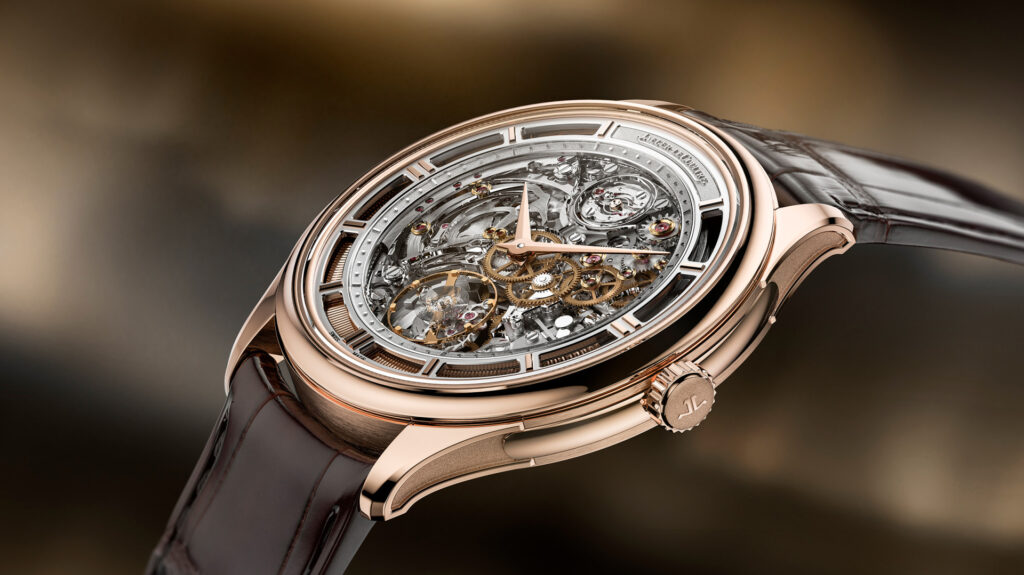
The flying tourbillon follows the same design philosophy. Composed of 59 components and weighing 0.248 grams, it does away with an upper bridge to reduce the height and open up the view. The inclusion of an S-shaped balance spring, patented by Jaeger-LeCoultre, is tailored to this specific design: maintaining the concentricity of the beat within a confined space. The automatic winding mechanism, meanwhile, features a peripheral rotor mounted on 36 ceramic ball bearings, eliminating the bulk of a traditional central rotor while keeping the movement visible from both the dial side and the case back.
Transparency, therefore, is not merely a matter of aesthetics. Three bridges essential to the movement’s stability are crafted from sapphire. The challenge lies not only in the material itself, but also in the setting of the eleven rubies required: the Manufacture uses 18-karat rose gold settings, a technical solution that allows the stones to be secured without being set directly into the sapphire. Polishing, anti-reflective coating, and anti-static treatment are then applied to reduce visual interference. The result is not a traditional skeleton movement, but an architectural design in which certain components appear to be suspended in mid-air.
This research is part of a specific lineage. Jaeger-LeCoultre notes that its expertise in ultra-thin watches dates back to the Caliber 145 of 1907, a pocket watch movement 1.38 mm thick nicknamed “Couteau.” The Maison also boasts a long tradition in striking watches: its first minute repeater dates back to 1870, and it has developed more than 200 striking calibers since then. These two traditions—thinness and acoustics—come together here in a timepiece that would not make much sense without this technical heritage.
The minute repeater remains one of the complications least immediately understandable to the general public. It does not provide any additional information; it translates time into sounds. On the Caliber 362, the square-profile monobloc gongs are paired with articulated trebuchet-style hammers, designed to strike with speed and precision. A patented mechanism for reducing dead time minimizes the pause between the hours and minutes, particularly when no quarter hour needs to be struck. Here again, the innovation does not seek to create a spectacular effect; rather, it corrects an unwanted silence.
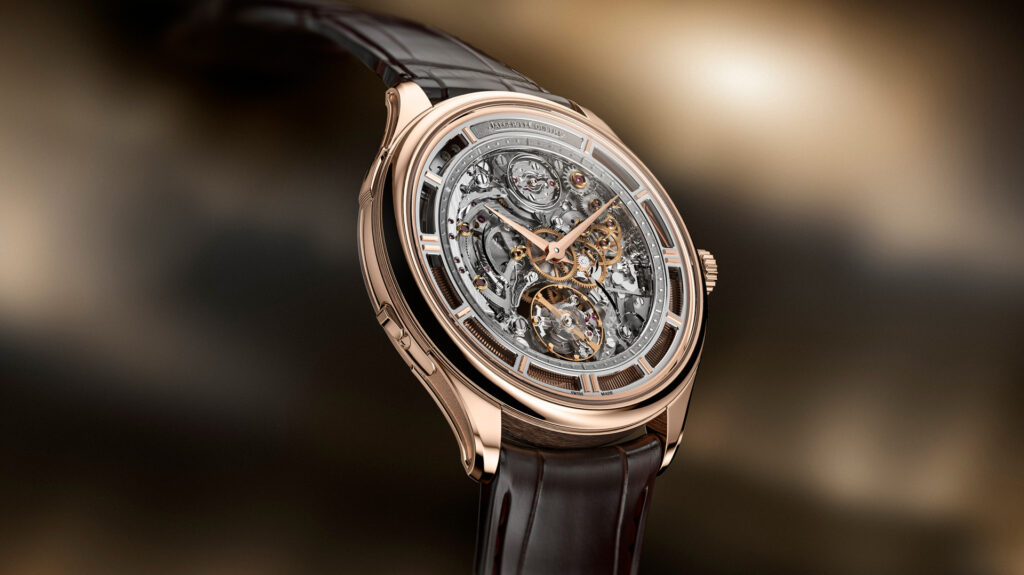
The case, composed of 60 components, adapts the design language of the Master Grande Tradition to this ultra-thin construction. The repeater is not activated by a conventional slide, but by a retractable push-button at 10 o’clock, paired with a second push-button at 8 o’clock that locks and unlocks the function. This design choice subtly alters the usual operation of a minute repeater, replacing the sweeping motion of the slide with a more restrained, almost architectural interaction.
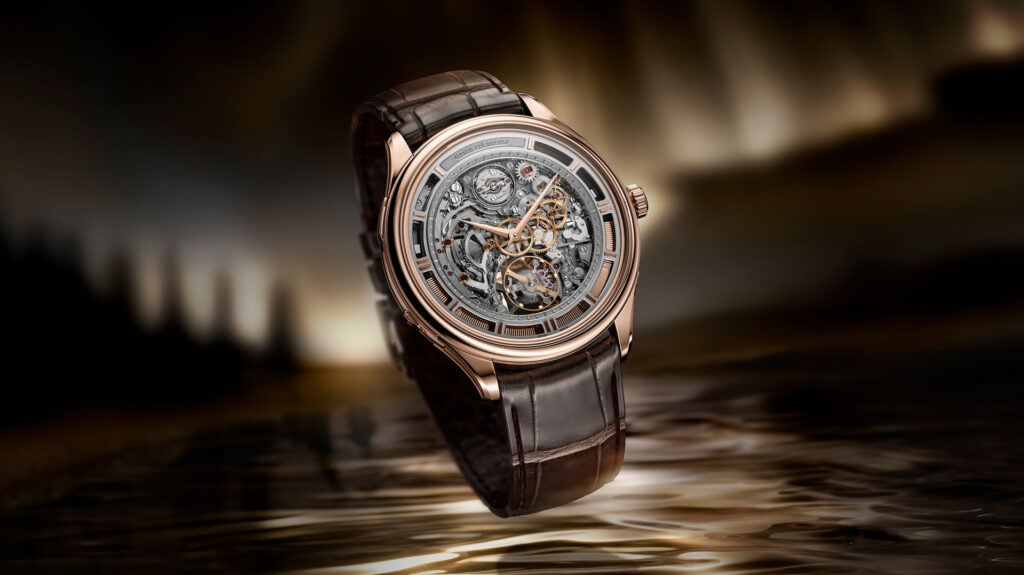
The design maintains this balance between visibility and restraint. The dial is reduced to an openwork ring in 18-karat white gold, revealing the caliber’s 593 components. The applied hour markers, hands, logo, and guilloché-finished peripheral rotor in rose gold ensure visual continuity with the case. Fourteen decorative techniques are featured, ranging from pearl-graining to Côtes de Genève, from sunburst to guilloché, with 48 recessed angles and 60 hand-beveled components. In an era when transparency is often treated as a superficial selling point, Jaeger-LeCoultre approaches it here as a finishing requirement: what is revealed must stand up to scrutiny.
Limited to ten pieces, the Master Hybris Mechanica Ultra Thin Minute Repeater Tourbillon is not just a watch with complications. It is a discreet statement on the role of integration in contemporary watchmaking. Many complicated timepieces add elements. This one subtracts: thickness, metal, layers, and sometimes even unnecessary noise. What remains is a sonic architecture, a five-millimeter movement, and the rather rare notion that a watch can be technically sophisticated without raising its voice.
Cette publication est également disponible en :

