
At Roger Dubuis, extravagance is never far away. It sometimes takes the form of a mechanical skeleton, a case shaped like a frame, or a tourbillon placed where one would simply expect to see hands. With the Excalibur Moonlight, Roger Dubuis has chosen a different path: rather than adding a celestial complication to the dial, the brand has organized the entire piece around a miniature sky.
This watch marks the public launch of Rarities, a program dedicated to one-of-a-kind pieces and bespoke creations. The workshop, located on the third floor of the Manufacture, brings together watchmakers, engineers, and designers around a simple principle: to involve the collector in the creative process, from materials to artisanal craftsmanship. The focus, therefore, is not merely on a new Excalibur, but on a way to reposition bespoke watchmaking within a dialogue between personal desire and mechanical architecture.
At the heart of the Excalibur Moonlight is the RD115 caliber, certified with the Geneva Seal. Roger Dubuis, founded in 1995, has carved out a unique niche in Geneva’s haute horlogerie since its inception, combining expressive design with in-house movements. The Geneva Seal, for its part, remains a certification tied to the origin, assembly, regulation, and finishing within the canton of Geneva; Roger Dubuis notes on its official website that this requirement specifically concerns the assembly, casing, and regulation of the movement.
The watch features a 45-mm case made of black DLC-coated titanium. Inside, the RD115-4 caliber operates at 3 Hz, offers a 72-hour power reserve, and comprises 277 components and 29 jewels, according to the technical specifications provided. The movement is 12.20 mm thick; the case is 15.20 mm thick. Water resistance is rated at 5 BAR, or 50 meters.
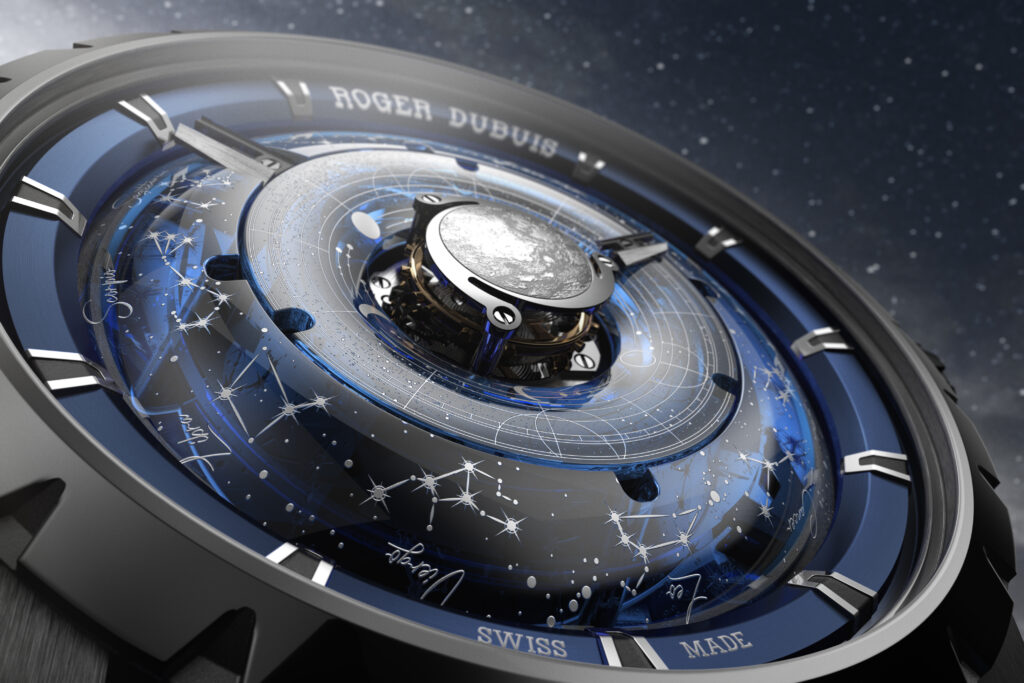
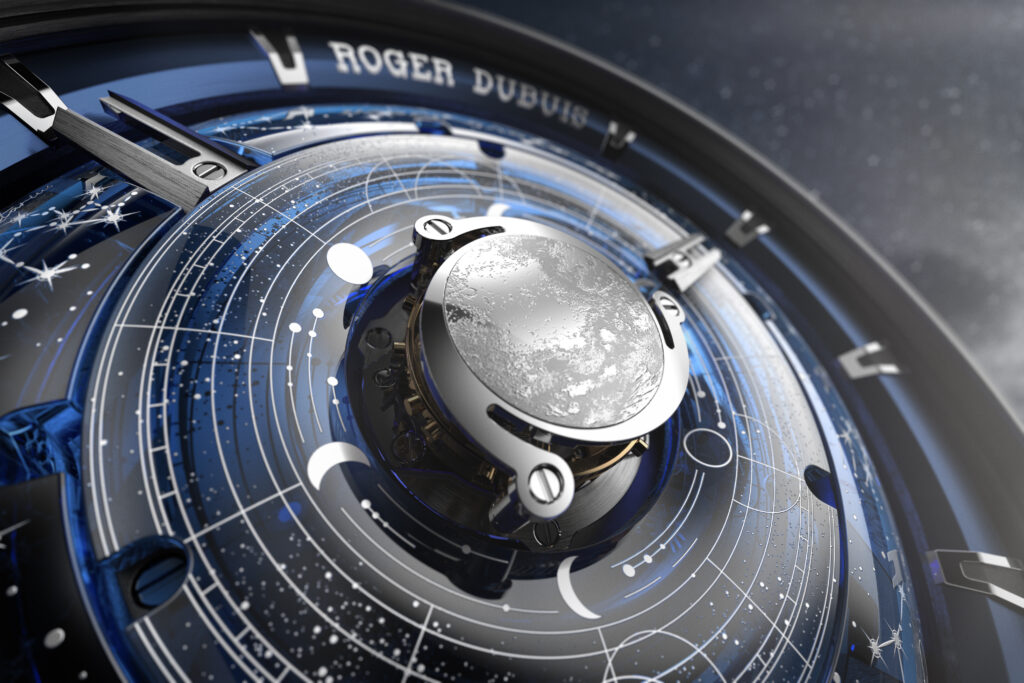
The distinctive feature of this design is the central tourbillon. By placing the regulating organ at the center of the movement, Roger Dubuis eliminates the space traditionally reserved for the hands. The hours and minutes are therefore displayed by two rotating discs mounted around the tourbillon. This design has led to two patent applications: the first concerns a planetary gear train with a differential, designed to conserve energy between the barrel and the tourbillon cage; the second relates to the time-setting mechanism, featuring a push-button-controlled clip disengagement system that allows the display discs to be released and then reconnected.
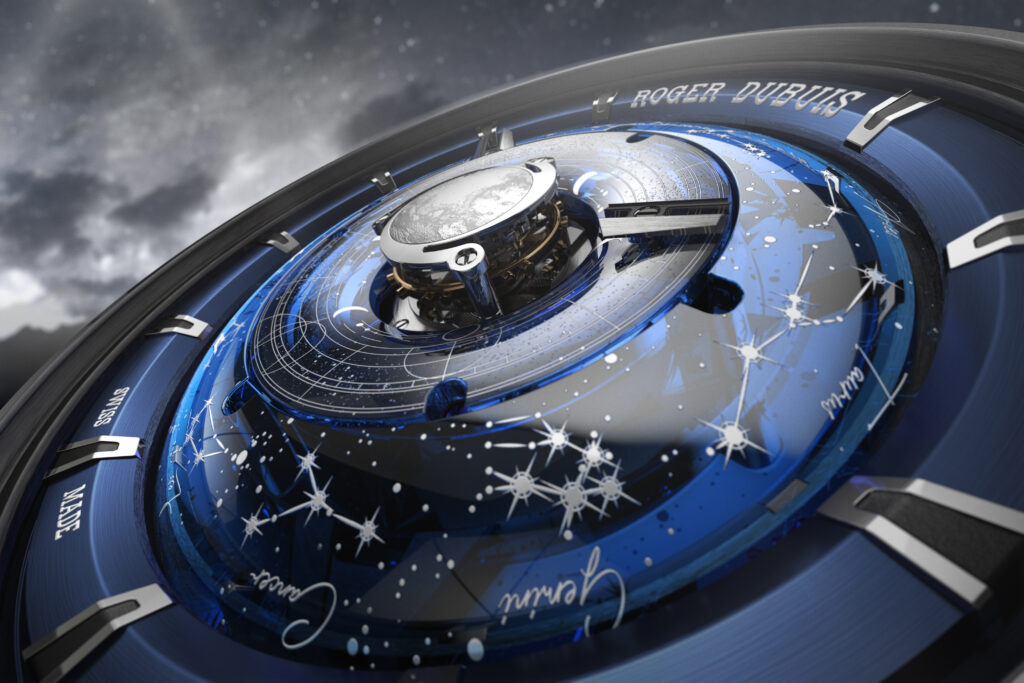
The dial reads like a stratigraphic cross-section. On the first level, a blue CVD-coated brass flange features applied rhodium-plated hour markers filled with black Super-LumiNova®. On the second level, the hour disc is crafted from translucent blue Murano-style glass and features the twelve zodiac constellations, their names painted in luminescent material. On the third level, the minute disc is made of the same material and features astral motifs, including a luminescent representation of the moon phases. Finally, at the center, an engraved appliqué reproducing the texture of the lunar surface is positioned on the cage of the one-minute tourbillon, which rotates in time with the seconds.
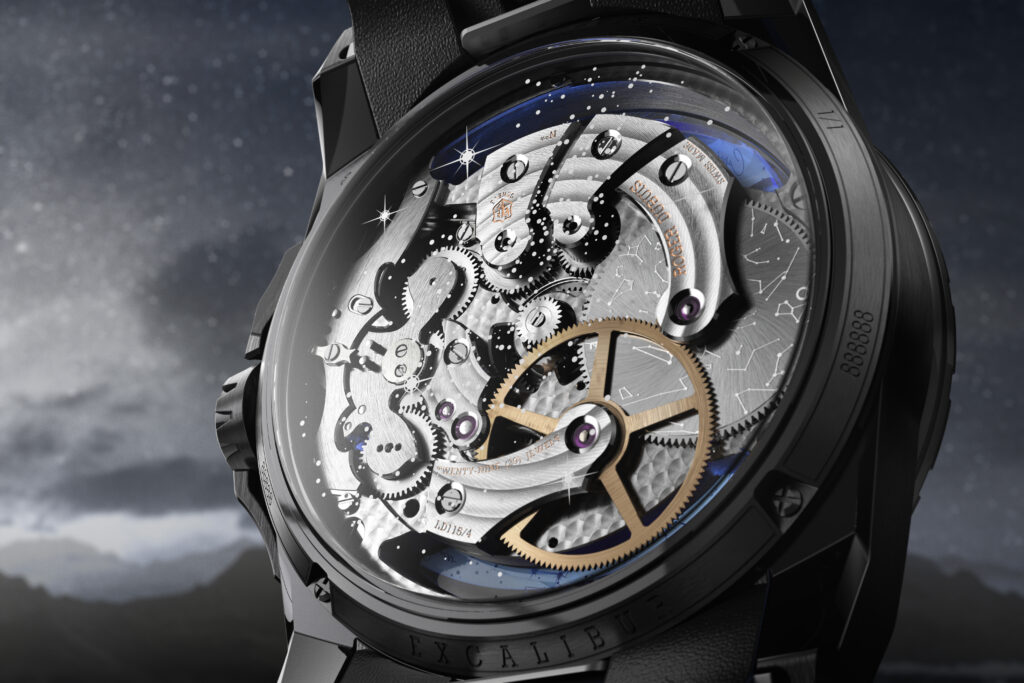
The back continues this design, but with a more intimate touch. The translucent sapphire crystal is laser-engraved with a multitude of dots inspired by the Milky Way. Each indentation is filled by hand with luminescent material. On the barrel cover, the constellations can be positioned according to calendar parameters specific to the owner, such as the sky on their date of birth. Here, customization is not about choosing a color; it is about incorporating a personal map into the movement.
This approach echoes a long-standing tension in watchmaking: measuring time while linking it to a vision of the heavens. Moon phases, perpetual calendars, celestial charts, and equations of time have always served as a reminder that a watch is not merely an instrument of punctuality. It is also an attempt to miniaturize a cosmic order. The Excalibur Moonlight does not seek the classic sobriety of an observatory; it embraces a nocturnal, almost theatrical drama, yet the watch’s appeal lies in the harmony between its display, movement, and design.
The finish of the movement is another point of interest. The dossier lists nineteen different finishes on visible and hidden components: perlage on the mainplate, drawn and beveled bridges, circular Côtes de Genève, graining on the wheels, satin-polished case band, and snail-patterned barrel drum. This accumulation could easily come across as showy; it makes more sense when viewed in the context of the Geneva Seal, a certification that remains tied to a specific vision of the Geneva movement, its origins, and its craftsmanship.
The Excalibur Moonlight is mounted on an interchangeable midnight blue calfskin strap with a three-blade folding clasp in black DLC-coated titanium. The choice of blue, black, translucent glass, and green luminescence places the timepiece in a constructed rather than romantic night. The sky becomes a device. The moon, a texture. The zodiac, a peripheral indicator. And the tourbillon, at the center, ceases to be a complication observed by a select few to become the physical axis around which the entire reading revolves.
In an industry where bespoke craftsmanship is often used to reinforce social exclusivity, Roger Dubuis employs it here as a laboratory for the language of watchmaking. This one-of-a-kind piece is not only rare because only one exists. It is rare because its mechanism requires a different way of reading the time: no longer on a surface, but in depth.


Cette publication est également disponible en :

