
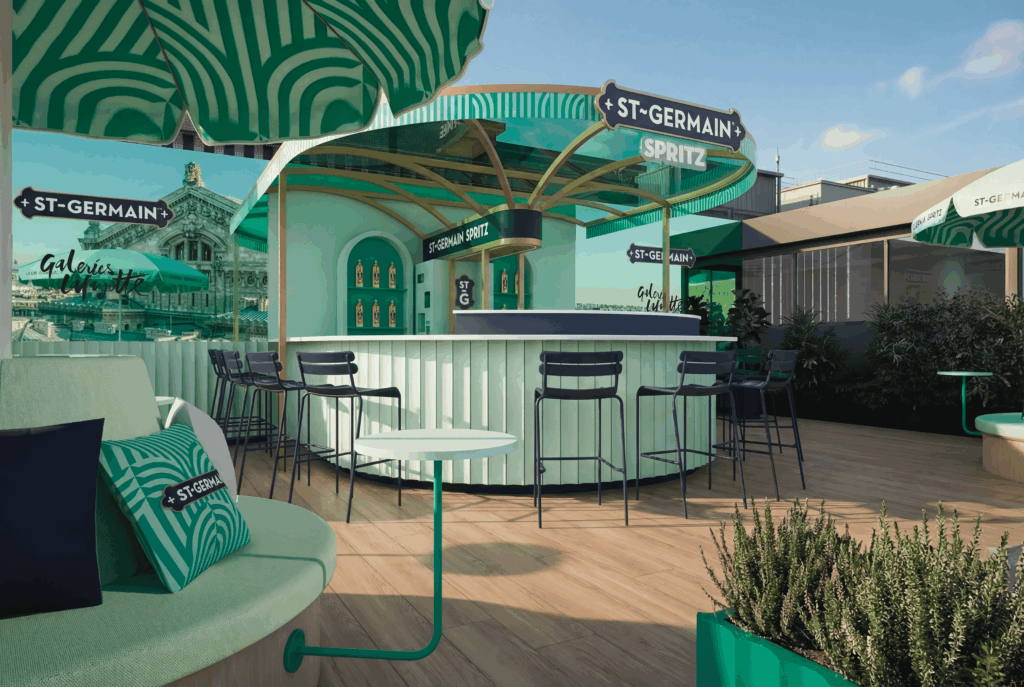
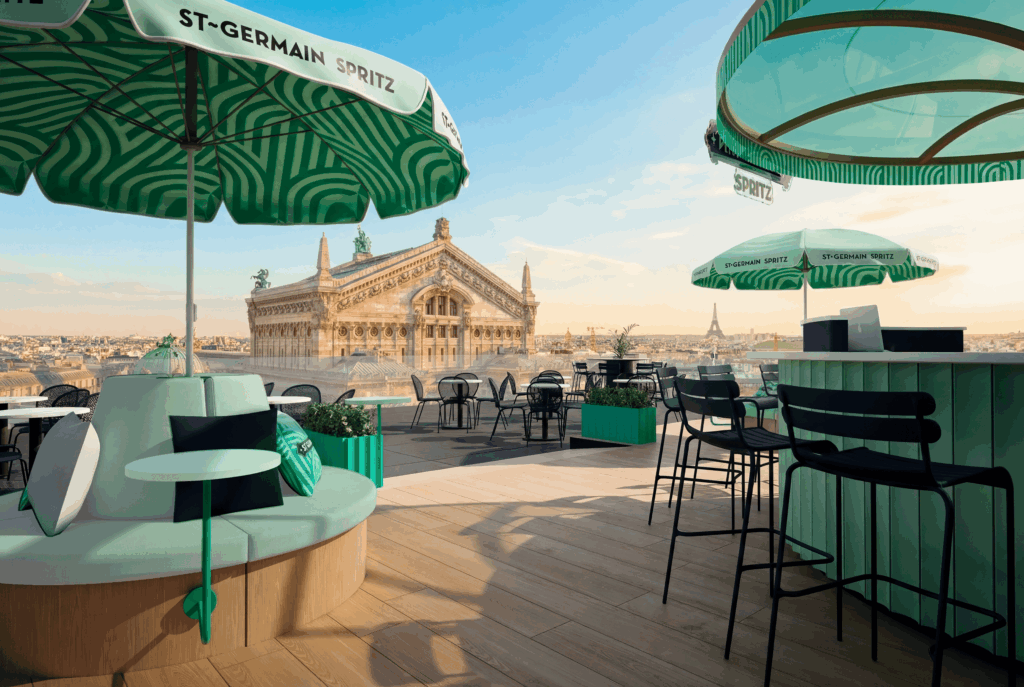
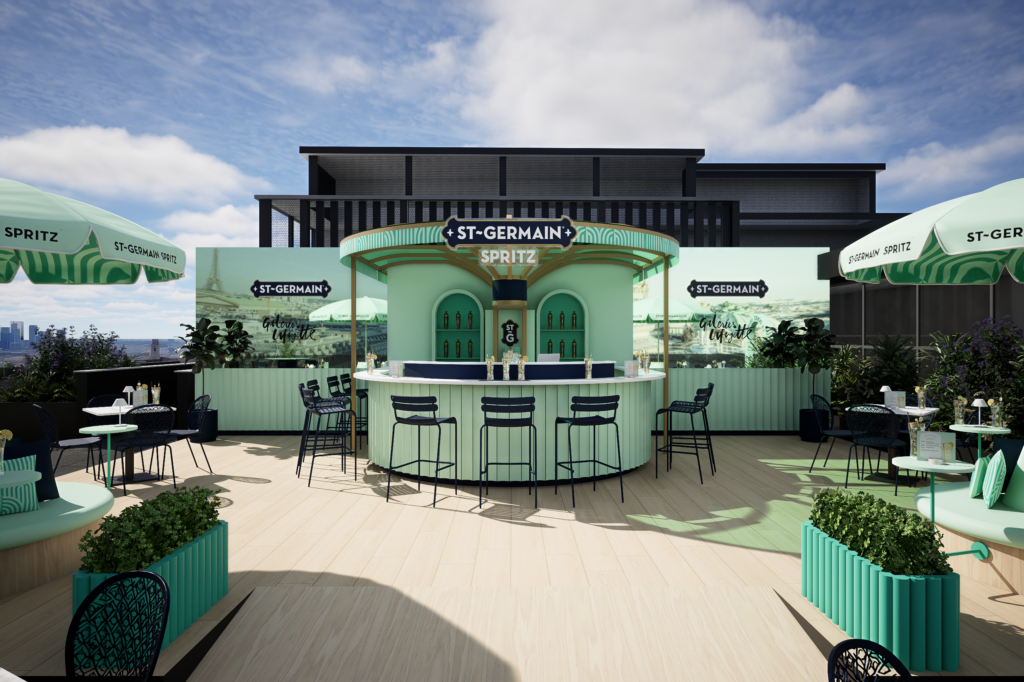
From June 18, St-Germain elderflower liqueur opens a seasonal bar on the 8th floor of Galeries Lafayette Paris Haussmann. Cyril Lignac signs the menu until September. This isn’t just another brand activation – it’s a topography.
Paris has become accustomed to its heights. Over the past few seasons, the rooftop has become a category in its own right in the geography of Paris – a hybrid format, somewhere between the perennial address and the ephemeral rendezvous, that forces each occupant to redefine what they mean by presence. St-Germain responds with La Douce Heure: a bar open from midday to midnight, every day, facing the Opéra Garnier, the Eiffel Tower and the Sacré-Coeur Basilica. Three monuments that don’t move, a cocktail that’s as much about its flower as its setting.
The liqueur is made from fresh, wild elderflowers, hand-picked and blended in France by a master distiller. This process – the hand-harvesting, the naturalness of the raw material, the artisanal blending – is what the dossier doesn’t say loud enough, but what the place ends up telling in spite of itself. When the brand belongs to the portfolio of a group headquartered in Bermuda, choosing the rooftop of a Parisian business landmark as the setting is no mean feat. It’s as much an affirmation of cultural belonging as of distribution.
The map as an argument
What sets La Douce Heure apart from an ordinary visibility operation is the food menu that Cyril Lignac has put together this season. The collaboration with the chef began in 2025 with a single appetizer, designed to accompany the St-Germain Spritz. The idea stuck. In 2026, it expanded into three shareable plates, available every evening from 6pm.
The principle is a rare logic in this type of partnership: each dish is named after an organoleptic characteristic of the liqueur. La Florale – crudités and tzatzíki sauce – plays on vegetable freshness. La Fraîcheur – sea bream crudo with elderberry, mimosa eggs, beef carpaccio, watermelon feta – makes elderberry a culinary thread, not just a liqueur name. La Douceur – a tropézienne accompanied by a peach-verbena salad – anchors the menu in the South of France, which Lignac readily cites as a land of rejuvenation. The menu is not built on what sells: it’s built on what the signature cocktail contains. That, in itself, is a chef’s decision.
What the roof says about the brand
Liqueur data
St-Germain is a French liqueur made from fresh, wild, hand-picked elderflowers. Assembled in France under the supervision of a master distiller, it has been part of the Bacardi Limited portfolio for several years. The brand has won awards in the spirits industry and is one of the most referenced cocktail ingredients of the last decade, according to industry professionals. Access: 25 rue de la Chaussée d’Antin, 75009 Paris – 8th floor – from midday to midnight.
The Galeries Lafayette terrace is a special place: not a confidential rooftop like the ones being invented above Paris in inner courtyards or former workshops, but one of the capital’s most photographed panoramas, accessible to anyone who pushes open the doors of one of Europe’s busiest department stores. Choosing this location for a seasonal bar means assuming maximum exposure. For a liqueur whose worldwide distribution relies precisely on its ability to be integrated into any cocktail, the location makes sense: St-Germain isn’t looking for rarity, it’s looking for relevance.
The elderflower ice creams offered from midday onwards extend the day of use beyond the aperitif. The narrowest window – Lignac’s three sharing plates – doesn’t open until 6pm. This temporal gradation, from the consumable in full sun to the evening meal, builds an occupation of the place that goes beyond the simple cocktail terrace.
What Paris is building, season after season, on its rooftops, is a cartography of cultural presence. Some plant a flag. St-Germain plants a flower. The nuance is in the gesture.
Cette publication est également disponible en :

