
Three dissonant seasons. A winter saturated with humidity, an unstable spring punctuated by frosts, then a dry summer that concentrated sugars as much as it weakened the berries. The 2016 vintage in Champagne is not a harmonious story, but a series of constraints. It is precisely in this tension that Moët & Chandon has created its two Grand Vintage cuvées.
Since 1842, the Grand Vintage collection has been based on a simple principle: a single year, interpreted by the Cellar Master. The exercise involves not so much a search for consistency as a trade-off. In 2016, this arbitration is based on the heterogeneous maturity of the grapes and the losses due to weather conditions.
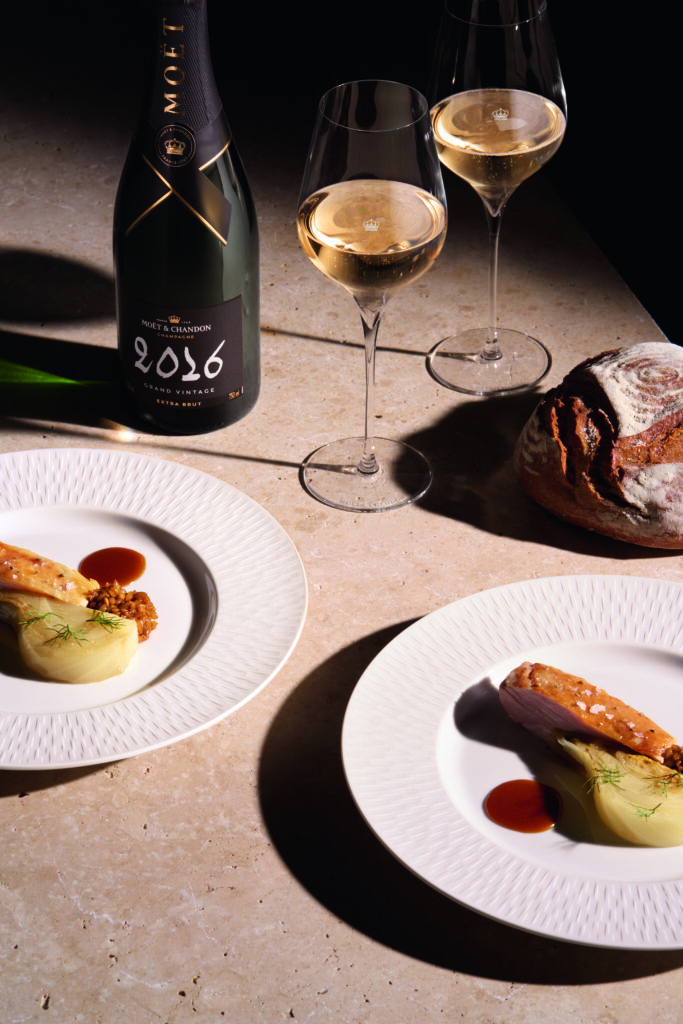
Grand Vintage 2016 white is organized around a blend dominated by Chardonnay (48%), complemented by Pinot Noir (34%) and Meunier (18%). This choice structures the cuvée: Chardonnay provides the acid backbone in a year when drought could have led to broader profiles. Pinot Noir and Meunier, better adapted to the ripening conditions of 2016, support the density.
Vinification takes a long time: six years of maturation in the cellar, then a minimum of six months after disgorging. The dosage, set at five grams per liter, classifies the cuvée as Extra Brut, which accentuates the direct reading of the wine – without any noticeable correction by sugar.
The aromatic profile, often abundantly described in files, can be read differently here: a classic progression of wines that have undergone prolonged lees ageing. First notes from the Maillard reaction (toast, cereals), then more evolved registers (marzipan, barley sugar), finally stone fruits and floral compounds. This stratification reflects less a sensory promise than a mechanical effect of time and controlled oxygenation.
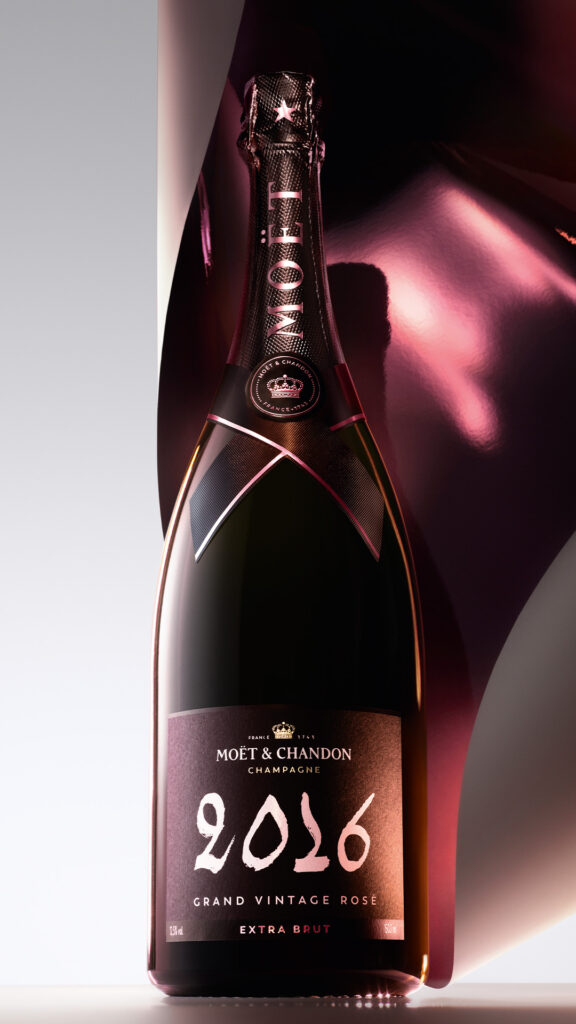
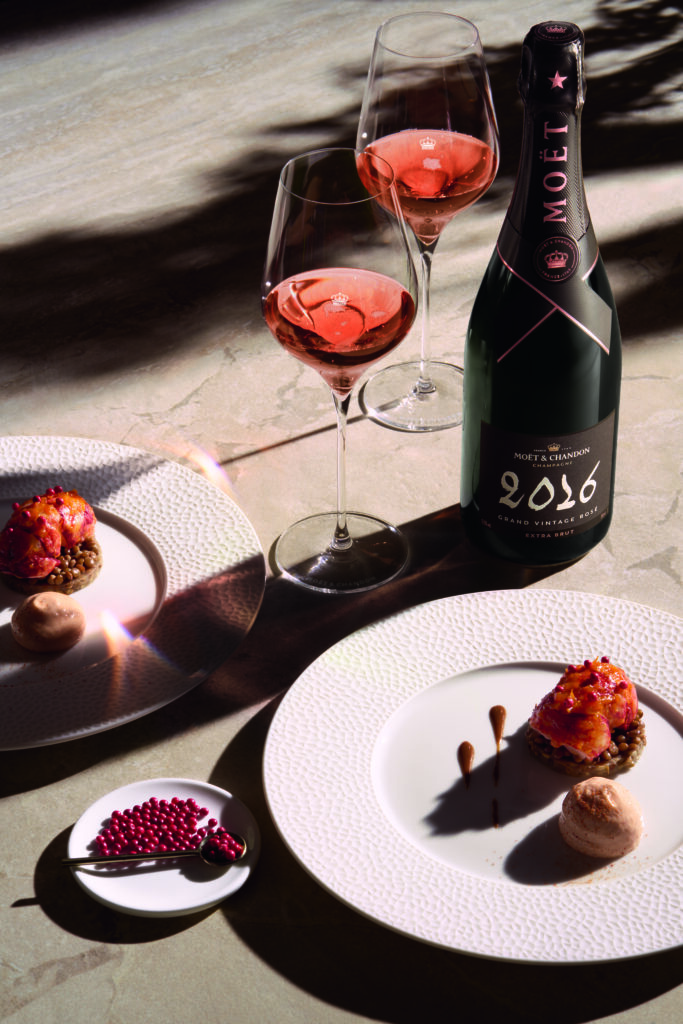
In contrast, Grand Vintage Rosé 2016 adopts a different architecture. Pinot Noir accounts for 43% of the blend, 13% of which is vinified as red wine, to which are added 42% Chardonnay and 15% Meunier. The introduction of red wine modifies the texture: it brings a light tannic structure and a more direct reading of the fruit.
The rosé thus favors immediate perception, driven by ripe red fruit – strawberry, raspberry, blueberry – complemented by floral and spicy notes. Here again, the same dosage (5 g/l) maintains a certain tension, avoiding the pitfall of an overly demonstrative rosé.
Detail
- Vintage: 2016
- Maturation: 6 years in the cellar + ≥ 6 months post-disgorgement
- Dosage: 5 g/l (Extra Brut)
- White blend: 48% Chardonnay, 34% Pinot Noir, 18% Meunier
- Rosé blend: 43% Pinot Noir (including 13% red wine), 42% Chardonnay, 15% Meunier
This double vintage reveals contrasting interpretations of the same year. On the one hand, a construction focused on tension and staying power; on the other, a more immediate approach, structured by fruit and a slightly softer body. Two technical responses to the same climatic problem.
One constant remains: the desire to see each vintage as a variation rather than a standard. In a market dominated by reproducibility, this approach maintains a form of uncertainty – and therefore, paradoxically, interest.
Cette publication est également disponible en :

