
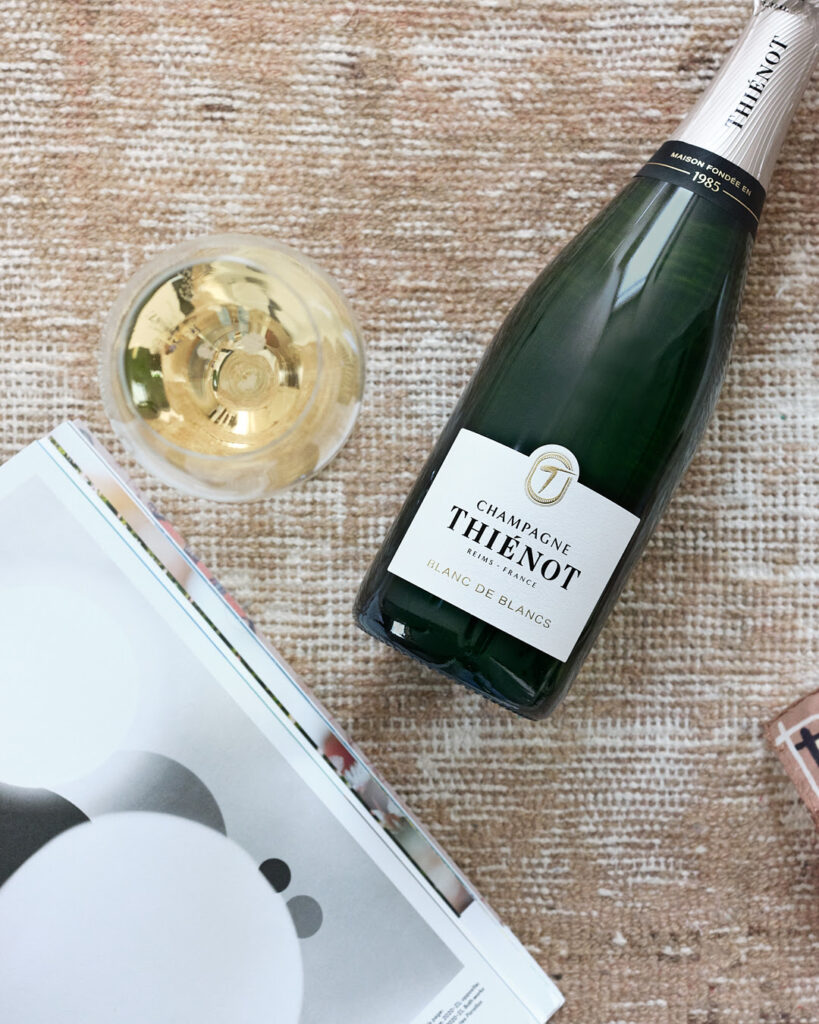
In the glass, everything begins with light. Not the expected light of suspended bubbles, but an almost razor-sharp clarity with emerald reflections. This detail, often relegated to sensory description, nevertheless says the essential: here, Chardonnay is not rounded, it’s taut.
Maison Thiénot’s Blanc de Blancs cuvée is in keeping with this Champagne tradition, where a single grape variety becomes a writing tool. One hundred percent Chardonnay, mostly from the Côte des Blancs, it conjures up a territory whose chalk is not a metaphor but a geological reality. This friable, porous chalk acts as a hydric and thermal reserve. It slows down, regulates and constrains the vines. The wine born of it retains this imprint: a verticality, an almost saline tension.
But it doesn’t stop there. The blend introduces Chardonnays from Vitryat and Montagne de Reims, notably Trépail and Villers-Marmery. Areas less systematically associated with Blanc de Blancs, but which provide a counterpoint here. Where the Côte des Blancs imposes the line, these terroirs add a more supple substance, a form of roundness right from the attack.
This balancing act is repeated on tasting. The nose opens with clean citrus fruits, led by lemon, followed by a mineral sensation reminiscent of fresh chalk – not an abstraction, but a dry, almost dusty odor. On the palate, the attack is direct. The effervescence doesn’t overwhelm, but accompanies. It remains fine, dynamic, without excessive pressure. The finish lingers on an impression of persistent purity, as if the wine were trying to disappear behind its structure.
This positioning says something about the current climate in Champagne. Over the last fifteen years or so, a number of houses – both historic and more recent – have been moving away from woody or demonstrative profiles to return to more legible expressions of terroir. Blanc de Blancs has become a privileged area for experimentation. Not to seduce immediately, but to build a relationship over time, especially at the table.
The gastronomic dimension, often evoked but rarely analyzed, takes on a concrete meaning here. The suggested pairings – gougères, fish, citrus desserts – are not merely decorative. They follow the logic of the wine: measured fatness, structuring acidity, precise aromas. Pearly cod or grilled salmon, enhanced by a lemony oil, work not by contrast but by continuity.
Behind this cuvée lies a relatively recent history in the Champagne landscape. Founded in 1985 by Alain Thiénot, the company was built on a detailed knowledge of winegrower networks and the gradual acquisition of plots of land. This approach is less patrimonial than strategic, and goes some way to explaining the freedom of the blends. Today, the next generation – Garance and Stanislas Thiénot – continues this logic, while developing a wine tourism dimension in Reims, with the opening of a dedicated venue and, eventually, a five-star hotel.
In this context, Blanc de Blancs acts as a positioning piece. Not a demonstration of power, but an exercise in precision. A reminder that, in contemporary Champagne, the question is no longer one of style alone, but of legibility.
And that sometimes, freshness isn’t a feeling. It’s a construction.
Cette publication est également disponible en :

