
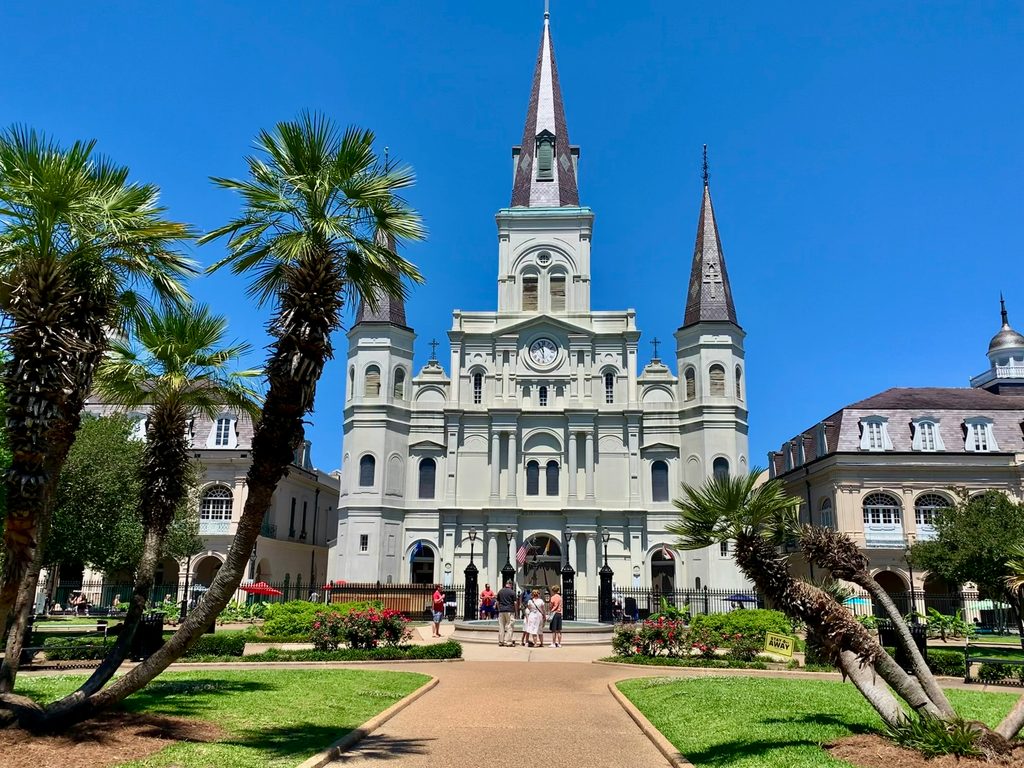
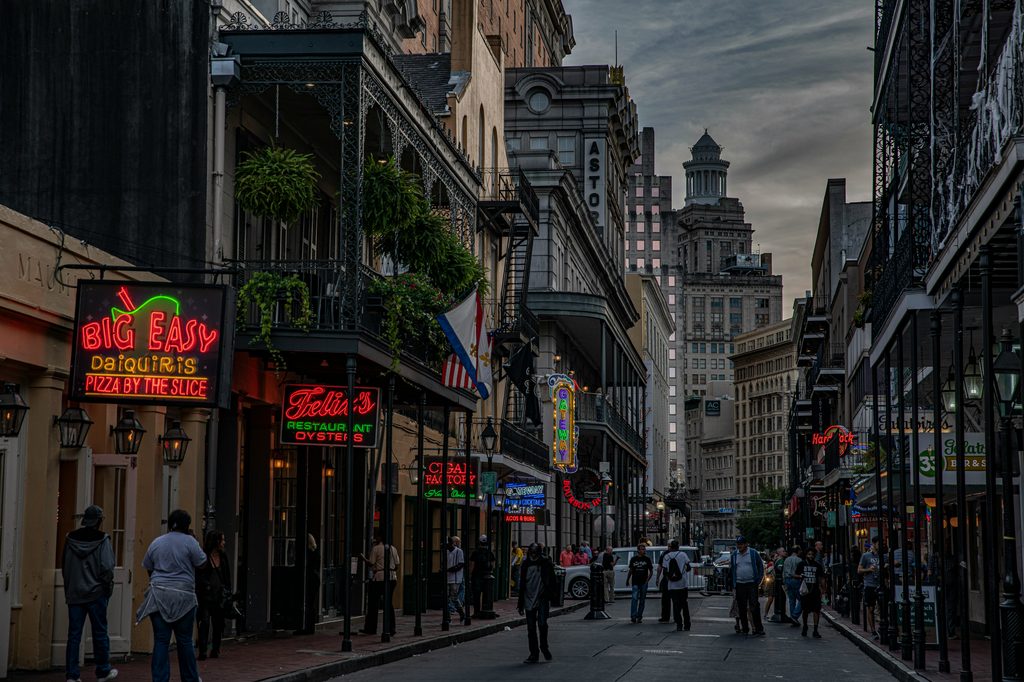
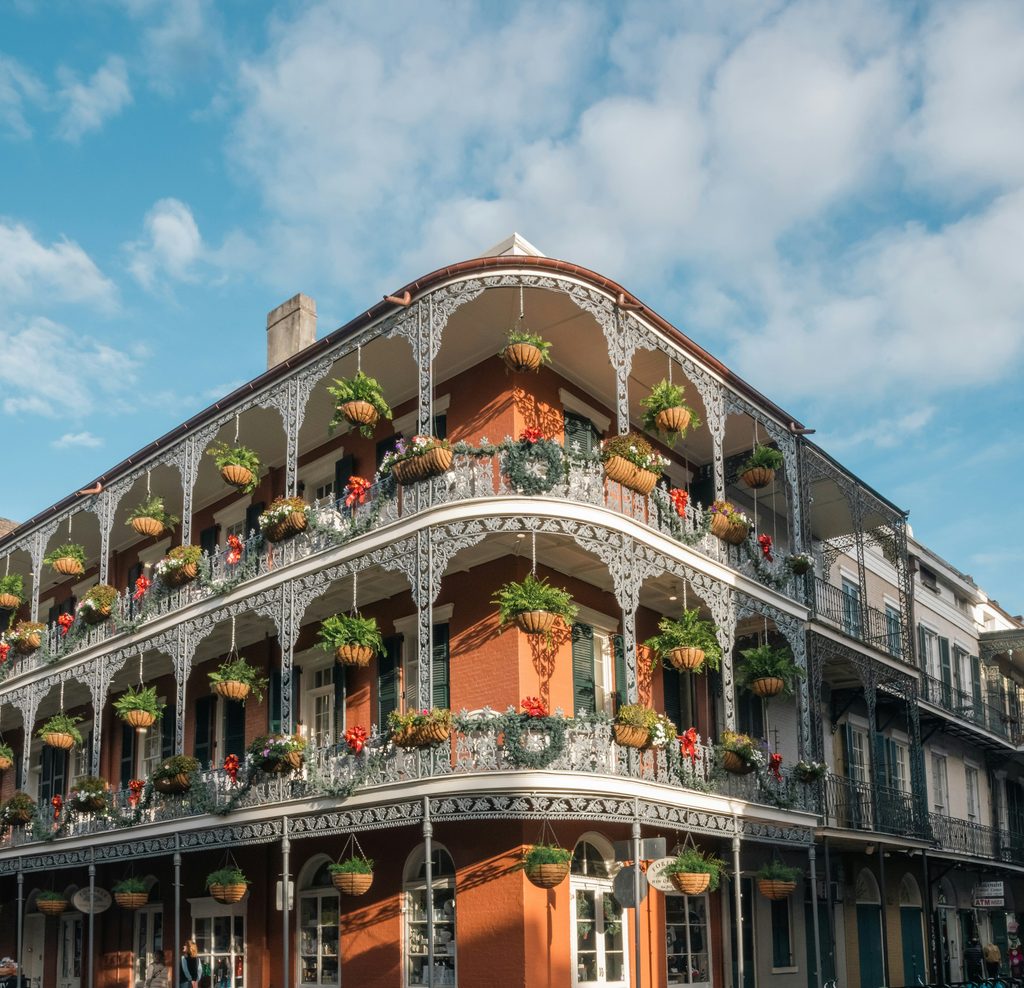
The most photographed neighbourhood in the United States bears a name that misleads. The Vieux Carré, which guidebooks also call the French Quarter, owes most of its architecture to the Spanish, not the French. Two fires, in 1788 and then 1794, destroyed much of the colonial timber buildings. It was the Spanish authorities who rebuilt in brick and stucco, adding covered galleries, pointed-arch windows and wrought-iron balconies — the décor that the whole world now associates, wrongly, with the city’s French heritage.
This founding confusion says something more general about New Orleans: its architecture never tells a single story. It piles up regimes, migrations and power relations, and leaves them visible instead of smoothing them over. Walking through its neighbourhoods is reading an urban stratigraphy in the open air.
Around Jackson Square, three buildings concentrate this official memory: St. Louis Cathedral, the Presbytère, and the Cabildo, where the transfer of Louisiana to the United States was signed in 1803. The surrounding streets also shelter single-storey Creole cottages, with steeply pitched roofs and ochre or celadon-green façades — a vocabulary inherited from the Caribbean and French Canada more than from the mother country. Lafitte’s Blacksmith Shop Bar, one of the few eighteenth-century buildings still standing in the city, still serves drinks within the same walls that have come through both fires and two centuries of renovations.
A few streets away, beyond Louis Armstrong Park, the Faubourg Tremé changes register. It is the oldest African American neighbourhood in the United States, and the place where jazz took shape. Its architecture is more modest than that of the Vieux Carré, but it carries an equivalent historical weight: Ursulines Avenue links St. Augustine Church to the Backstreet Cultural Museum, and Dooky Chase’s Restaurant has received there, over several generations, artists and figures of the civil rights movement. The built fabric here does not display wealth. It documents a cultural continuity that few American cities can claim within so small a territory.
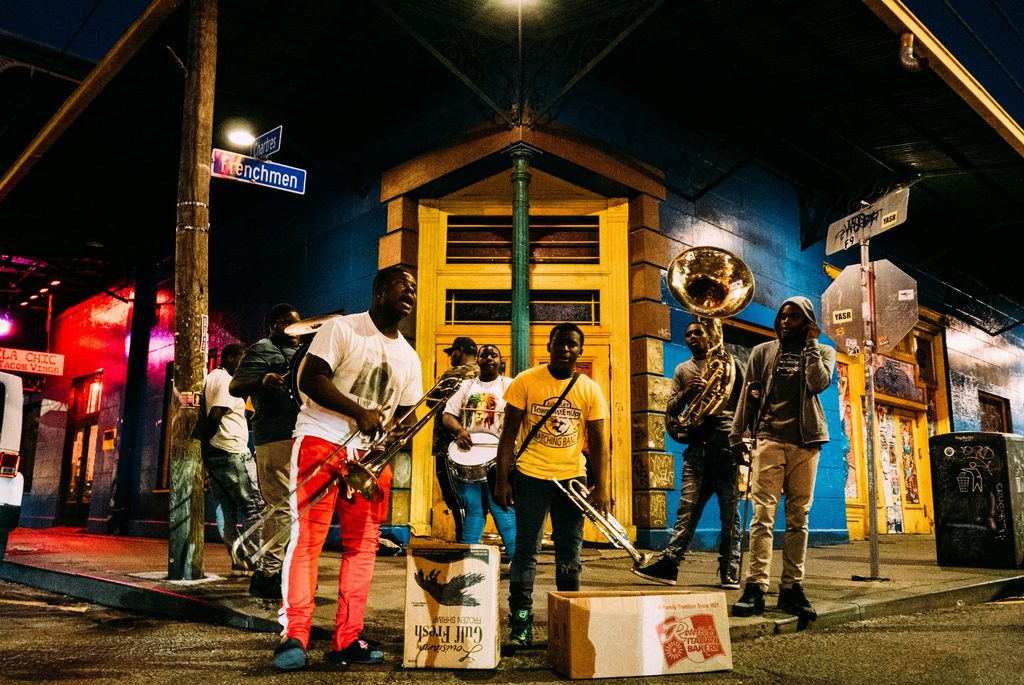
Faubourg Marigny and Bywater, more residential, extend this popular vein with shotgun houses: narrow houses, one room after another, from the street to the garden, with no hallway. The plan is economical, designed for small plots, and it ended up becoming a visual signature of the city, taken up and recoloured by several generations of residents. Creole townhouses complete this landscape: narrow façades, wrought-iron galleries, two to four floors that once housed a shop on the ground floor and living quarters above. The LaBranche House, with its balconies of oak-leaf motifs, remains the reference of the type. In the evening, Frenchmen Street takes over with its clubs — Snug Harbor, The Spotted Cat, Café Negril — where music keeps spilling out into the street, as it has for a century.
The sharpest contrast is seen in the Garden District. After the Louisiana Purchase, newly enriched Americans refused to settle in the historic Creole neighbourhoods and founded their own suburbs, apart. The result, now designated a national historic landmark, is a collection of Greek Revival and Italianate residences: white columns, enclosed gardens, wrought-iron railings — an architecture designed less to house than to display the success of planter and merchant families. The contrast with Tremé, a few kilometres away, is the best key to reading the city: two neighbourhoods, two architectures, two definitions of power.
St. Charles Avenue, along eight kilometres lined with centuries-old oaks, is the thread that links these worlds. For a hundred and fifty years, the St. Charles Streetcar has run there without interruption — the oldest tram line in the world in continuous operation. It is not an attraction restored for tourists: it is a means of transport still in use, which passes the neo-Gothic façades of Loyola and Tulane before running alongside Audubon Park. A few discreet addresses — Sully Mansion, Columns, the Grand Victorian Bed & Breakfast — allow one to stay there without leaving this perspective. The area also remains one of the preferred vantage points for Mardi Gras or for the Crescent City Blues & BBQ Festival.
Other neighbourhoods, Algiers Point, Lakeview, Mid-City or the Warehouse Arts District, extend this same logic of stylistic fragmentation without ever repeating it identically. What strikes you on arrival is not the diversity of styles in itself — many cities have as many. It is that in New Orleans, this diversity was not harmonised after the fact. The city never chose a single narrative for its architecture, and that is precisely what makes it legible: each neighbourhood remains the confession of an era, unretouched.
The St. Charles Streetcar has run without interruption for a hundred and fifty years on an eight-kilometre line: it is the oldest tram in the world still in service, and not a tourist reconstruction.
Also on Luxsure: Refined getaways around New Orleans: between bayous, plantations and…
Cette publication est également disponible en :


