
Twenty years ago, the puffer jacket belonged to the wardrobe of mountains and building sites. Today, you see it on an RER platform as readily as in a hotel lobby, over a suit or a sweatshirt. This shift owes much to luxury houses, which took a purely technical garment and treated it like a piece of tailoring. To face cold mornings without sacrificing style, the season’s men’s puffer jackets slip just as easily over a knitted sweater as over a shirt, provided you choose the right cut and filling.
Where does the puffer jacket come from, and why did luxury embrace it?
The story begins with necessity. In the mid-20th century, quilted jackets equipped mountaineers and outdoor workers for one reason alone: to trap warm air close to the body. Moncler, founded in the Alps in 1952, made this its signature. For a long time, the silhouette was that of a sleeping bag with sleeves.
The turning point came when designers realised that volume could be shaped. Prada brought technical nylon into luxury ready-to-wear, Loro Piana applied its wool and cashmere expertise to the puffer jacket, and others reduced the stitching, refined the shoulders and lengthened the line. The garment did not lose its function. It gained a silhouette.
Which cut should you choose for a puffer jacket that does not make you look bulky?
This is the question that matters most, and the answer comes down to one word: proportion. A puffer jacket that is too roomy and too long overwhelms a man of average height. One that is too fitted compresses the filling and loses warmth, since it is the air trapped between the fibres that provides insulation.
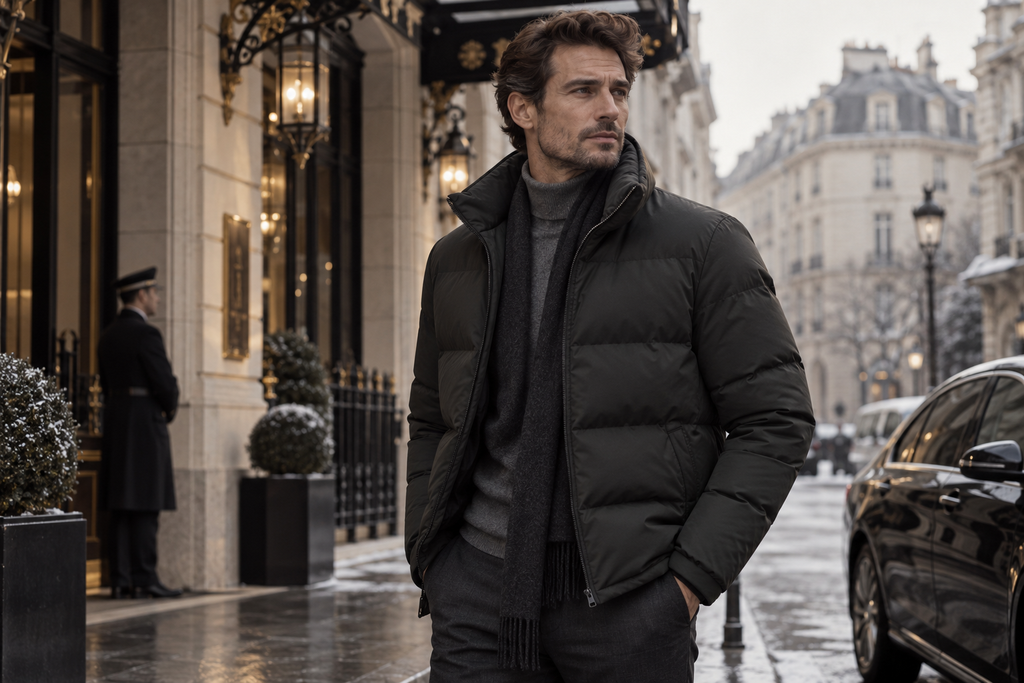
A few simple pointers. The shoulder should sit in the right place, without drooping. The ideal length ends at the hip or just below the belt, avoiding the duvet-coat effect. Wide horizontal stitching gives a sporty look; finer, more closely spaced stitching works better with office clothes. Finally, the collar matters: a stand collar, perhaps with an unobtrusive hood, protects the back of the neck without adding bulk.
Down, synthetics, wool… what does the filling really contain?
The filling provides warmth, and down remains the benchmark for the weight-to-insulation ratio. The higher its fill power, the more air it traps at a low weight. Labels often specify the proportion of down to feathers, with a predominantly down filling being lighter and warmer than a feather-heavy mix.
Synthetic filling has its supporters, especially for damp winters. It handles water better, dries faster and suits vegetarians. It is a little less compact and a little less light, but the difference narrows each season. The lining, meanwhile, plays a discreet yet decisive role: a smooth fabric makes the jacket easy to pull on over knitwear, whereas a rough lining catches the fibres.
How should you wear a puffer jacket in town, at the office and at weekends?
The golden rule is to let the puffer jacket be the sporty piece in the outfit and choose everything else accordingly.
In town. A black or navy puffer jacket with no conspicuous logo, over a merino wool crew-neck sweater, raw denim jeans and boots. It is a formula that never goes out of style.
At the office. Choose a thin version without a hood that fits under a coat or can be worn on its own over a shirt and cool wool trousers. Layering does the work, with fine knitwear under the shirt and the puffer jacket as the outermost layer. Avoid bright colours and shiny finishes.
At weekends. Here, you can have fun. A hooded puffer jacket in an earthy shade, khaki or camel, a sweatshirt, chinos and leather trainers. A casual outfit gains depth through contrasting materials: matte nylon against thick cotton.
As for trends, the season favours muted shades (olive, chocolate, charcoal grey), slightly cleaner volumes than before and lightweight waterproof fabrics, for a puffer jacket that handles drizzle without looking like expedition gear. Retailers such as Celio also offer these more understated cuts, accessible to those who want a well-cut garment without making it a seasonal investment.
Which materials should you favour when it is really cold?
Under the puffer jacket, it is all about layers. Wool, especially merino wool, regulates temperature and feels comfortable against the skin. Cotton on its own retains moisture and quickly becomes cold when you sweat. Finer wool-and-silk blends suit those who dislike thick collars.
For the outer layer, tightly woven nylon or polyester blocks the wind, and a water-repellent treatment prevents rain from seeping into the seams. What you gain in protection can sometimes be lost in breathability, which is why a breathable middle layer, such as knitwear or a waistcoat, is better than a thick, impermeable sweater.
How do you care for a puffer jacket so that it lasts several winters?
Many men hesitate to wash their puffer jacket, which is a shame, because grease and perspiration flatten the filling. Read the label first. Generally, a low-temperature delicate cycle with a mild detergent and no fabric softener is enough.
The important step is drying. Dry it at a low temperature with two or three clean tennis balls in the drum to beat the down and restore its loft. Alternatively, dry it flat, shaking the jacket regularly. At the end of the season, store the puffer jacket on a wide hanger or in a breathable bag, never compressed under a pile of clothes, because filling flattened for months loses some of its volume.
So, what should you remember before buying?
A good puffer jacket is recognisable by three things: a cut that respects your build, a filling suited to your climate and an understated look that carries it through the seasons. Luxury has shown that technical clothing can be elegant. Everyone can decide how far to go with the details, but the piece that lasts is the one that does not try to draw attention.
Cette publication est également disponible en :


