
For a long time, watchmaking for women too often meant miniaturising codes conceived elsewhere. With two new interpretations of the Rendez-Vous, Jaeger-LeCoultre reminds us that a women’s watch can be conceived as an autonomous horological territory, where mechanics, jewellery and decorative crafts are in dialogue from the outset.
The subject is therefore not only the femininity these pieces display, but the way the Manufacture turns small size into a space of complexity.
Launched in 2012, the Rendez-Vous collection already answered a persistent anomaly: few mechanical watches were then designed exclusively for women’s wrists. Fourteen years later, Jaeger-LeCoultre extends this stance with two almost opposite propositions. The Rendez-Vous Jewellery Night & Day concentrates the spectacular expression of the Métiers Rares, while the Rendez-Vous Hour-Minute explores a form of technical and aesthetic restraint.
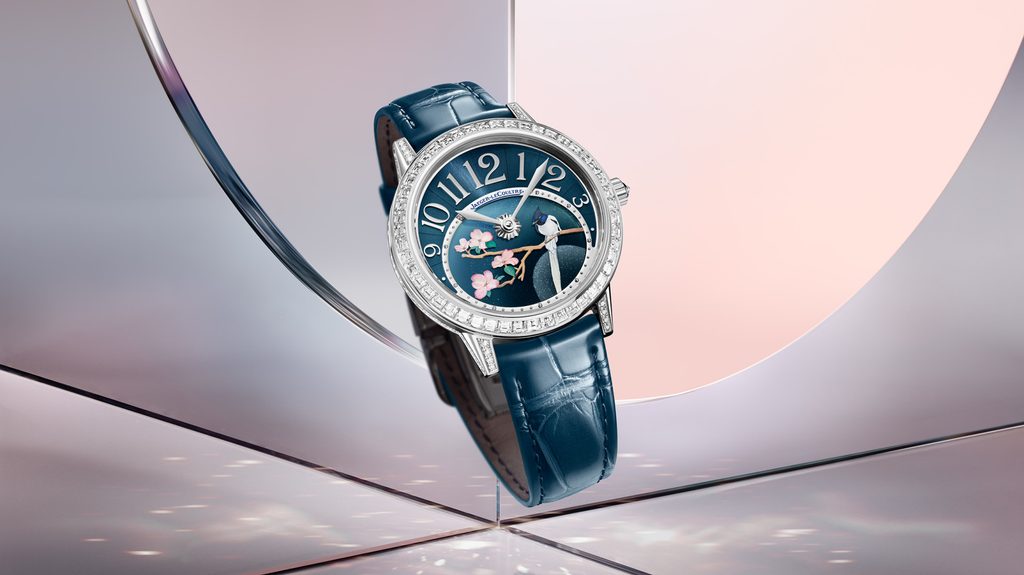
The first is limited to ten pieces. Its 950/1000 platinum case measures thirty-four millimetres and is set with forty-eight baguette-cut diamonds. The transparent sapphire dial is hand-painted using the miniature technique. It depicts an Asian paradise flycatcher perched on a branch of Korean dogwood. Beneath this scene, a disc completes one full rotation in twenty-four hours, revealing the Moon and the Sun in turn.
This choice is interesting because it reverses the usual hierarchy. The complication is not displayed as a self-standing technical argument; it acts from the background to change the perception of the image. The watch is thus read as a scene on several levels, where the movement of time silently transforms the landscape.
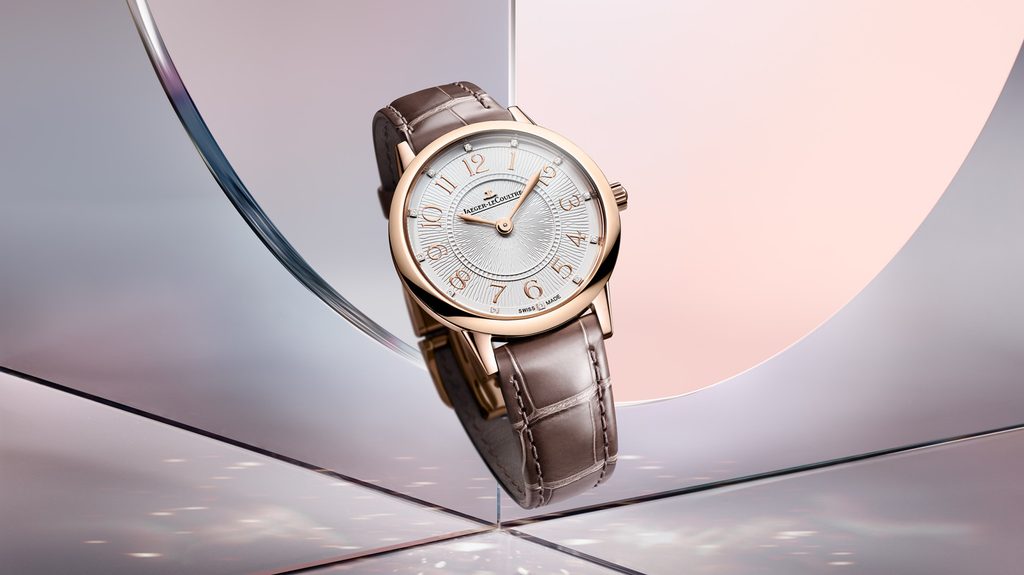
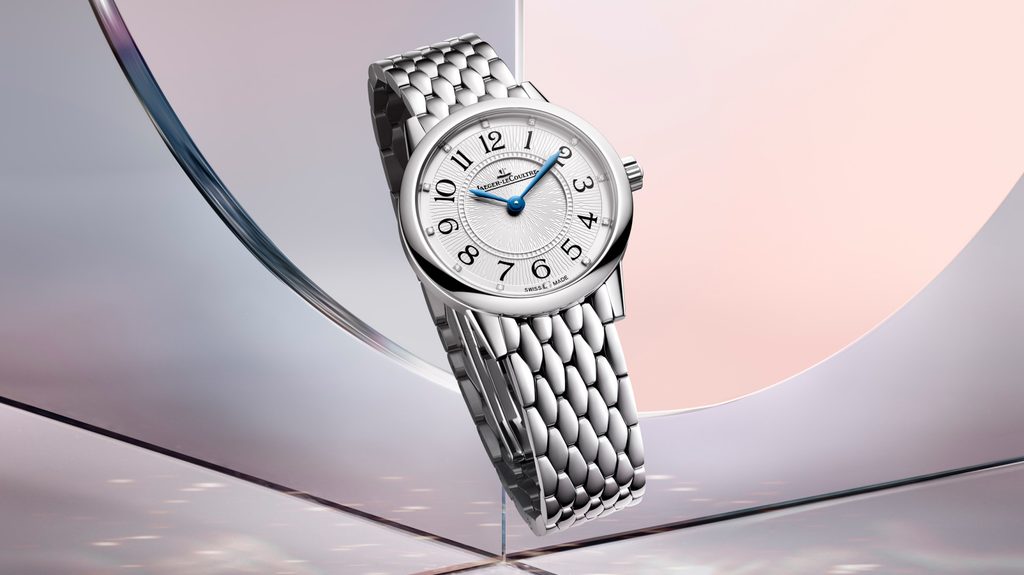
The second piece adopts a more discreet language. The Rendez-Vous Hour-Minute measures twenty-nine millimetres and only 7.47 millimetres in thickness, which makes it one of the thinnest watches in the collection. Offered in steel or 750/1000 rose gold, it combines a smooth bezel, an engraved caseback and a supple strap designed as a second skin.
Above all, these two objects show that the question of women in watchmaking can no longer be reduced to a matter of colour, diameter or setting. It involves a complete conception of the piece: its use, its mechanics, its relationship to jewellery, its legibility and its presence on the wrist.
The contrast between the two novelties is, in the end, their main interest. One asserts the narrative power of the Métiers Rares; the other demonstrates that a pared-back architecture can carry the same demands.
Cette publication est également disponible en :


