
For the fourth edition of its THE DENIM series, the G-STAR Manufacture entrusts the jean to Tommy Bogo, founder of the TOMBOGO studio. His gesture: transposing the logic of a technical boot harness onto five pockets, between utilitarian archives and panel construction.
A street observation as a starting point
THE DENIM 004 stems from a precise image, not a marketing brief: that of a person wearing harness boots, strapped with metal buckles. Tommy Bogo, founder of the California-based studio TOMBOGO, decides to transpose this system onto a jean rather than a shoe. The idea is not to decorate denim with military references, but to make an everyday garment function according to the same logic as technical equipment: straps, buckles, visible anchor points.
“For this project, I approached denim from a technical angle, with the aim of creating something new. Translating the idea of harness straps onto a jean felt like a natural way of bringing TOMBOGO’s creative language into denim, while echoing G-STAR’s heritage in utility and construction,” explains Tommy Bogo.
Archives as raw material
The designer did not work in a vacuum. A visit to the archives of G-STAR enriched the initial creative direction, in particular through the historic metal elements and utilitarian silhouettes that have shaped the identity of the Dutch Manufacture since 1989. It is this meeting of two vocabularies — the modular, technological aesthetic of TOMBOGO, born in Los Angeles in 2020, and the utilitarian heritage of G-STAR — that structures THE DENIM 004.
TOMBOGO has built a reputation on modular design systems and technological experimentation, from transformable clothing to connected accessories. For Tommy Bogo, denim represented a terrain still little explored by this vocabulary: a rigid material, historically tied to manual labour, to which he applies a construction grammar usually reserved for technical equipment.
A panel construction, conceived as a mechanism
The result is distinguished by a panel construction, held by systems of visible straps and buckles. The pockets are concealed beneath the outer layers rather than applied to the surface, and numerous metal elements punctuate the piece — not as decorative accessories, but as structural points of tension, in the manner of a functional harness.
This approach belongs to a broader trend in contemporary design, in which urban clothing borrows from outdoor and medical equipment its systems of adjustment and support. At TOMBOGO, this grammar is not an isolated aesthetic borrowing: it extends work begun since the studio’s launch around wearable systems and functional narrative.
The fourth chapter of a research into material
THE DENIM is not a one-off collaboration but a research series: after Ottolinger and then KNWLS, TOMBOGO becomes its third name, each invited to reinterpret the same jean through their own creative language. The principle has remained constant since 1989, the year G-STAR was founded: to make denim a platform for experimentation rather than a fixed product, an approach that has brought the Manufacture collaborations with figures as diverse as Pharrell Williams, Marc Newson or Snoop Dogg.
What these successive collaborations have in common is that none seeks to dress denim in the notoriety of its guest: each instead requires the jean to bend to a working method foreign to its history. Ottolinger brought a logic of drape and deconstruction to it; KNWLS, a tailoring vocabulary inherited from British military archive clothing. TOMBOGO in turn introduces an engineer’s reading: the garment as an assembly of mechanical parts rather than a surface to decorate.
What the harness says about functional clothing
The choice of the harness as a starting point is no accident. In the utilitarian wardrobe, this object has a precise function: distributing a load, holding equipment in motion, offering a fit that depends not on a single cut but on individual adjustment. By importing this principle onto a jean — a priori the most standardised piece in the contemporary wardrobe — TOMBOGO shifts a technical question onto an object that has, historically, never needed to resolve it.
This translation illustrates a broader trend observed for several seasons in fashion emerging from American streetwear culture: the pursuit of functionality as a sign of creative legitimacy, breaking with a purely ornamental logic. It joins, by another path, the approach G-STAR has claimed since its beginnings — making denim a material for technical research rather than a mere support for cut.
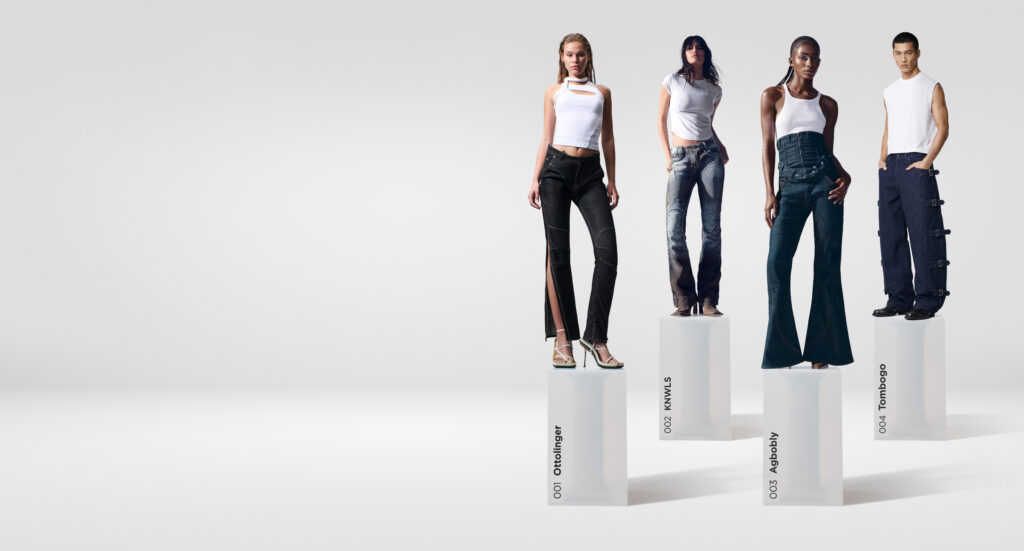












The piece combines a panel construction held by straps and metal buckles, pockets concealed beneath the outer layers, and multiple metal elements serving as structural points of tension — TOMBOGO’s industrial vocabulary grafted onto G-STAR’s utilitarian heritage.
THE DENIM 004 will be available worldwide on g-star.com and in a selection of G-STAR stores from September 2026. One question remains that the piece leaves open: if denim can absorb the grammar of the technical harness without losing its legibility as an everyday garment, which other material of the utilitarian wardrobe will the series’ next guests choose to make speak in turn?
Also on Luxsure: G-STAR FW26: Denim as industrial architecture · G-STAR x Marc Newson: twenty years of design reinvented · Magnus Carlsen defies the rules in denim: G-STAR signs a radical Autumn 2025 campaign
Cette publication est également disponible en :


