
Berluti returns to Italy through the door of a former convent
In Milan, on via Gesù, the Parisian House is installing its first boutique of a new kind — and doing so before Paris. A calendar detail that says a great deal about where its heart now beats.
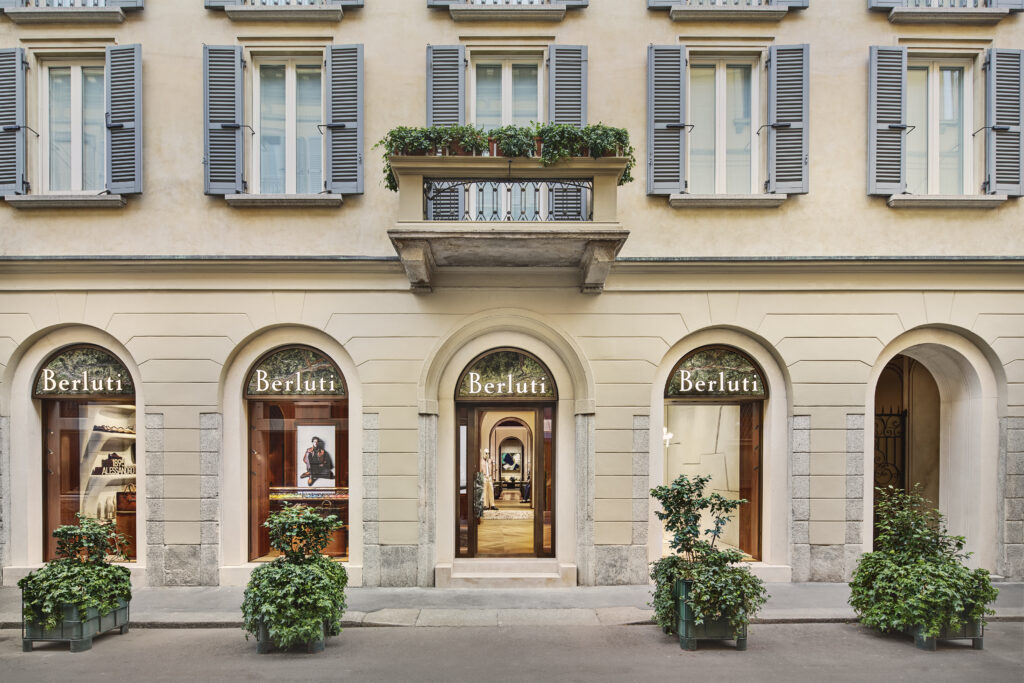
A French House choosing Milan, rather than Paris, to unveil its most accomplished boutique concept: the sequence is worth pausing over. Berluti, founded in Paris in 1895 and built by four generations of bootmakers, has just opened at 4 via Gesù, on the ground floor of the Four Seasons Hotel Milano, itself housed in a converted 15th-century religious building. The setting is not neutral. One enters Berluti’s new address as one would a former convent — through a threshold that has already known other forms of contemplation.
Italy as a return to its roots, not as a market
The official narrative insists on the House’s dual culture, and for once the formula matches the facts. The Berluti family originally came from the Marche, a region on the Adriatic coast, before founding its workshop in Paris at the end of the 19th century. The production centre is now located in Ferrara, where the Manifattura brings together more than two hundred and sixty artisans supplying some sixty boutiques worldwide. The elegance claims to be French; the hand remains Italian.
In this geography, opening in Milan before Paris ceases to be a communications flourish. Jean-Marc Mansvelt, Berluti’s chief executive, puts it bluntly: “Presenting our new European distribution concept here, in a space as significant and ambitious as this one, reflects the confidence we place in this market and in our Italian clients around the world.” The House is not settling on new ground; it is returning to the land of its origins, and claims this as a deliberate strategy rather than a one-off flourish.
A boutique conceived as an apartment
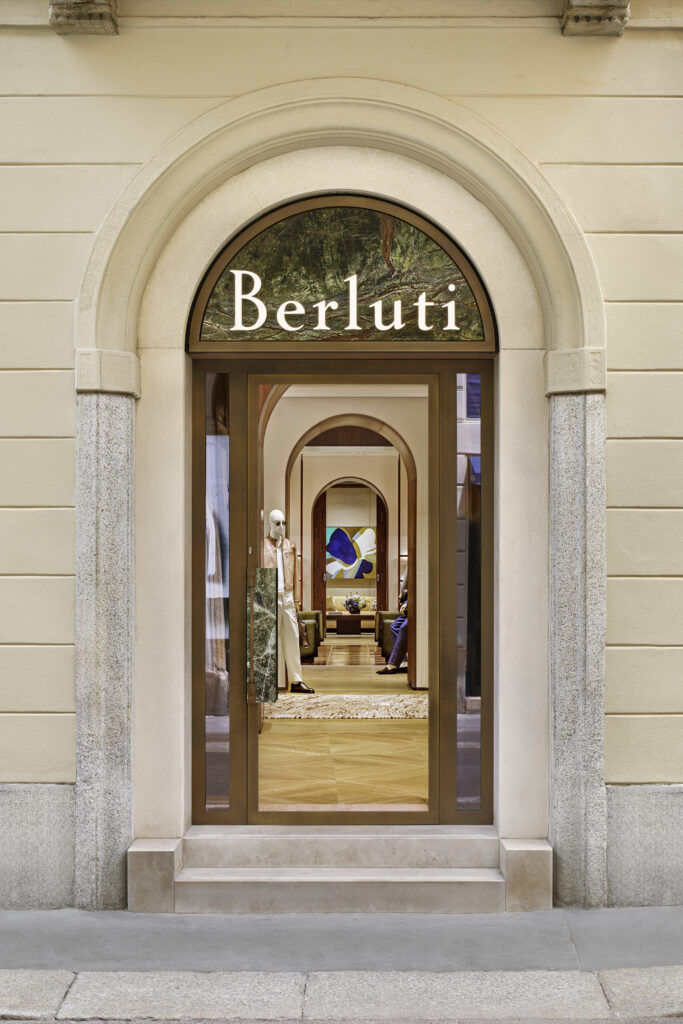
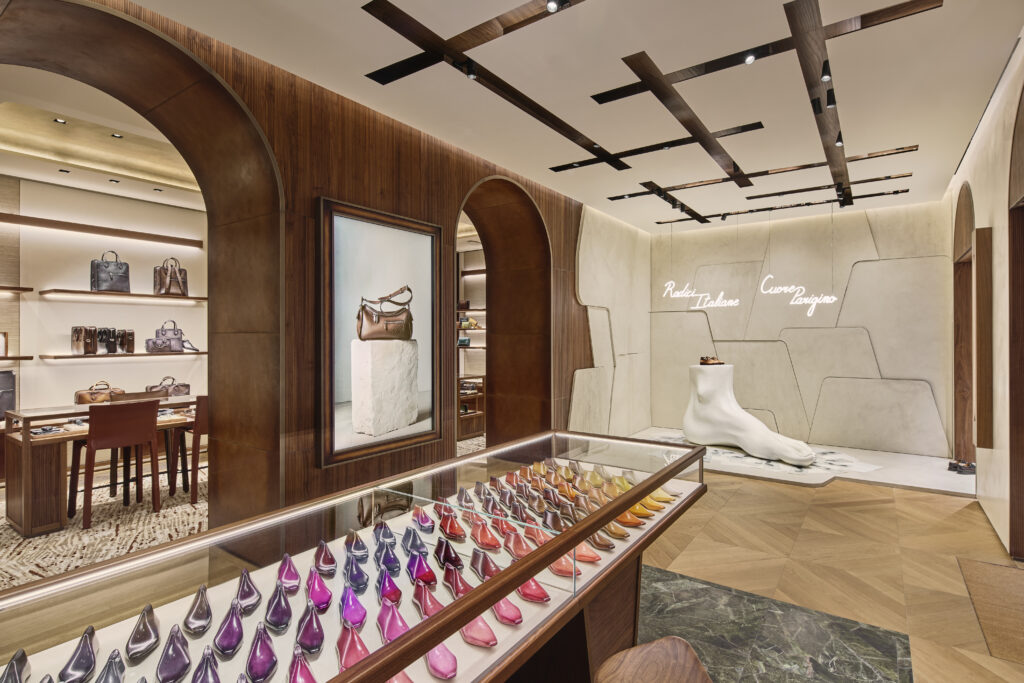
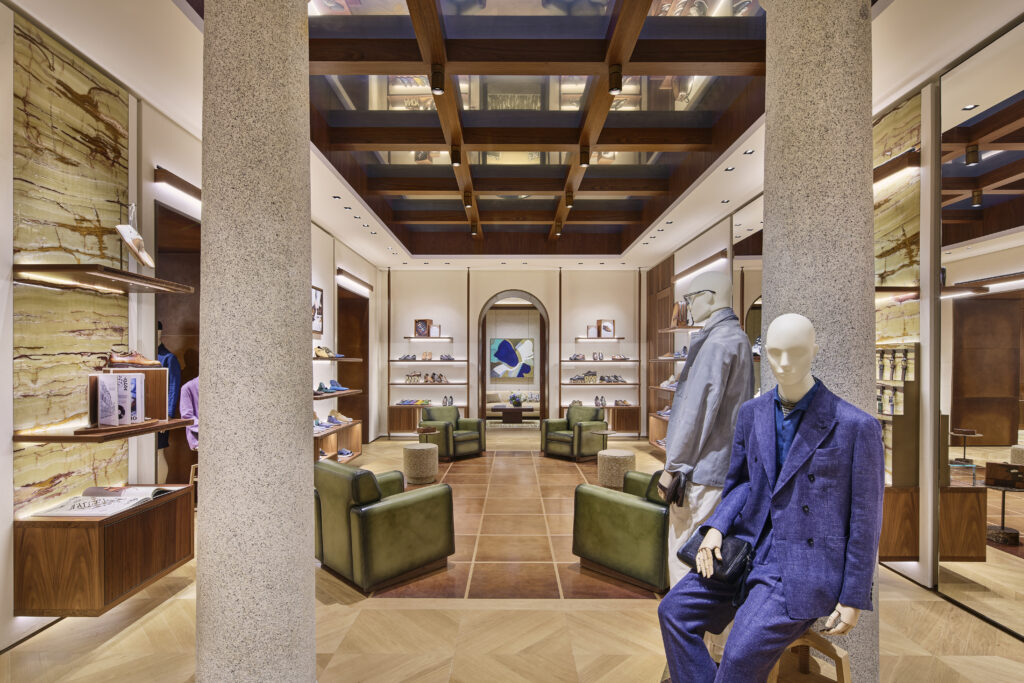
Across two hundred and nineteen square metres, Berluti sets aside the usual grammar of luxury retail — the window that impresses, the ceiling height that intimidates. The space unfolds like a suite of private rooms, closer to an apartment or a club than to a shop. The entrance plays on four round arches, pale granite and sandstone, bronze eyeglasses and green marble. In the first room, a large central table presents shoe lasts finished in different Patines, the House’s signature colour work, passed down from generation to generation.
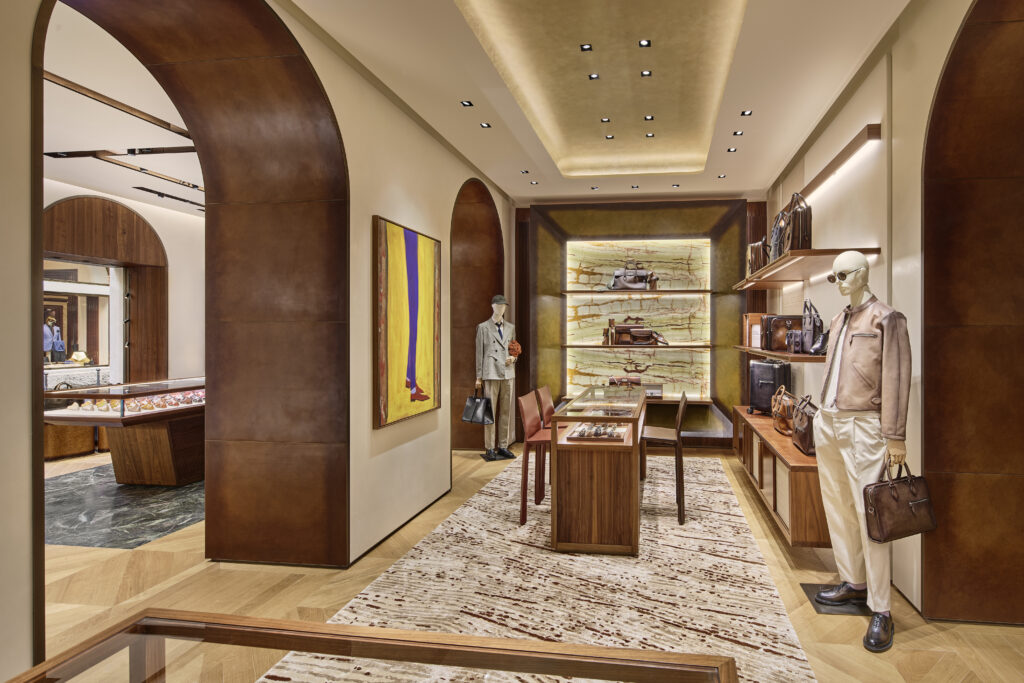
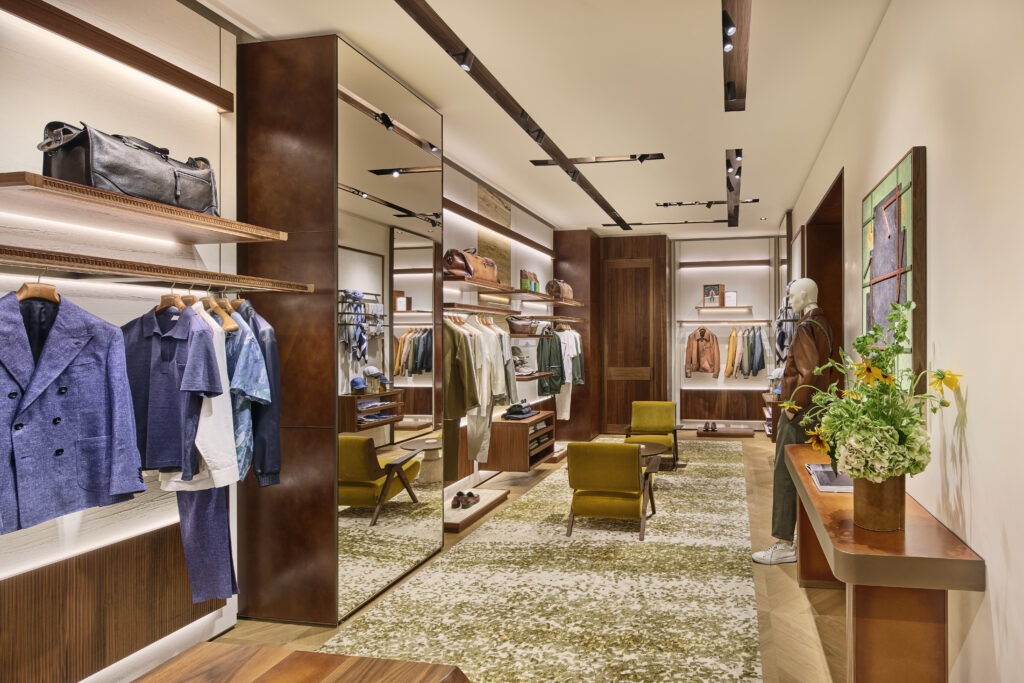
The centrepiece was originally a typical Milanese courtyard. Berluti has installed there its leather ring, a recurring feature of its boutiques, around which the shoe fitting unfolds — a slow, almost ceremonial moment that the House holds to be the heart of its craft. The shoes line the walls according to a hanging principle inspired by the Italian designer Franco Albini. Further on, the ready-to-wear salon calls on contemporary Italian art: an abstract work by Lorenzo Monnini, two armchairs designed by Gianfranco Frattini. The salon reserved for the House’s best clients, meanwhile, borrows its doors from traditional Milanese entrances and displays a chosen piece by Gabriele Cappelli.
What a House that no longer wants to sell, sells
The accumulation of names — Albini, Frattini, Monnini, Cappelli — is not decorative name-dropping. It draws out a thesis: the Berluti store presents itself as the interior of a 1950s Italian connoisseur, where designer furniture and artworks screen the act of purchase from view. One enters for the Patine and stays for the silence. Victor Belmondo, the Franco-Italian actor and House ambassador, opened the ball at the inauguration; but the event matters less than the decor that outlives it.
A question remains, one this staging leaves open. At a time when men’s luxury increasingly plays out in experience and less and less in transaction, how far can a House disguise its boutique as a residence before the client forgets that, at the end of the leather ring, there is a shoe to buy? Berluti is betting that in Milan, on the land of its bootmakers, the confusion will be welcome.
Cette publication est également disponible en :


