
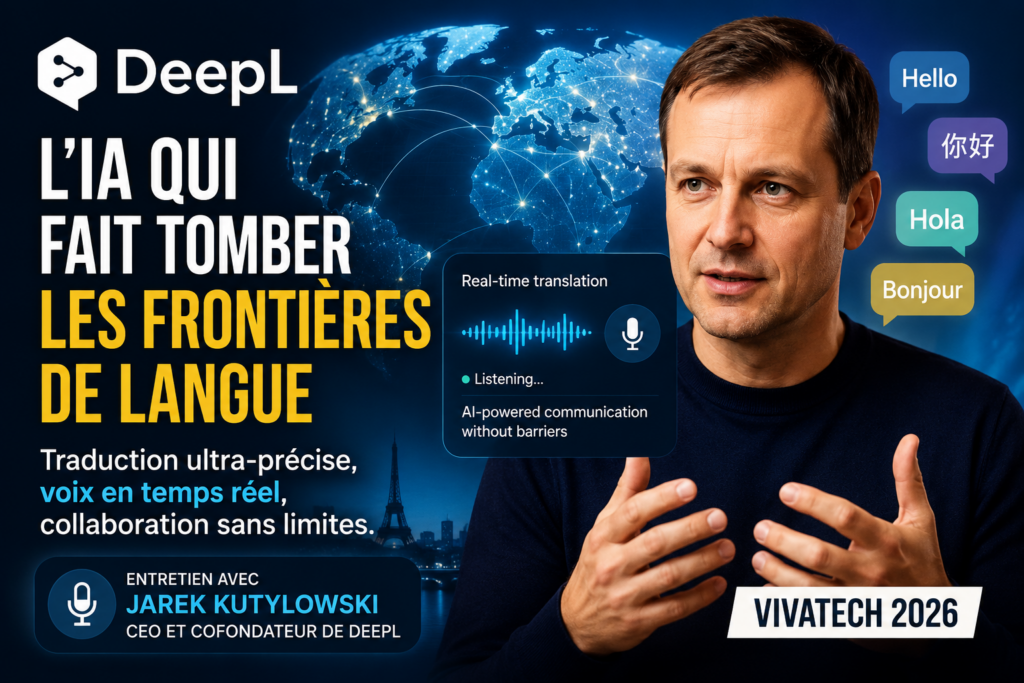
VivaTech 2026 – Interview with Jarek Kutylowski, CEO and Co-Founder of DeepL
For a long time, machine translation was simply a matter of convenience. An email you needed to understand quickly. A foreign webpage you needed to decipher. A document you wanted to skim through without hiring a professional translator.
That era is coming to an end.
At VivaTech 2026, Jarek Kutylowski, founder of DeepL, championed a far more ambitious vision: that of a world where language becomes an invisible layer of the human experience. No longer an obstacle to be circumvented, but a technological constraint that artificial intelligence is gradually erasing.
The challenge is no longer translation. It is communication.
From a productivity tool to a communication infrastructure
Four years ago, DeepL was primarily known as a particularly high-performing translation tool. Its success was based on a simple, viral product that was far superior to the available alternatives.
Today, the situation is different.
The explosion of generative AI has turned translation into a standard feature. Every major model is capable of translating text. The question, therefore, is no longer whether a machine can translate, but to what degree of accuracy, reliability, and domain-specific adaptation it can do so.
For Kutylowski, the answer lies in a clear commitment to specialization.
The German company isn’t trying to become a one-size-fits-all assistant. It aims to solve organizations’ most critical communication challenges: complex legal contracts, technical documentation, sensitive multilingual exchanges, and international collaboration.
This strategy illustrates a broader trend in the AI market: value is gradually shifting from generic capabilities toward vertical expertise.
The End of the “Free” AI Myth
One of the most revealing parts of the interview concerns the actual cost of the models.
In 2017, the executive explains, developing a high-performance translation model required a few hundred thousand euros’ worth of computing power.
Today, the costs run into the tens or even hundreds of millions.
To remain competitive, DeepL must now train very large models comparable to the architectures used in the world of LLMs.
This cost inflation is profoundly changing the nature of the industry.
For several years, AI innovation was driven by a relatively accessible approach to experimentation. Now, every investment in research must be justified by a business model capable of absorbing the cost.
In other words: the question is no longer just about building a better model. It’s about who will still be able to finance this race five years from now.
Why DeepL Refuses to Depend on American Giants
While many companies build their products using APIs from major American players, DeepL continues to develop its own models.
This is a strategic choice.
According to Kutylowski, owning the entire technology stack offers two major advantages:
- maintain superior quality for specific applications;
- incorporate customer feedback into the models much more quickly.
This line of reasoning echoes a distinction that has become central to the AI industry: that between “overlays” and “builders.”
The former depend on the technological decisions of other players. The latter control their own destiny but bear much higher costs.
DeepL has clearly chosen its side.
The Next Battleground: Voice
The most significant announcement at the conference, however, had nothing to do with text.
The day before the presentation, DeepL had officially announced the integration of the team from MixHalo, a California-based company specializing in real-time voice translation.
The acquisition marks a significant milestone in the company’s evolution.
Until now, most of its value has come from document translation. Now, DeepL is tackling a much more complex challenge: enabling two people to converse naturally in their native languages while understanding each other instantly.
The difference is significant.
A document can be analyzed, proofread, and corrected.
A conversation requires preserving emotion, intent, cultural nuances, rhythm, and sometimes even humor—all with just a few hundred milliseconds of latency.
The challenge is as much linguistic as it is human.
The real product isn’t the translation
The most interesting part of the conversation comes when Kutylowski talks about his own family.
As a Pole living in Germany who speaks several languages on a daily basis, he observes firsthand how each language conveys a particular way of seeing the world.
The perfect translation has never been about replacing one word with another.
It involves conveying a cultural context.
This is precisely why translation remains a difficult technological challenge despite the spectacular advances in generative AI.
Models must understand not only what is said, but also what is implied.
For luxury brands, cultural institutions, or heritage organizations, this distinction is essential.
Translating a text is relatively simple.
Translating an identity is another matter entirely.
The Detail
Most observers view language models as conversational tools. DeepL uses them differently.
To achieve a professional level of translation, the company says it must now leverage architectures comparable to those of major LLMs, with hundreds of billions of parameters.
Machine translation has thus become a very large-scale computational problem, with investments now on par with those of the world’s leading AI companies.
When the Boundary Disappears
For decades, technology has promised a “universal translator” worthy of science fiction.
For the first time, this goal seems technically achievable.
The question then becomes less about technology and more about society.
What happens when language ceases to be a barrier to access to information, education, trade, or international collaboration?
For Kutylowski, the answer is simple: more exchange, more mutual understanding, and more opportunities.
But another question deserves to be asked.
If language barriers disappear, will the cultural diversity they sometimes protected also disappear?
The future of linguistic AI may not hinge on its ability to make everyone speak the same language.
It will depend on its ability to allow everyone to continue speaking their own language.
Cette publication est également disponible en :

