
There is a category of watches that no longer seek to prove their diving credentials. They draw on a well-established set of functional features: a rotating bezel, immediate readability, serious water resistance, brushed steel, and a generous power reserve. The question, therefore, is no longer one of raw performance, but rather how a brand reinterprets the very concept of the dive watch today.
With the new Khaki Navy Scuba Auto 40 mm and Khaki Navy Scuba Auto GMT, Hamilton is continuing a trend that began several years ago: evolving the American tool watch toward a form of contemporary versatility—more urban, less ostentatious—without abandoning its technical heritage.
Founded in Lancaster in 1892, Hamilton has long built its reputation around demanding environments: railroad timing, aviation, and military use. The maritime world appeared later in this industrial narrative, but today it allows Hamilton to occupy an interesting niche between the accessible dive watch and the everyday mechanical timepiece.
The 40-mm version is undoubtedly the more cohesive of the two options. Not because it aims for discretion—its textured dial and generously luminescent hour markers remain very bold—but because it reflects a fundamental shift in contemporary watchmaking: a return to wearable proportions. The 40-mm stainless steel case, combined with a thickness of 13 mm, positions the sports watch as an everyday timepiece rather than a showpiece.
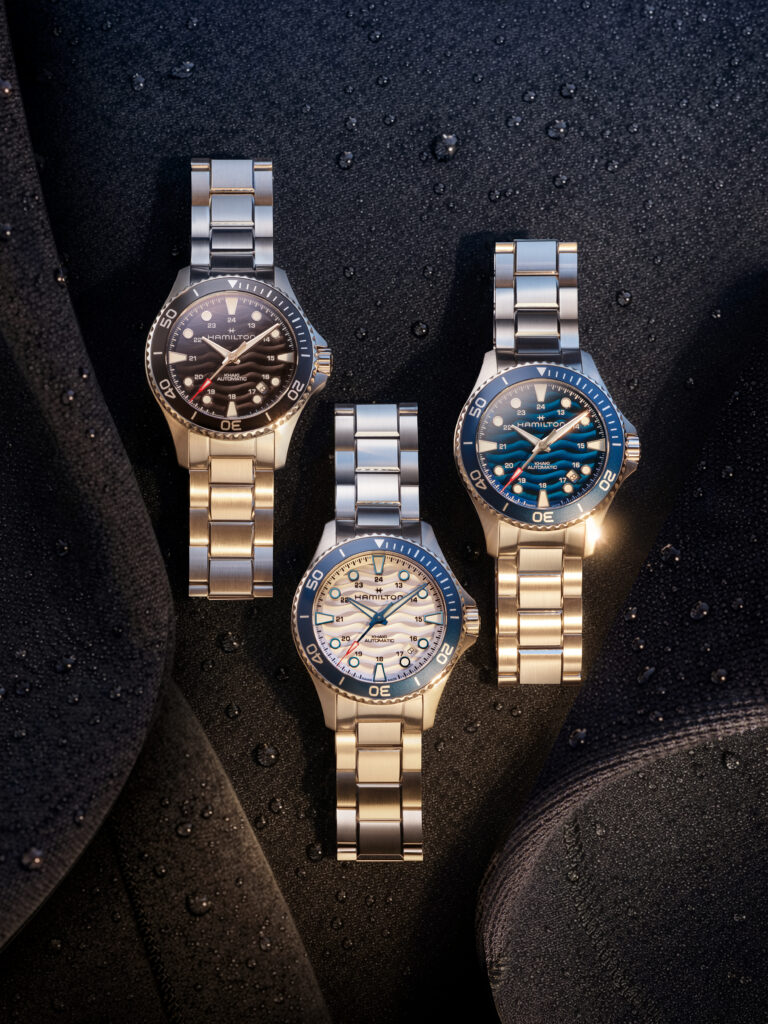
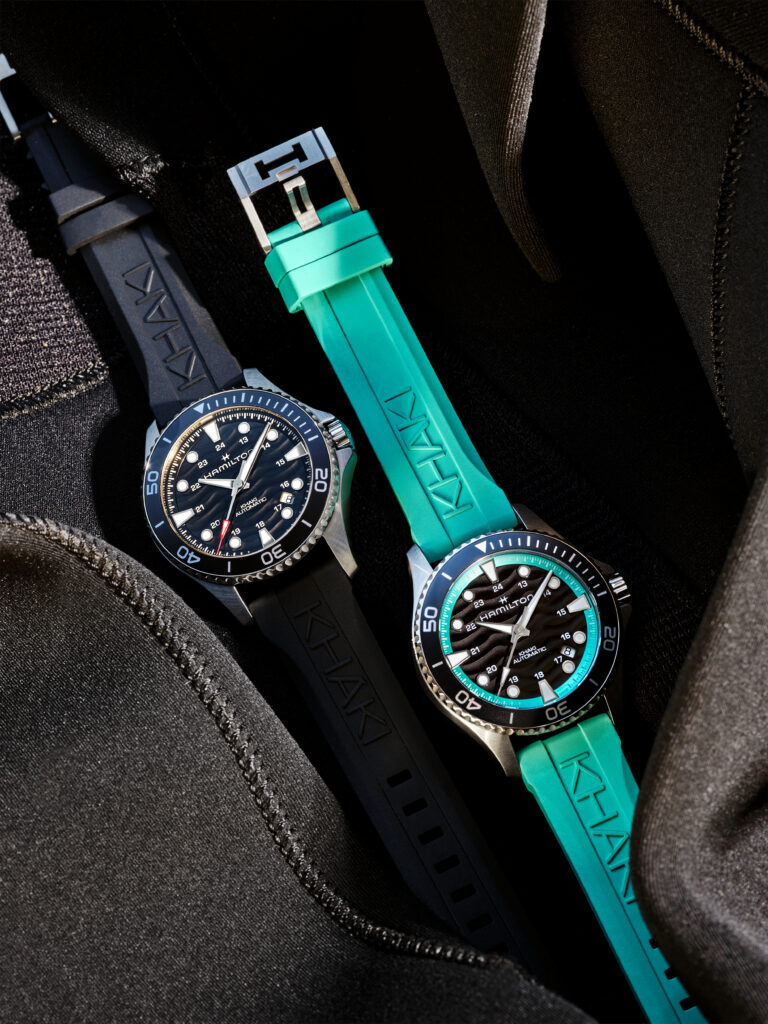
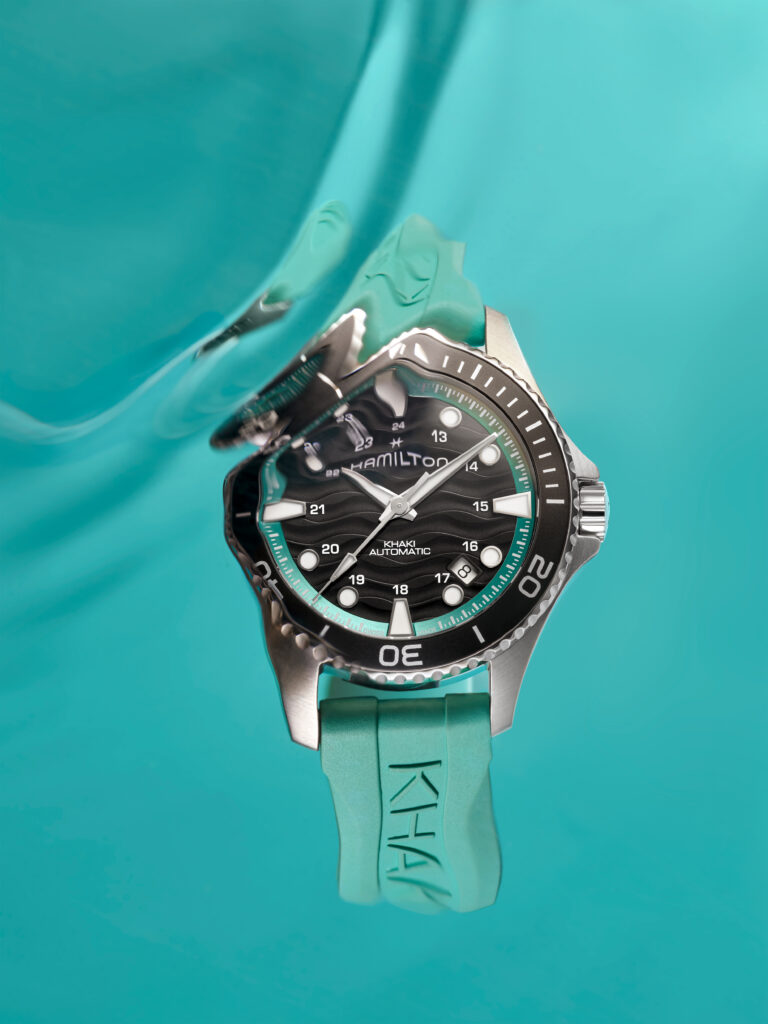
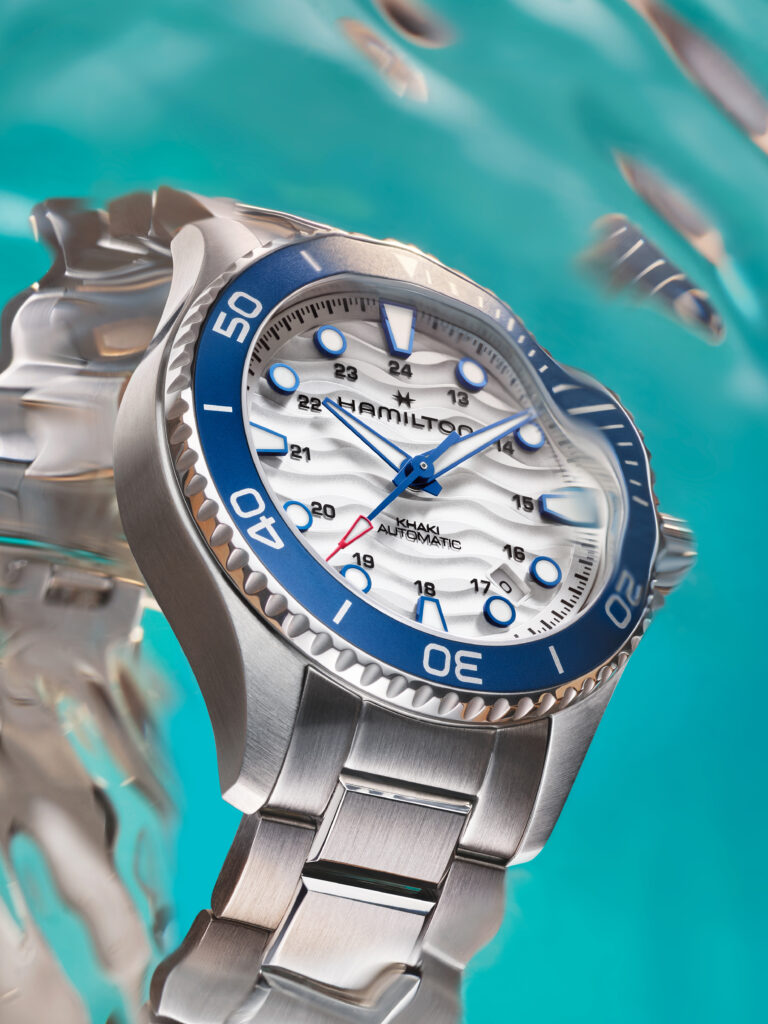
The most subtle detail is probably found on the dial. Hamilton has incorporated an embossed wavy texture beneath a lacquered finish—a discreet way of evoking the marine world without resorting to literal imagery. Many so-called “ocean-themed” watches today feature an abundance of decorative elements. Here, the motif remains understated, almost architectural. It captures light more than it seeks to tell a story.
Inside, the H-10 automatic movement offers an eighty-hour power reserve and features a Nivachron™ balance spring—an alloy that has now become essential in the Swiss watchmaking industry for improving resistance to magnetic fields, temperature fluctuations, and everyday shocks. The subject may seem technical; yet it reveals a broader transformation in contemporary watchmaking. Discreet luxury no longer consists solely of hand-finishing a movement bridge, but also of designing timepieces capable of withstanding a mobile lifestyle saturated with electromagnetic waves and electronic devices.
The Khaki Navy Scuba Auto GMT shifts this logic toward a different vision: that of constant movement. Historically, the GMT complication has been associated as much with aviation as with maritime applications. Here, Hamilton chooses to link it to contemporary travel—the kind characterized by seamless international journeys where one moves from one time zone to another without any real geographical break.
The case is now 43 mm in diameter and has a more instrument-like appearance. Water-resistant to 300 meters, featuring a screw-down crown and a ceramic bezel graduated over twenty-four hours, the model retains the hallmarks of a diver’s watch while replacing the concept of elapsed time with that of multiple time zones. The red GMT hand serves here less as an aesthetic accent than as an immediate functional reference point.
The H-14 movement features the same robust design: an 80-hour power reserve and a Nivachron™ balance spring. In reality, these features speak above all to the evolution of our contemporary relationship with mechanical watches. A timepiece designed to be taken off on Friday evening and put back on Monday morning without needing to be wound becomes an object that fits seamlessly into the fragmented rhythms of everyday life.
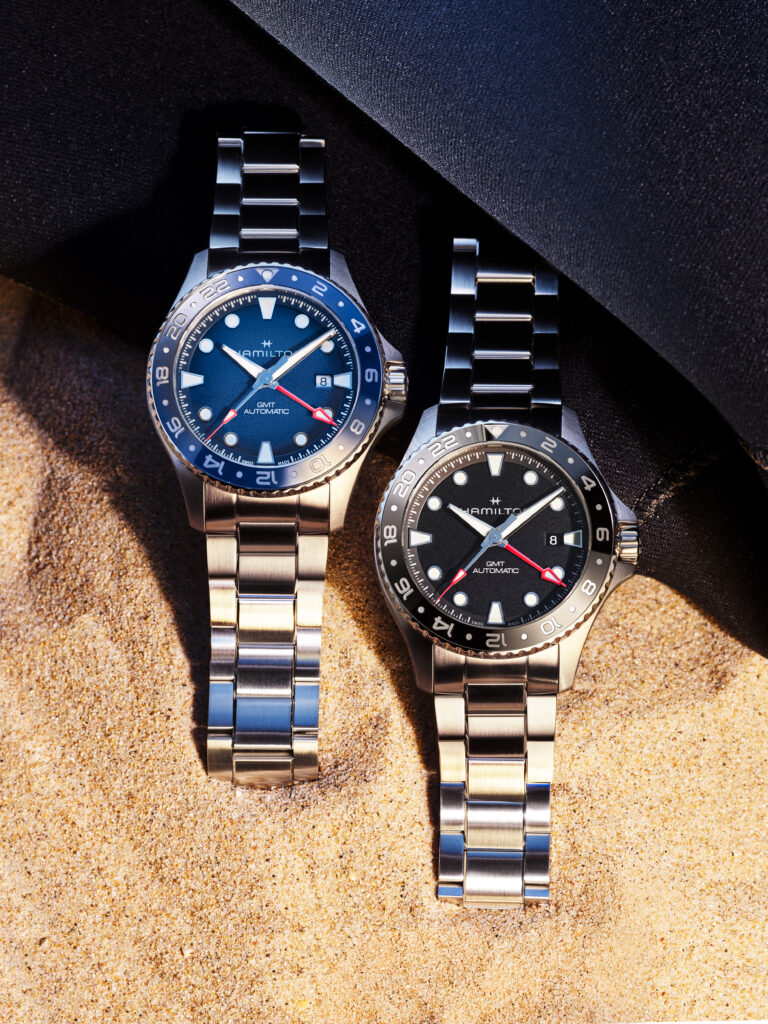
Both models feature an anti-reflective sapphire crystal and a Grade A Super-LumiNova® coating on the hands and hour markers. On the GMT version, Hamilton replaces the traditional diving bezel with a 24-hour scale that allows the wearer to track a third time zone.
More broadly, these new Khaki Navy models say something about the current era of Swiss watchmaking. Spectacular grand complications still dominate the display cases, but the core of the market is shifting toward technically sound timepieces designed for long-term wear—capable of transitioning seamlessly between the office, travel, and sports without a change in aesthetic style. It’s a form of watchmaking that emphasizes continuity rather than radical change.
Hamilton seems to have understood that the contemporary challenge for the tool watch is no longer about feats of achievement, but rather about quiet endurance.
Cette publication est également disponible en :

