
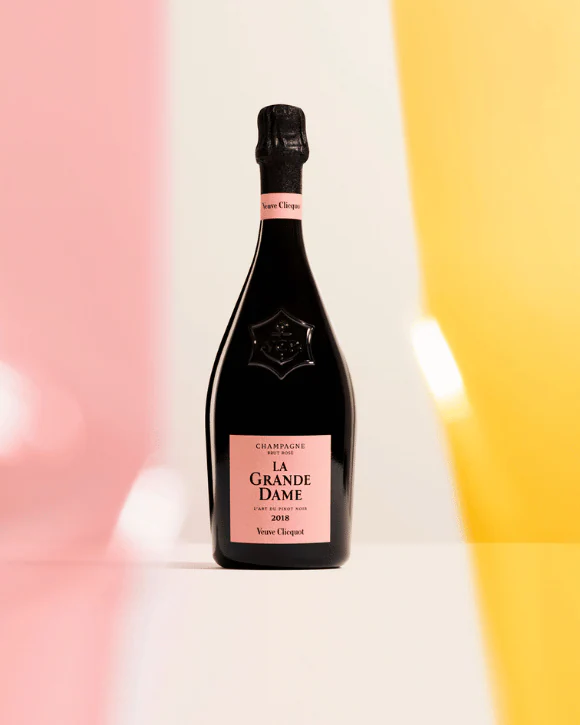
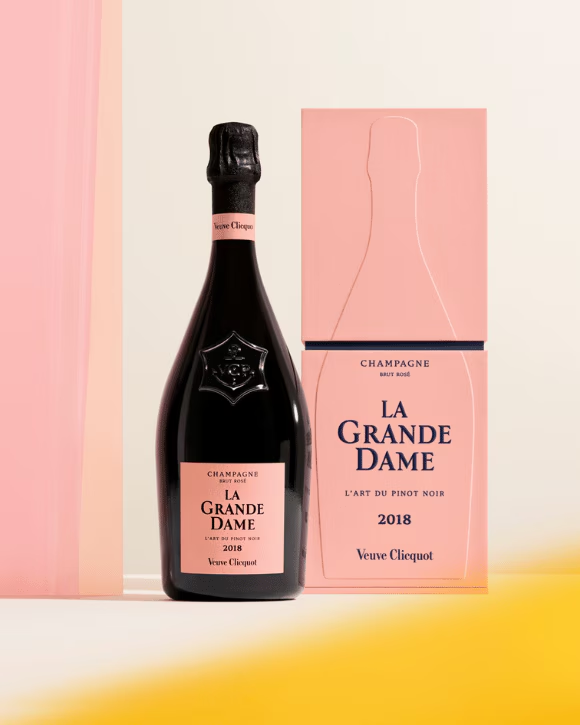
Veuve Clicquot’s 2018 Grande Dame Rosé is produced on a 1.3-hectare plot of land acquired before the Revolution. Two hundred eighty-five years of uninterrupted ownership for a single purpose: to provide the red wine used in the blend of a cuvée that is produced only in vintages the House deems worthy of Pinot Noir.
The history of blended rosé champagne began in Bouzy in 1818. Madame Clicquot blended red wines from this Grand Cru village with her white wines, producing what the archives describe as the first known blended rosé. This move was not improvised: as early as 1812, she had been shipping still wines from Bouzy separately to her customers, considering them a distinct product in their own right. She knew the soil well; she had owned a portion of it since 1741, known as Clos Colin.
This vineyard, now 1.3 hectares in size, is the sole source of the red wine used in La Grande Dame Rosé. Its sandy clay-limestone soil creates moderate water stress—a condition that concentrates the berries and develops structured tannins without harshness. The vineyard’s exposure promotes effective drainage, a crucial factor for a grape variety as sensitive to excess water as Pinot Noir.
Detail — Assembly as Architecture
The 2018 vintage combines two distinct styles from the Montagne de Reims: the Pinot Noirs from the northern slopes bring tension and verticality, while those from the south contribute texture and what Champagne winemakers call “silky smoothness.” The Chardonnay from the Côte des Blancs complements the blend, adding salinity and freshness. The red wine from Clos Colin—fermented with punching down and pumping over in temperature-controlled stainless steel tanks following cold maceration—serves as the linchpin that maintains the balance between these contrasting elements. Didier Mariotti, Cellar Master at Veuve Clicquot, describes this structure as follows: “La Grande Dame and Gastronomie de Jardin are linked. Both stem from the earth and the work of human hands; they remind us of the cycle of the seasons, the anticipation of the harvest, and the distinct character of a soil and a vintage.”
The 2018 vintage is the eleventh Rosé since the cuvée was first created in 1988—a figure that speaks volumes. In thirty-seven years, there have been only eleven vintages. The cuvée is not produced every year; it waits until the Pinot Noir is, in our internal terminology, up to standard. In 2018, a rainy winter followed by a long, hot summer produced a harvest that the House deemed to meet its criteria. The historical blending log—a document kept in Reims—contains records of every decision made since 1818.
In Verzy, a 2,500-square-meter vegetable garden cultivated using permaculture on soil comparable to that of the vineyard now complements the wine through the Garden Gastronomy program—fourteen Michelin-starred chefs working on pairings using vegetables grown in the same soil as the vines. This convergence of viticulture and vegetable farming is not a marketing ploy: it is a question posed to the terroir regarding its own coherence.
Madame Clicquot wrote to a correspondent on November 15, 1833: “There is indeed a hillside in Champagne called Bouzy, which has always produced still red wines of remarkable quality and delicate flavor. ” Clos Colin is located on this hillside. It still is today.
Cette publication est également disponible en :

