
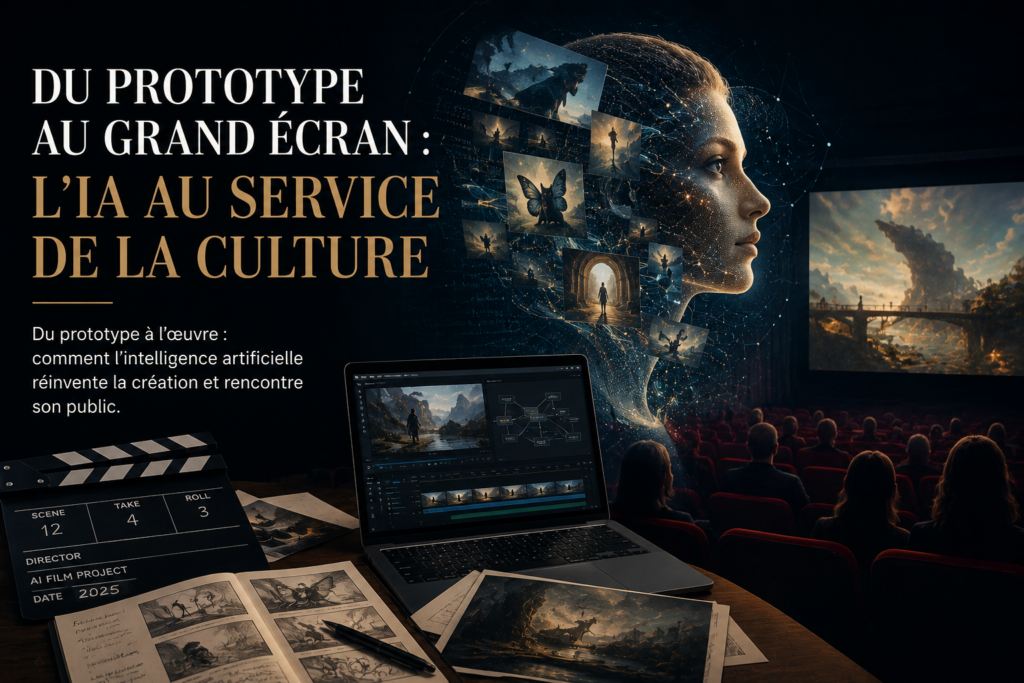
At the MK2 Artefact AI Film Festival, the question is no longer whether artificial intelligence can produce images. It is about understanding at what point these images become a work of art, a story, or a shared emotion.
It took just two years to shift the conversation. At the first edition of the MK2 Artefact AI Film Festival, the focus was still on technical feats: generating an image, maintaining a style, and avoiding visual glitches. By 2025, the projects submitted were already using an average of five to six tools, spread across pre-production, production, and post-production. AI-assisted filmmaking was no longer an isolated demonstration, but a production pipeline.
This shift is decisive. For a work of art does not arise from a tool. It arises from a process, a perspective, and a series of choices—sometimes minute ones. François Brogy, a partner at Artefact, sums up this transition with a simple phrase: from prompting to directing. The first generation asked the machine to surprise. The next is beginning to ask it to obey.
Constraint has always been a part of cinema
Technical limitations initially dictated the aesthetic. The consistency of facial expressions, the continuity of form, and the ability to maintain a character’s pose for several seconds remained weak points. Some films therefore opted for fragmentation: vignettes, disjointed sequences, and a narrative told in fragments. Not out of laziness, but through a clever use of these constraints.
This is often how writing comes to be. Silent films had their gestures. The French New Wave had its breaks. Music videos have their ellipses. AI, for its part, produces its own accidents: visual hallucinations, unstable textures, sudden bursts of shapes. The question isn’t whether to erase them too quickly, but to know which ones are worth keeping.
Anne Aurel, winner of the 2025 Technical Award for *La Tisseuse d’Ombre*, demonstrates this with *The Butterfly Effect*. Her artistic world blends collage, surrealism, personal archives, and digital imagination. But the most interesting detail isn’t just visual—it’s auditory. For her new film, she spent two days in the studio with Lucien Richardson, working with the voice, the mouth, organic sounds, and a sound-transformation tool developed at Polyson. Sometimes, the more AI there is, the more human it feels.
Details
During the festival’s second season, approximately 75% of the projects submitted were created entirely using artificial intelligence tools, even though the rules only required the use of at least one AI tool at each stage: pre-production, production, and post-production. This difference says it all: the creators didn’t just follow a rule—they explored a new approach.
AI as a workshop, not as an author
Vocabulary still lags behind practice. Realizing, prompting, directing, generating: no single word is sufficient yet. Anne Aurel rejects the idea of absolute control. For her, creating also involves letting go, riding the wave of ideas, and engaging with an unstable medium. This insight is valuable: it prevents AI from being reduced to a mere execution machine.
At the other end of the spectrum, major tech companies are working to stabilize the technology. Google is highlighting Gemini, Veo, and multimodal models capable of integrating text, images, video, and audio. Technical advancements are focused in particular on facial consistency, narrative continuity, and the transformation of a sequence via natural language. In other words: fewer glitches, more direction.
But cinema is not limited to the model’s performance. MK2 emphasizes another point: AI can open up access to production resources that were previously reserved for studios. It can enable creators from YouTube, video games, digital art, or online communities to build worlds, intellectual property, and broadcast-ready formats. The issue then becomes as much an economic one as an artistic one.
Elisha Karmitz puts it aptly: what creates desire is not the machine, but the unique perspective, the universe, and the relationship with the audience. AI can adapt intellectual property into a trailer, a series, an immersive experience, or social media content. It does not replace the fundamental requirement: having something to say.
From the Festival to the System
The third edition of the MK2 Artefact AI Film Festival will accept submissions from September 2 to December 2. Olivier Nakache and Éric Toledano will chair the jury. The announced theme, “disconnection,” has the beauty of a paradox: asking creators aided by AI to explore what lies beyond constant connectivity.
As part of the festival, MK2 is also developing an incubation program. Winners can receive support and be connected with producers, companies, and distribution networks. Raphaël Friedman, winner of the first edition with his studio Archave, already embodies this transition: from an award-winning film to a production and service business serving a broader ecosystem.
This is perhaps where the event becomes interesting beyond mere technological curiosity. It is no longer about celebrating prototypes, but about witnessing the birth of an industry. An industry that is still fragile, grappling with issues of law, training, quality, and legitimacy. But it’s an industry that’s beginning to understand that AI won’t make cinema disappear. It simply forces the industry to ask itself, once again, what truly deserves to be seen on the big screen.
Cette publication est également disponible en :

