
Twenty years after the first human genome project, sequencing a patient’s DNA no longer costs three billion dollars or takes ten years of work, but rather less than a thousand euros, in just one week. This technological shift is moving fertility medicine from late diagnosis to data-driven prediction.
One Hundred Genes, Three Families
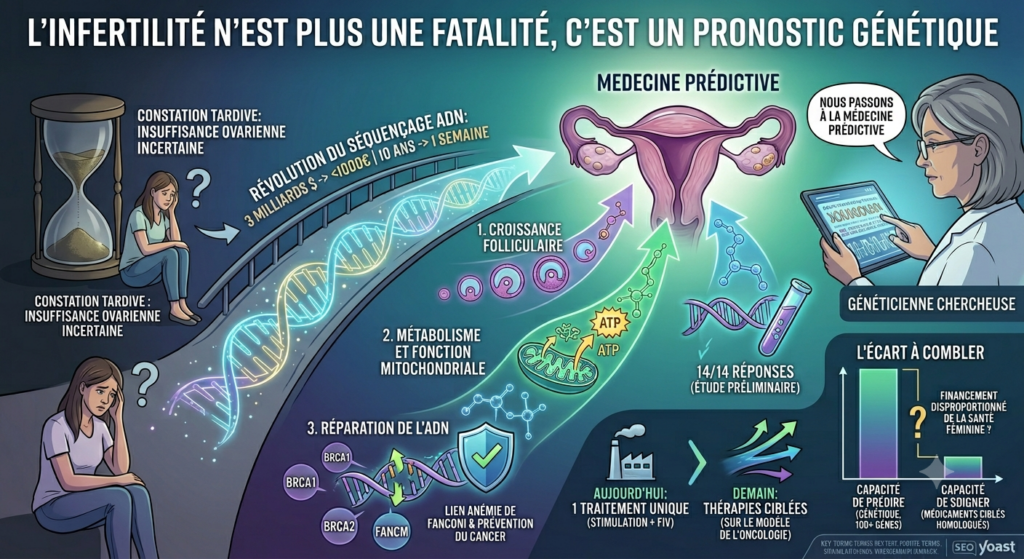
Primary ovarian insufficiency and diminished ovarian reserve affect 4% of women under the age of forty and account for a significant proportion of patients undergoing in vitro fertilization. For decades, their causes remained largely unknown. Next-generation sequencing has changed the equation: in the space of about a decade, it has enabled the identification of approximately 100 genes involved in these conditions. An international cohort—the largest ever assembled on this topic—has shown that the causes remain unexplained in 70% of cases, but that genetics now makes it possible to identify 30% of them—a proportion that would have seemed out of reach fifteen years ago.
Even more significant than the number is the architecture. The identified genes fall into three distinct biological pathways, each with radically different prognoses. The first governs follicular growth. The second governs metabolism and mitochondrial function in the ovary. The third, and most numerous, group comprises DNA repair genes—a family that, prior to this research, no one had linked so clearly to infertility, even though its role in meiosis might have suggested such a connection.
The Gene That Links the Ovary to Cancer
This third pathway led to the most unexpected discovery of the past year: genes belonging to the Fanconi anemia pathway—including BRCA1, BRCA2, and FANCM, already known to predispose to cancer—cause primary ovarian insufficiency when present alone. The established link is no longer merely statistical: it is mechanistic, and it changes the scope of the diagnosis. Identifying a mutation in these genes in an infertile patient also opens up the possibility of cancer prevention.
“We’re moving toward predictive medicine,” summarizes geneticist Micheline Misrahi-Abadou, a professor of biochemistry and molecular biology at Paris-Saclay University, who led the study of this cohort. According to her, understanding the biological pathway involved makes it possible to anticipate the progression toward loss of ovarian reserve, predict the onset of comorbidities, and, if necessary, offer fertility preservation before it becomes an urgent necessity.
A Hundred Causes, One Treatment
There remains a gap that genetics alone cannot bridge: for every hundred or so identified causes, there is currently a single treatment—hormone stimulation followed by in vitro fertilization—regardless of the molecular origin of the disorder. Predictive medicine now seeks to bridge this gap, following the model of what oncology has achieved with targeted therapies: characterizing a patient’s molecular alteration before selecting a treatment, rather than administering the same protocol to everyone.
Initial results are in. A team tested a series of drugs—already approved for other indications—on patients with impaired follicular growth. All fourteen patients responded with a resumption of follicular growth. For impairments in DNA repair, resveratrol, an antioxidant, has demonstrated its ability to stimulate this repair in the ovaries. Neither of these two findings constitutes an approved treatment—but both point in the same direction: toward a pharmacological approach to infertility organized by molecular target, rather than by symptom.
Details. The project to sequence the first human genome took about ten years and cost three billion dollars. Today, next-generation sequencing can accomplish the same task in a week, for less than a thousand euros.
What genetics reveals, it does not provide a way to treat: a hundred identified genes represent a hundred potential targets, not a hundred drugs. The gap between our ability to predict and our ability to treat remains the true measure of how far we’ve come—and how far we still have to go. As long as funding for women’s reproductive health remains—by the very admission of the researchers working in this field—disproportionate to the scale of the problem they are documenting, how many of these targets will remain mere diagnoses, never becoming treatments?
Cette publication est également disponible en :

