
Bvlgari at VivaTech 2026: When Blockchain Becomes the New Stone Setting
There is something strange about the fact that the luxury industry waited for blockchain to solve a problem as old as the desire for authenticity. Ever since Venetian merchants hallmarked gold, ever since jewelers on the Place Vendôme engraved their hallmarks inside rings, the question has never changed: how can one prove that an item is indeed what it claims to be? By unveiling at VivaTech 2026 the expansion of its digital passport to its entire jewelry and watch collections, Bvlgari offers an answer that isn’t technological in the narrow sense of the term. It is philosophical.
The New Language of Authenticity
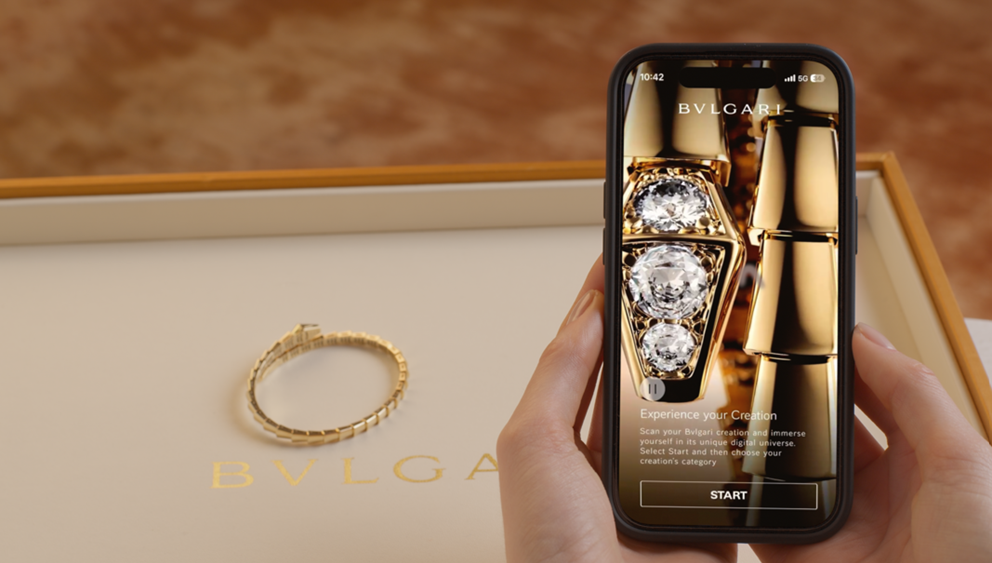
Because what the Roman House is implementing is less a traceability system than a new kind of relationship between the object and its owner. Every piece of Bvlgari jewelry now features a micro-engraved serial number—invisible to the naked eye but readable via a dedicated app available on iOS and Android. Watches, meanwhile, are marked with a Datamatrix code concealed within their finishes. In both cases, the technology recedes into the background, giving way to what it creates: certainty.
Laura Burdese, deputy CEO of Bvlgari, sums up this ambition with a precision that deserves our attention: “Each creation becomes a gateway to the House.” The phrase is beautiful because it turns the usual use of technological terminology on its head. It is not the House that opens itself up to technology—it is technology that becomes the threshold to a House.
The Object’s Memory
The Aura Blockchain Consortium platform, which Bvlgari helped found alongside other major luxury brands, provides the infrastructure for this promise. But infrastructure alone doesn’t make the experience. What matters to someone holding a Serpenti bracelet in their fingers or fastening an Octo Roma to their wrist is the idea that this object now has a memory—a certified, immutable, shareable—and silent—memory. Bvlgari’s digital passport does not speak. It waits to be asked a question.
This marks Bvlgari’s sixth consecutive appearance at VivaTech. Six years of observing how the tech world views luxury—and how luxury views it in return. The dynamic has changed. The early editions felt like diplomatic forays—the major luxury houses came to show that they had a place in this world. Today, Bvlgari no longer comes just to show that it’s there. It comes to explain how technology can serve something that algorithms don’t yet fully understand: the enduring nature of beauty.
What Technology Cannot Verify
There is a gentle paradox in this approach. Jewelry, by its very nature, stands the test of time without any outside help. An emerald from 1960 doesn’t need a software update. But its story—who wore it, who passed it down, how it traveled—that story has always been fragile, whispered from one heir to the next, sometimes lost at the bottom of a drawer along with the original box. The digital passport doesn’t change the stone. It preserves the story.
There is one question that the press release does not ask, but that the initiative suggests: What does it mean to own a luxury item in the age of digital certificates? Does the Bvlgari Touch app transform our relationship with jewelry, or does it simply reinforce it? Perhaps the true innovation lies not in the blockchain itself, but in the decision to offer each customer a mirror: one that reflects the value of what they have chosen to keep.
Cette publication est également disponible en :

