
In traditional jewelry, a pearl often takes center stage. It sits, hangs, or is encircled by metal—sometimes diamonds—and waits for the light to do the rest. With the “Balance” collection, launched in 2010 under the direction of Thakoon Panichgul, TASAKI chose a different path: removing the pearl from its pedestal, aligning it along a line of gold, and giving it a graphic edge rather than a ceremonial setting. The 2026 collection extends this concept with new interpretations in yellow gold and white gold pavé, centered around three variations: balance step neo, balance parallel neo, and balance arm neo.
The original concept of balance stems from a very Japanese sense of economy: several pearls set on a slender bar, in an almost mathematical balance. Nothing overflows. The jewelry does not seek to amplify the pearl, but rather to create a sense of tension around it. The official TASAKI website notes that the collection was unveiled in 2010 as Thakoon Panichgul’s first design for the TASAKI Collection Line, and that it continues to challenge the conventions of pearl jewelry through this precise alignment on a gold structure.
This shift is significant. The Akoya pearl, traditionally associated with Japanese ideals of polish, roundness, and uniformity, moves beyond its heritage roots to embrace a more architectural aesthetic. TASAKI, founded in 1954, has built its identity on mastery of pearls and diamonds; its official narrative emphasizes this dual expertise, spanning selection, cultivation, transformation, and contemporary jewelry. The “Balance” collection therefore does not break with the House’s heritage; rather, it presents it in a new light.
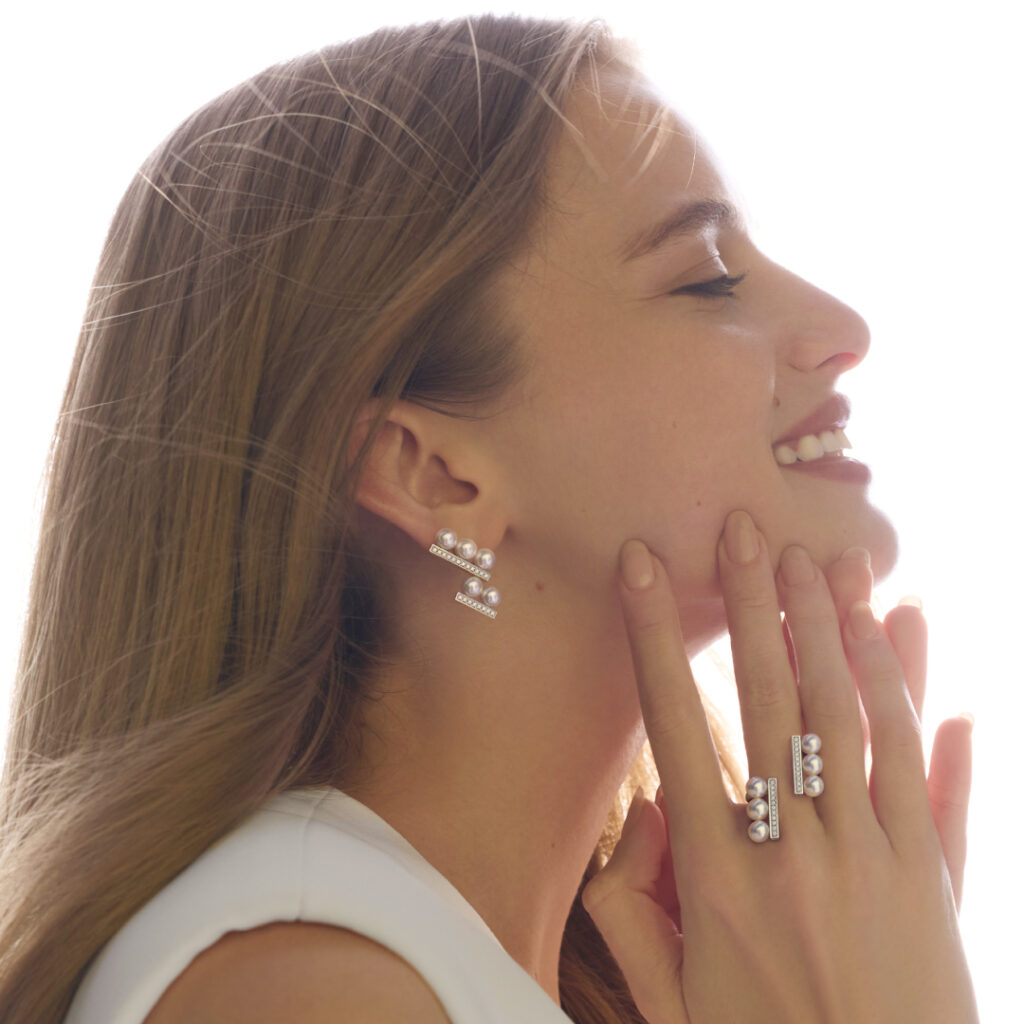
The new 2026 collection plays precisely on this tension between continuity and minimalism. Balance Step Neo introduces new earrings in yellow gold or white gold with pavé setting. The Akoya pearls appear to follow a diagonal line along the ear, as if the jewelry were no longer simply worn, but suspended in a moment of suspended motion. On page two of the feature, the images show this tiered arrangement: two parallel metal bars, slightly offset pearls, and a controlled asymmetry that avoids the coldness of a purely geometric design.
The “Balance Parallel Neo” takes a similar concept and applies it to the finger. The ring features the same parallel motifs, reimagined in a design that’s easier to wear every day. The press release emphasizes that the floating effect has been preserved, despite the adaptation to a more natural way of wearing it. This detail speaks to the evolution of luxury jewelry: signature pieces can no longer exist solely in display cases or on ceremonial occasions. They must accompany the wearer’s movements, their hand, their desk, and their city. Jewelry is becoming closer to the body, less confined to ceremonial settings.
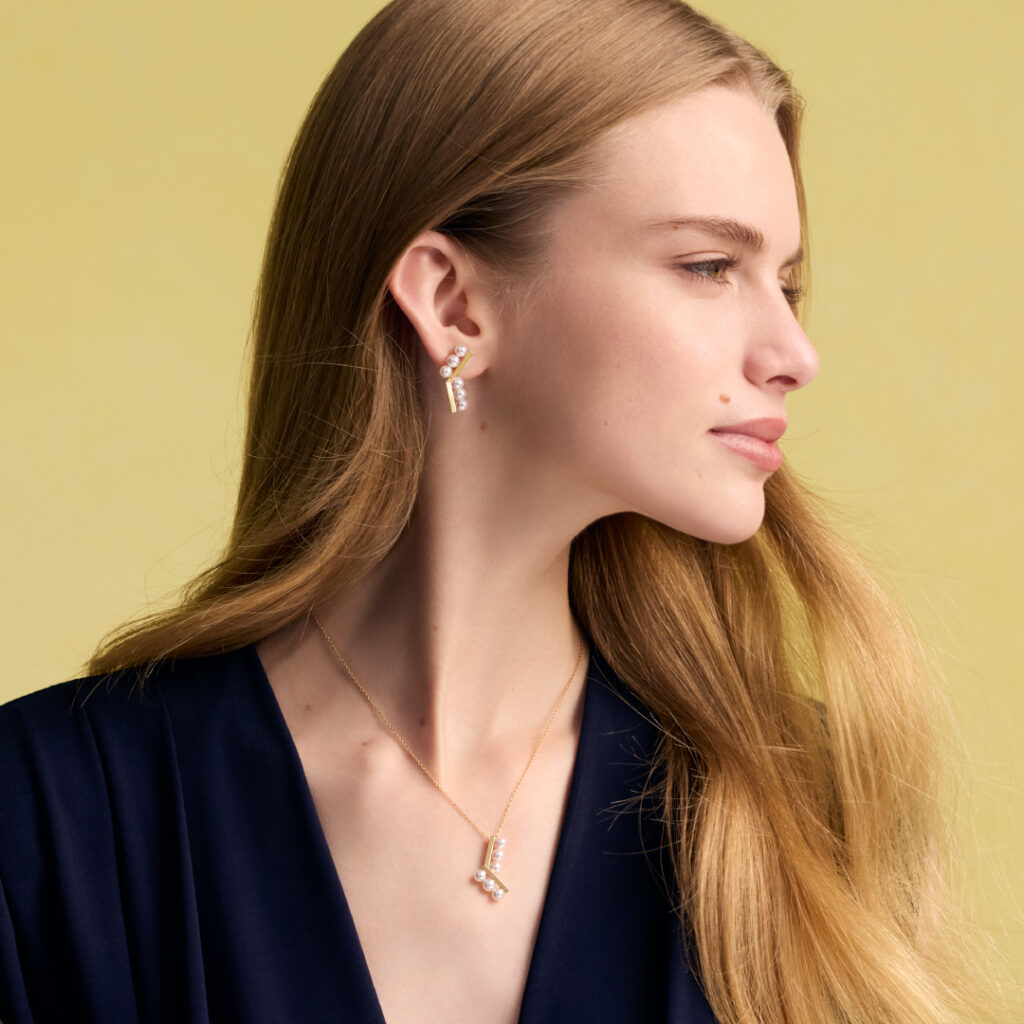
The Balance Arm Neo collection adds an almost tactile dimension. Inspired by the image of two hands coming together, it joins the Balance Arm line in a more compact version, available as earrings and a pendant. Here again, the focus is not on lavish ornamentation, but on touch. Depending on the angle, the earrings reveal different movements; the simpler pendant adds a contemporary touch to an everyday look.
What makes “Balance” timeless is not just its recognizable design. It is its ability to resolve an age-old contradiction: how to transform the pearl into a modern object without stripping it of its softness? Many jewelers have attempted to modernize the pearl by overloading it with symbols, hybridizing it to the point of obliterating its essence. TASAKI takes a different approach. The House preserves the sphere, the luster, and the pearly surface, then reimagines the design around it. A single line of gold is enough to draw the eye.
Thakoon Panichgul’s involvement in this story also sheds light on the outcome. A New York-based designer of Thai origin, he brings a fashion sensibility to TASAKI—not fashion as a seasonal trend, but as a relationship to the body, to movement, and to how a piece is worn. The TASAKI Collection Line, born of his imagination, brings together collections that have become the House’s signature pieces, including “balance.” Jewelry is no longer conceived solely as an isolated piece; it becomes a line, almost a silhouette.
This 2026 collection speaks to a clientele that isn’t necessarily seeking ostentation, but rather precision. Yellow gold for its warm visual appeal, white gold with pavé setting for luminous contrast, Akoya pearls for their organic regularity: the materials remain classic, but the composition rejects nostalgia. This is perhaps where TASAKI strikes the right balance. The House does not modernize the pearl by severing it from its history. Instead, it keeps it poised on a sharper line.
Cette publication est également disponible en :

