
In Lhasa, some journeys don’t begin with an itinerary, but with a change of pace. During Saga Dawa, the fourth month of the Tibetan calendar, the city is not so much visited as observed: footsteps slow down around the Barkhor, prayer wheels turn in discreet repetition, monasteries absorb the day with that gravity proper to places that never quite give themselves away.
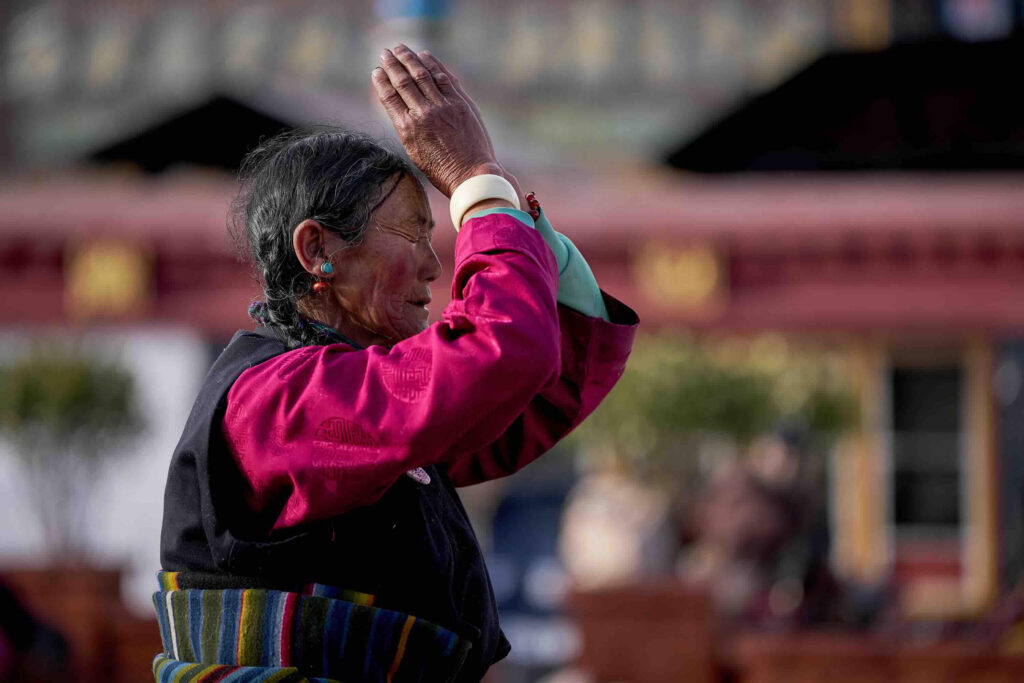
In 2026, the central day of Saga Dawa will fall on May 31, corresponding to the fifteenth day of the fourth Tibetan lunar month. This day, called Saga Dawa Düchen, commemorates in Tibetan Buddhism the birth, awakening and passage into parinirvana of Shakyamuni Buddha. The entire month is devoted to pilgrimages, prayers, acts of generosity and merit practices. The point is not only religious. It’s social, almost urban: for a few weeks, the city is organized around an economy of repeated gesture, of walking, of offering, of shared silence.
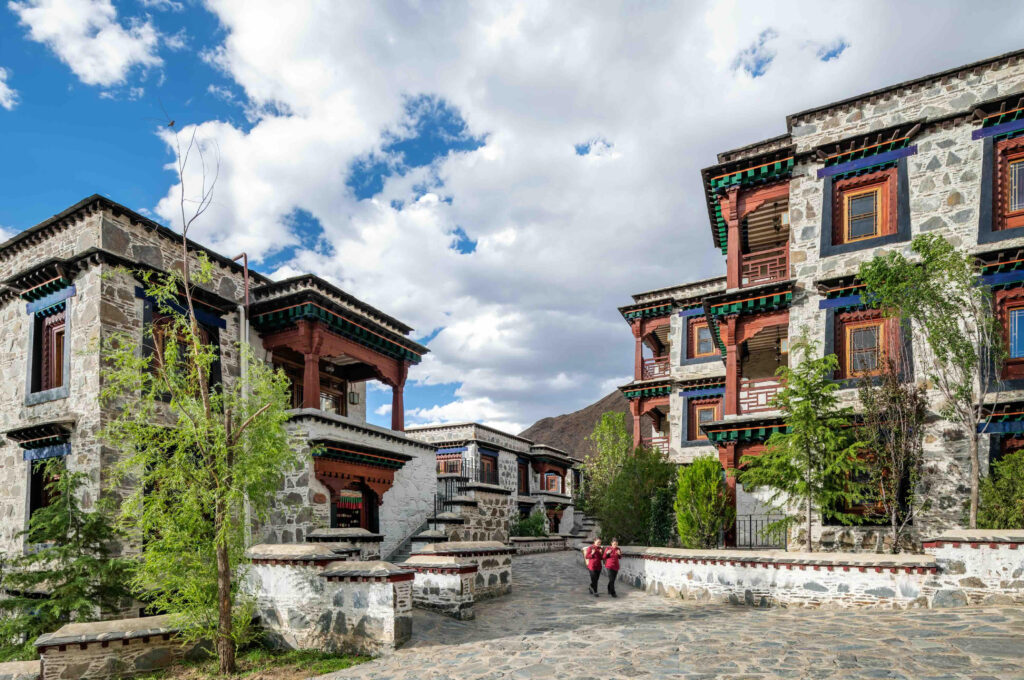
This is precisely where luxury travel finds a rarer function than comfort: creating the right distance. Not to isolate visitors from the world they are passing through, but to offer them the conditions to look at it without consuming it too quickly. Songtsam Linka Retreat Lhasa, set on a hillside at an altitude of 3,700 metres, follows this logic. The press release mentions a view of the Potala Palace, whitewashed walls, indigo-carved windows, a fish-fin-shaped façade, Thangka paintings and wall tapestries inspired by ancient Tibetan interiors.
There are 45 rooms, where parquet floors, Tibetan rugs and hand-crafted copper objects make up a material grammar more interesting than the conventional vocabulary of exceptional hotels. Each room is equipped with oxygen concentrators, a feature less spectacular than essential in a high-altitude capital. Here, comfort becomes technical rather than decorative: the aim is not to add service, but to enable the body to follow the mind.
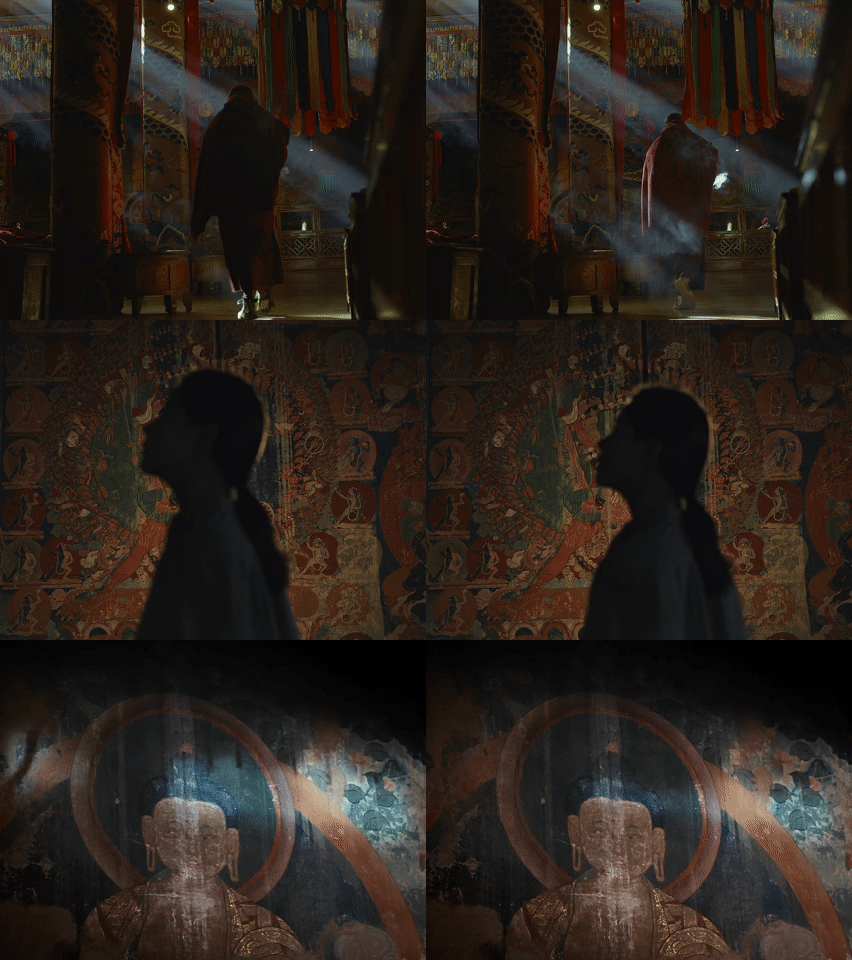
During Saga Dawa, the lodge functions as an observatory. From the lodge, visitors can join the pilgrimage circuits around the Barkhor, observe the offerings in the monasteries, follow the processions and discuss the morning rituals with the local teams. This mediation counts. In such a lively spiritual context, it’s not the traveller’s vocation to be at the center of the picture. Rather, he learns to take his place: close, but discreet; curious, but not intrusive.
Songtsam, founded in 2000 by Baima Duoji, a former Tibetan documentary filmmaker, now boasts eighteen addresses between Tibet and Yunnan, organized around lodges, Linka retreats and glamping sites. La Maison’s itineraries take in the territories of the ancient Tea and Horse Roads, with an approach that combines hospitality, Tibetan culture, itinerancy and local accompaniment.
This positioning is not insignificant. For several years now, the destination hotel industry has been seeking to go beyond decor to build stories about the territory. The risk is well known: transforming spirituality into a scenography, craftsmanship into a motif, the community into an experiential setting. The strength of a stay in Lhasa during Saga Dawa will therefore depend less on the beauty of the view than on the quality of the restraint. Tibet does not lend itself to accumulation. It requires slowing down, walking and looking for a long time.
In late May and early June, travel conditions on the Tibetan plateau are generally favorable, with clearer skies and milder temperatures than in winter. The spiritual calendar then encounters a favourable climatic window. This overlap explains why the weeks surrounding May 31, 2026 are particularly intense: they allow us to approach Saga Dawa not as an isolated event, but as a complete temporality.
The real luxury here is not having the best room facing the Potala. It’s accepting that the landscape, the rituals and the people retain their share of inaccessibility. In Lhasa, during Saga Dawa, the well-informed traveller doesn’t collect proof of passage. He learns to let something pass before him.
Cette publication est également disponible en :

