
When was Dior watchmaking born and how has Dior Horlogerie evolved since?
Dior launched its first watch collections in 1975. At the time, they were very classically inspired, with no particular link to the House style.
In the 2000s, Dior watches became fashion accessories in phase with the women’s ready-to-wear collections, thanks in particular to interchangeable bracelets coordinated with the fabrics of the ready-to-wear collections.
In 2001, Dior decided to set up its own manufacturing unit in the cradle of Swiss watchmaking, in La Chaux-de-Fonds. Dior Horlogerie thus opened a new chapter in its history.
In 2003, the House entrusted the creator of Dior jewelry, Victoire de Castellane, with the creation of its first watch, La D de Dior, inspired by a men’s watch from the 1970s, which a woman had borrowed from him to always think of him. This collection was an opportunity to inject Dior watchmaking with jewelry codes such as gold, diamonds and ornamental stones.
2004 saw the birth of Chiffre Rouge, a classic watch with an exclusive automatic movement, revisiting the codes of Dior Homme: pure form, red, black, asymmetry, scar.
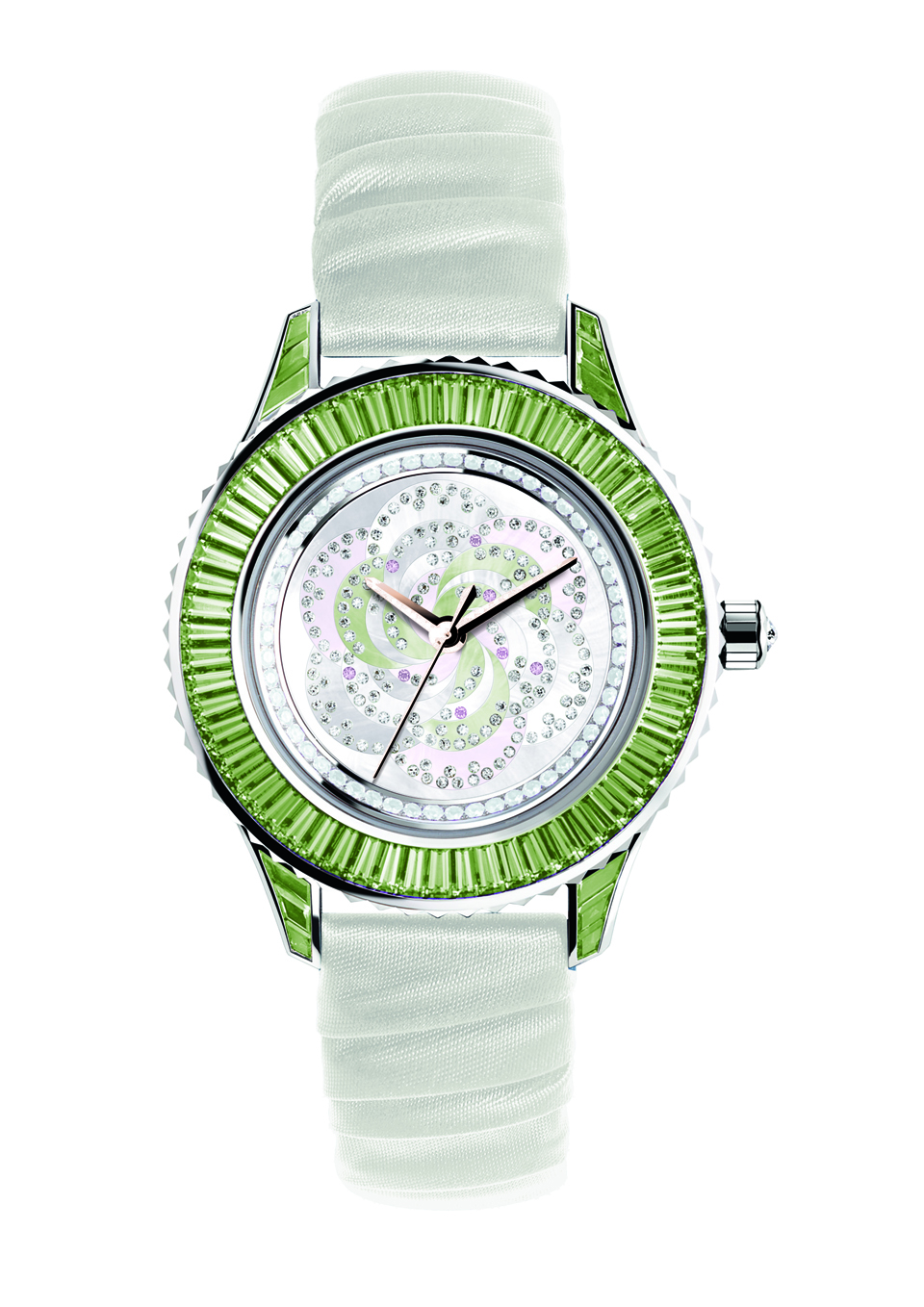
In 2005, Dior Christal was created, with its colorful aesthetic in keeping with the codes of women’s fashion, turning sapphire crystal, usually used on watch crystals, into an ornamental element.
Since 2008 and the introduction of a Tourbillon caliber in the Dior Christal collection, Dior watchmaking has proven every year its ability to draw on the codes of the House and to surprise, with the introduction of new movements and new aesthetics. 2011 sees the birth of Dior VIII, our 4th watch line, inspired by the codes of the House of Dior.

What is the DNA of Dior Horlogerie? Is there a difference between Dior Horlogerie and its competitors?
Dior watchmaking draws on the heritage of a haute couture house, with all that this implies in terms of timeless elegance (which never goes out of fashion): femininity, creativity, expertise, quality, excellence in execution, refinement of materials and details. Thus, the reverse side of the watches is treated with the same exacting care as the lining of a dress or the inside of a bag: the oscillating weights become more sophisticated; they are covered with lacquer or mother-of-pearl and become, when placed on the dial, a fishnet or a feather fan.
Is creating complicated timepieces one of your priorities?
Our vocation is not to be a manufacture, but a Parisian haute couture house that makes exceptional timepieces. The movements we integrate into our creations must above all serve an artistic and creative purpose. The “Dior Inversé” caliber is the clearest example of this.
What sets Dior Horlogerie customers apart?
Our customers are looking for an alternative to classic manufactures, and perhaps above all for the creative aesthetic that has become our signature.
What image and message do Dior watches convey?
Parisian luxury, refined down to the smallest detail, combined with Swiss expertise. Dior watchmaking could be the marriage of an elegant Parisian woman from Avenue Montaigne and a Swiss watchmaker.
How do Les Ateliers Horlogers and the designers work together?
All creation comes from our studios on Avenue Montaigne. The Ateliers Horlogers then study the technical feasibility of an artistic vision. They then seek out the most expert partners capable of translating these ideas into dials, movements, cases or bracelets.
Can you tell us about Dior VIII?
Dior VIII was born of the desire to create a line that was linked to the House of Dior as a whole, rather than to a particular universe. Its roots lie in a quotation from Christian Dior: “I wanted to be an architect; being a couturier, I am obliged to follow laws, principles of architecture.” The pyramid-shaped structure of the bracelet is inspired by the Bar suit (fitted shoulders, cinched waist and wide hips). Its name, meanwhile, evokes the fetish number of Monsieur Dior who, superstitiously, opened his house in the 8th arrondissement of Paris on October 8, 1946, and whose first collection was called “en huit”.
 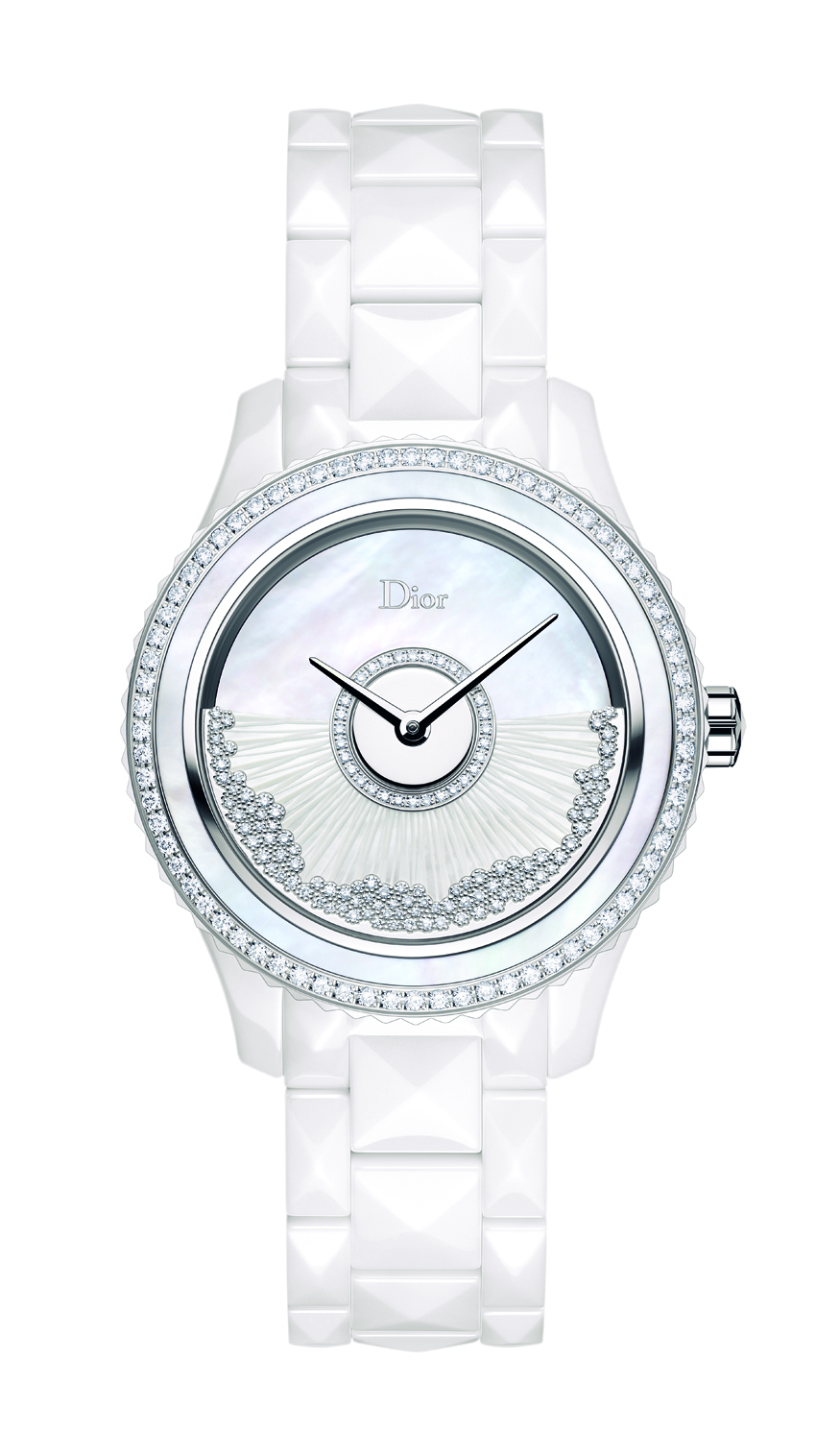
The collection is a metaphor for a woman’s wardrobe, composed of “day” versions, “cocktail” versions (with colored baguettes) and “evening” versions (with the “Grand Bal”).
Can you tell us about the new Dior VIII products for 2012?
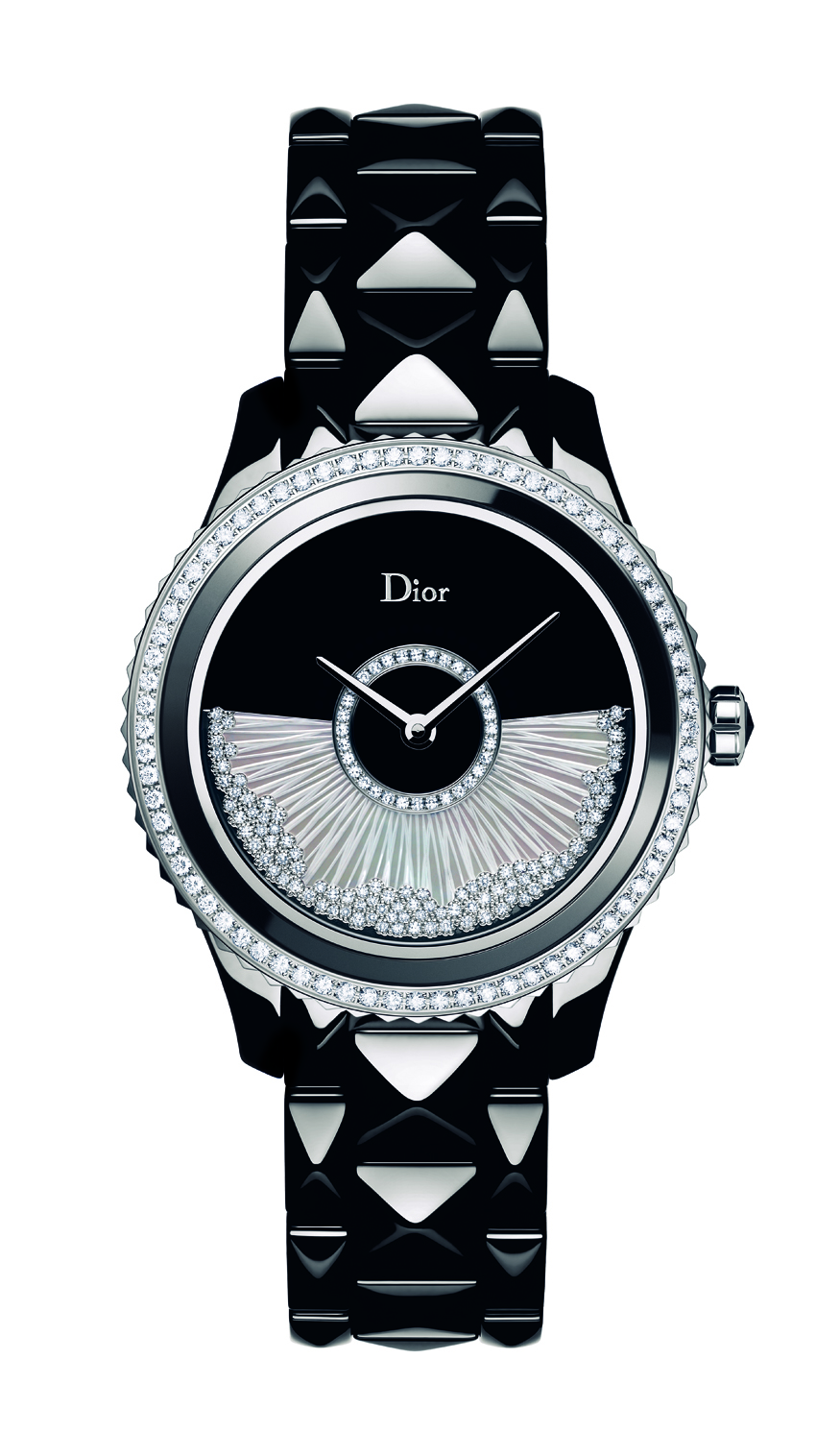
The Dior VIII story, which began last year, continues and, naturally, like the Bar tailor who first inspired it, offers new versions in white ceramic. Christian Dior used to say: “White is pure, simple and goes with everything. White, in a house like Dior, has a very special significance, as it is the color of the canvas, the fundamental starting point in the construction of a dress. “With its lines, volumes, shadows and light, the canvas is in front of me. I’ll do everything according to it…” said Christian Dior. We are also continuing the story of black, offering a new 28 mm diameter, diamond bezels in “serti neige”, and reinforcing the story of the “Dior inversé” caliber begun last year.
Christian Dior wrote: “Black and white might be enough, but why deprive yourself of color? Colors are wonderful and make you look your best. It therefore seemed essential to us to express color on Dior VIII. So we’re launching versions whose dial is hemmed with a thread of colored stones, Grand Bal Pièce Unique versions whose mass on top of the dial is adorned with mother-of-pearl or tinted or ornamental stones, Grand Bal versions whose mass is made of pink feathers. Color is also present in the form of lacquer applied to the weight on the back of certain watches, bezels in baguettes of aquamarines, rubies, amethysts and peridots, and case backs in colored sapphire crystal.
Can you tell us about the Dior Pièce Unique collection and its new products for 2012?
Since 2010, we’ve been creating an annual collection of one-off pieces known as “Dior Pièce Unique”, whose design is a horological retranscription of a dress from the Dior heritage. Five of these were presented in Basel, and five more will be launched at the Biennale des Antiquaires in Paris in September. On each of them, the colors, the pleating of the bracelets, the dial work (set or marquetry) and the oscillating weights are linked to the House’s heritage.
Can you tell us about Dior Christal and its new products for 2012?
Dior Christal has given itself a new face, taking on the watchmaking attributes of Dior VIII to its credit. It retains its distinctive element (which gave it its name), which is the detour of sapphire crystal, a material usually used for watch crystals, into a decorative element. Applied to the bezel and pyramid links of the bracelet, sapphire crystal allows for all manner of colors.

And so, in 2012, Dior Christal is dressed in bright red (which Christian Dior described as “full of youth and gaiety”) and intense purple (“the queen of colors”, according to Christian Dior). Available in 33 or 38 mm versions, with diamond-set bezel or diamond-edged dial, each is available in four models.
Can you tell us about La D de Dior and its new products for 2012?
La D de Dior is more deeply rooted in the codes of Dior jewelry, with new dials in hard stones: turquoise and jade in 25 mm, lapis lazuli, sugilite and turquoise in 19 mm. Extravagantly colored versions are also available: the dials are paved with Paraïba tourmalines, pink sapphires and snow-set tsavorites. Combined with gold and a fluorescent lizard strap, they create a joyful visual contrast. A 38 mm rose gold version with mother-of-pearl dial back and a 38 mm version with opal dial back complete the line. The Biennale des Antiquaires in Paris in September will also be the occasion to unveil a unique all-diamond piece.
Can you tell us about Chiffre Rouge and its new products for 2012?
Chiffre Rouge A05 (with its COSC-certified automatic chronograph-chronometer movement) is reborn in a new form, combining traditional watchmaking attributes with a new design. On the creative side, the proportions and case/strap integration have been reworked. On the watchmaking side, the arrival of an anti-reflective crystal, watchmaking finishes on the dial and a screw-down crown complete the look. To continue the story of the “Dior inversé” caliber on Chiffre Rouge initiated in 2011 with the M01, two new M05 pieces have been created, placing an openworked, functional black or red oscillating weight in 22-carat gold on top of the dial of an all-black watch. Finally, two new Chiffre Rouge models in limited editions of 200 pieces (C01) unveil new small horological complications placing 3 indications on the watch face: power reserve, day and retrograde date.
You’ve already offered a lace-like tourbillon in 2008, a mysterious movement in 2009 to evoke the transparency of dress petticoats, the “Dior 8 time zones” caliber in 2010 inspired by kinetic art. If we’re talking about movements, which one in 2012 should grab our attention?
2012 marks the first anniversary of the deposited “Dior inversé” caliber, developed in partnership with Manufacture Soprod in 2011. “Elegance is a whole, and what cannot be seen counts as much as what can be seen”, said Christian Dior. The oscillating weight, which winds the movement and is traditionally hidden under the case, is here placed on top of the dial and becomes an animated decoration evolving on the dial, even when the watch is wound.

It’s the desire to push ever further the idea of technology and innovation above all at the service of creation. This movement, whose functional oscillating weight is openworked and set, sometimes even composed of feathers, pays homage to the work of the couturier, for whom the lining must be as beautiful as the dress itself. Imagined by the Avenue Montaigne studios to evoke the swirling movement of a ball gown, this caliber is featured this year in the Dior VIII Grand Bal (in an openworked mesh set with diamonds, a fan of feathers, jade, opal or mother-of-pearl) and Dior VIII Grand Bal Pièce Unique (in the flamboyant colors of ornamental and precious stones), as well as in the Chiffre Rouge. Technically, these masses, sometimes 90% openwork, are a feat, as their different designs require total recalculation of inertia.
Cette publication est également disponible en :

