
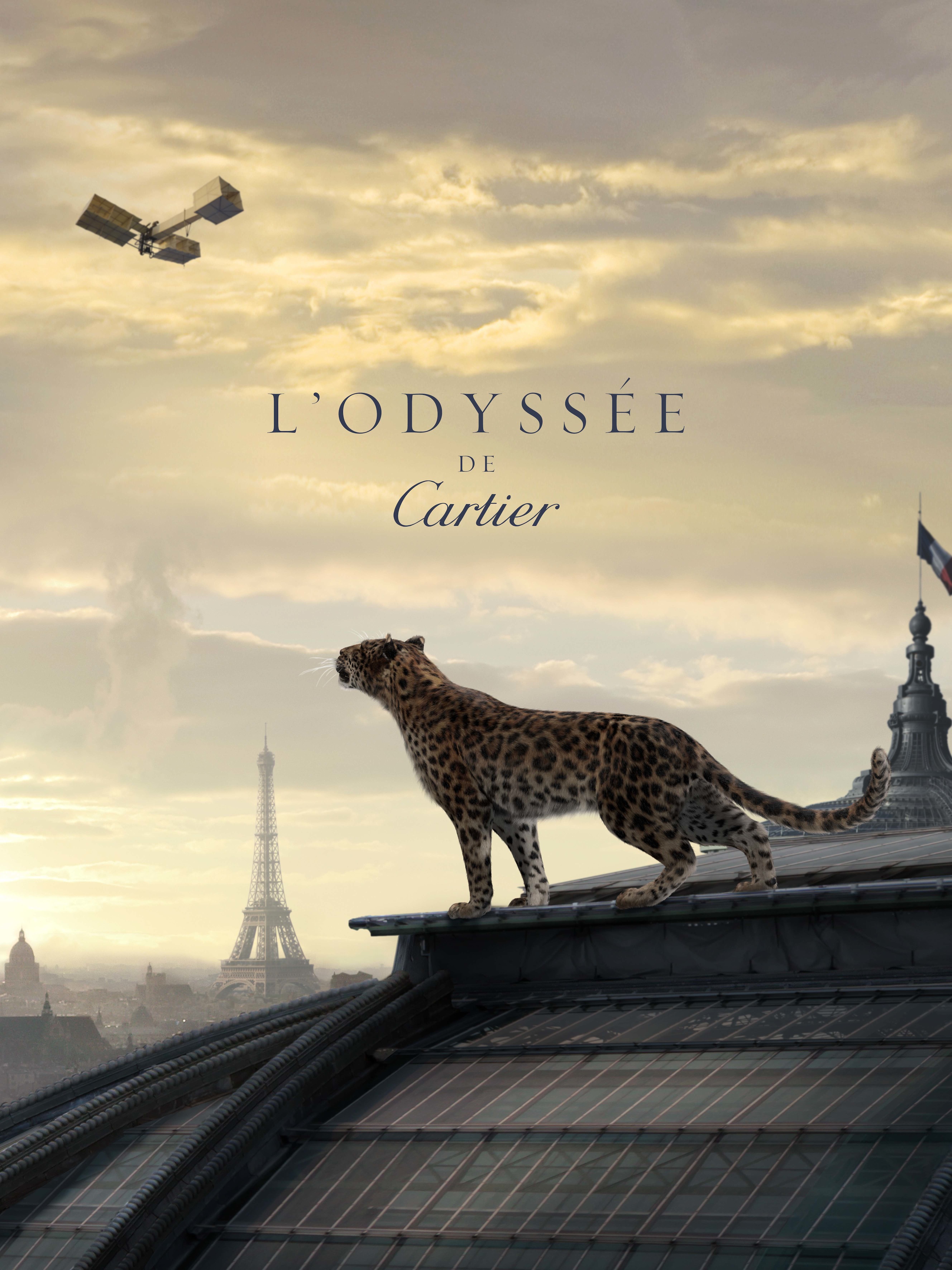
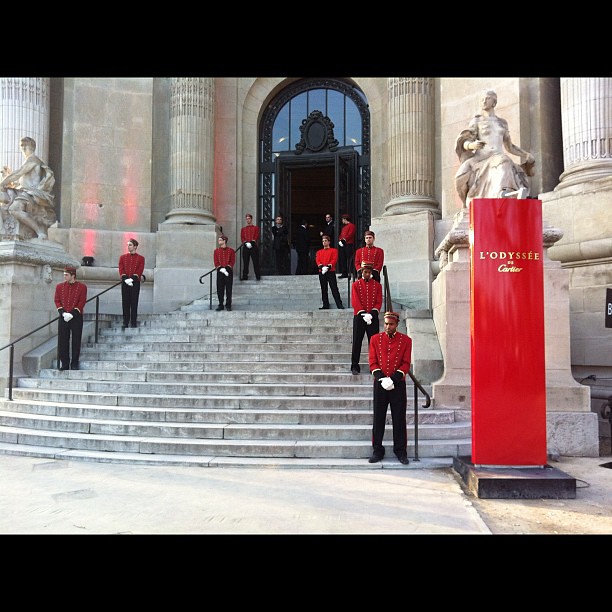
A few days ago, we had the privilege of previewing the film l’Odyssée de Cartier: a marvellous three-minute cinematic fresco recounting the history and mythology of Cartier. The film is a work of absolute meticulousness, reminiscent of the precision of watchmaking and jewelry.
Cartier entrusted the direction of the film to Bruno Aveillan. A graduate of the Ecole des Beaux-Arts in Toulouse, he is now one of the leading international directors of advertising films. He was able to reconcile shooting on a natural set, as the company wanted to shoot with real wild animals, with three-dimensional animation.
“It was obvious to me that the magic of the film lay essentially in our ability to work with the Panther from start to finish. Bruno Aveillan
Shooting on natural sets required a team of around sixty people around the director. The special effects work mobilized over fifty people for more than six months.
A little history:
The House of Cartier, with its 165-year history, has had a worldwide presence from its earliest years, the Cartier brothers having divided their time between the Boutique at 13 rue de la Paix (1899) for Louis, the boutique at 175 New Bond Street for Jacques, and the boutique on 5th Avenue in New York for Pierre (1909). Discovering the world was undoubtedly a passion shared by the three brothers, who forged friendships in many countries through fabulous encounters. The film traces the cultural influences and exceptional encounters that played such an important role in stimulating the House’s creativity. For the first time in this film, Cartier shows the World it has imagined in its creations, through the eyes of its emblematic muse, the Panther. Cartier is a ferryman of culture, jeweler to kings and maharajas, revolutionizing jewelry by blending worlds and cultures.
The heroine: the Panthère
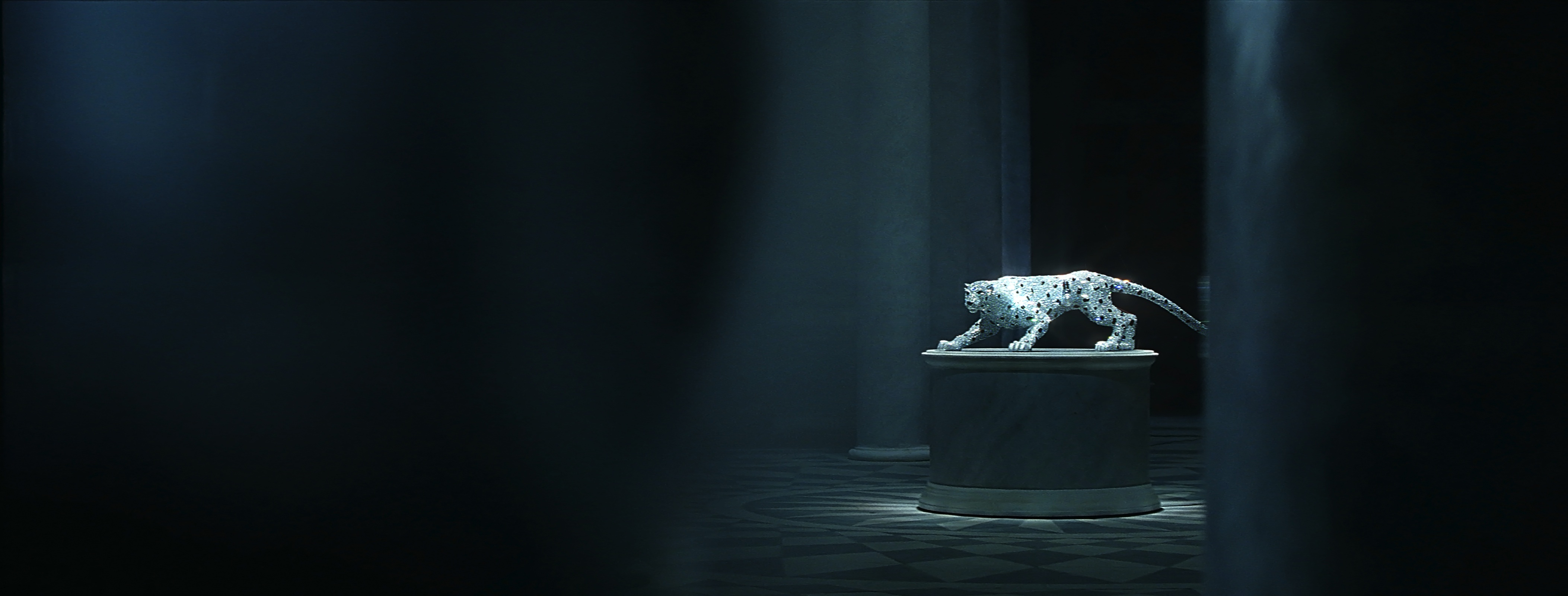
The Panthère has established itself as the heroine of this. She has been the emblem of Cartier’s jewelry expertise since the 30s, thanks to Jeanne Toussaint, a free-spirited, whimsical Parisian and Cartier’s most gifted artistic director. Her unerring eye, her incisive style and her great elegance have left their mark on the House’s style. Sobriety of form, opulence of color, originality of wear, Jeanne Toussaint, nicknamed “La Panthère”, modernized jewelry and adapted it to the tastes of Café Society. Elegant women of the time, from the Duchess of Windsor to Barbara Hutton and Nina Dyer, Daisy Fellows and Maria Felix, loved to wear a Panthère piece. Even today, Panthère pieces are the most appreciated collections, rare and precious symbols of exceptional craftsmanship.
In the film, the feline, symbol of strength and freedom, is by turns menacing, haughty or charming, metamorphosing according to the times and desires, reflecting the spirit of the times she lives in. Free, the animal follows its instincts, sensitive to the universe around it, its emerald eyes bright and ready to pounce to savor life…
Three young panthers, Cali, Tiga and Damou, have embodied the Panthère Cartier, an organization that was imposed to respect the natural rhythm of wild animals. Born in captivity, they were raised by trainer Thierry Le Portier, who looked after them with the utmost care throughout the shoot. Today, this passionate expert occupies an undisputed place in the world of cinema. In 1974, he met Pasolini and collaborated on his film Les Mille et une nuits… It was the beginning of a great love affair, which he was to share with other directors such as J.J. Beinex, J.J. Annaud and R.Scott.
In full compliance with safety standards, the wildcats were able to film in the studio as well as in Italy and Spain, and in Paris at the Grand Palais and Place Vendôme. In a rare film feature, the final scene brings the feline and international model Shalom Harlow together in the same room. The feline Cali jumped several times on the exact replica of aviator Santos Dumont’s Bi-plane n°14 while the actor was at the controls!
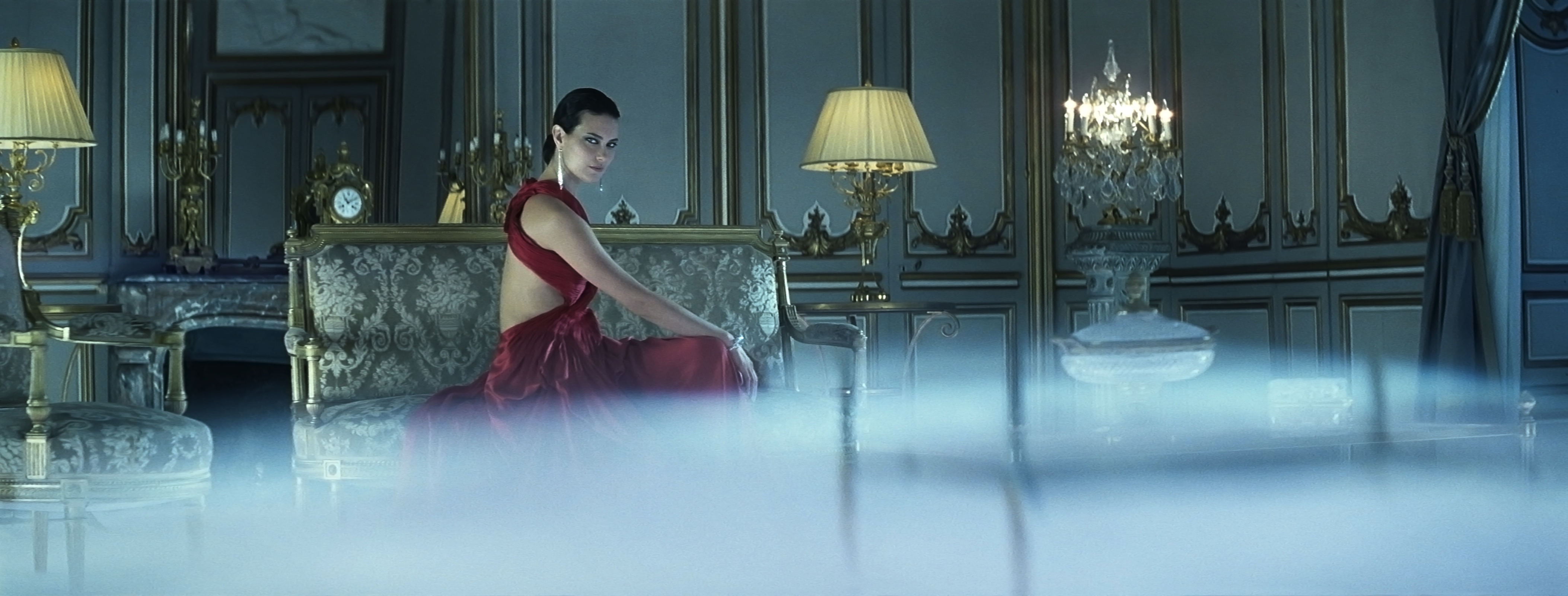
The woman from the Hôtel Particulier
Shalom Harlow, an international top model, lends her face to the character of the woman in the final scene. Her sensual character embodies the spirit of the Cartier woman, a free, elegant, passionate woman, in the image of the great customers who have played a part in the House’s destiny, like Jeanne Toussaint.
The young Chinese designer Yiqing Yin, a graduate of the Ecole Nationales des Arts Décoratifs, has specially created a made-to-measure dress for this character, a red dress with a flowing skirt and a fitted bustier with a tight handmade drape. Yiqing Yin was featured in Luxsure during Paris Haute Couture.
Shalom Harlow wears three Haute Joaillerie creations from the House of Cartier:
– “Monica” diamond and pearl earrings
– A 13.4-carat pear-shaped diamond solitaire ring
– A one-of-a-kind Panthère Haute Joaillerie bracelet, platinum, 1 green beryl of 51.58 carats, onyx spots and
onyx truffles, emerald eyes, brilliants, so-called “hair setting”.
Music
For the first time, Cartier wanted to orchestrate a piece of music in its own image. An original work punctuated by a three-beat theme, a happy waltz that can be played ad infinitum, adapting to the whims of time and place, in major or minor, piano or cello….
It was created and orchestrated by Pierre Adenot, a noted arranger and orchestrator. He has worked on numerous films: La Vérité ou presque (Sam Karmann), Paris je t’aime (O. Assayas, E. and J. Coen, B. Podalydès, W. Salles, A. Payne, R. Lagravenese, W. Craven, etc).
In 1996, he wrote the music for Jean-Pierre Améris’s film Les Aveux de l’innocent, for which he received the SACEM Grand Prix. More recently, he composed the musical arrangements for Jean-Pierre Améris’s film Les Émotifs anonymes (2010).
The original Cartier theme was recorded at Abbey Road Studios in London, a studio used to record music for films such as Harry Potter, Star Wars and Lord of the Ring….
Pierre Adenot conducted an 84-strong ensemble of strings, percussion, wind instruments, harp and piano.
A 60-voice women’s and children’s choir underscores the musical work.
But above all, this work is an invitation to travel:
This international shoot began in June 2011 in Prague and ended in Paris at the end of September.
The snow scenes were shot in the Dolomites in Italy, the arid scenes in Spain. In the presence of the real animals, the Panthers but also the Asian Elephant in Spain.
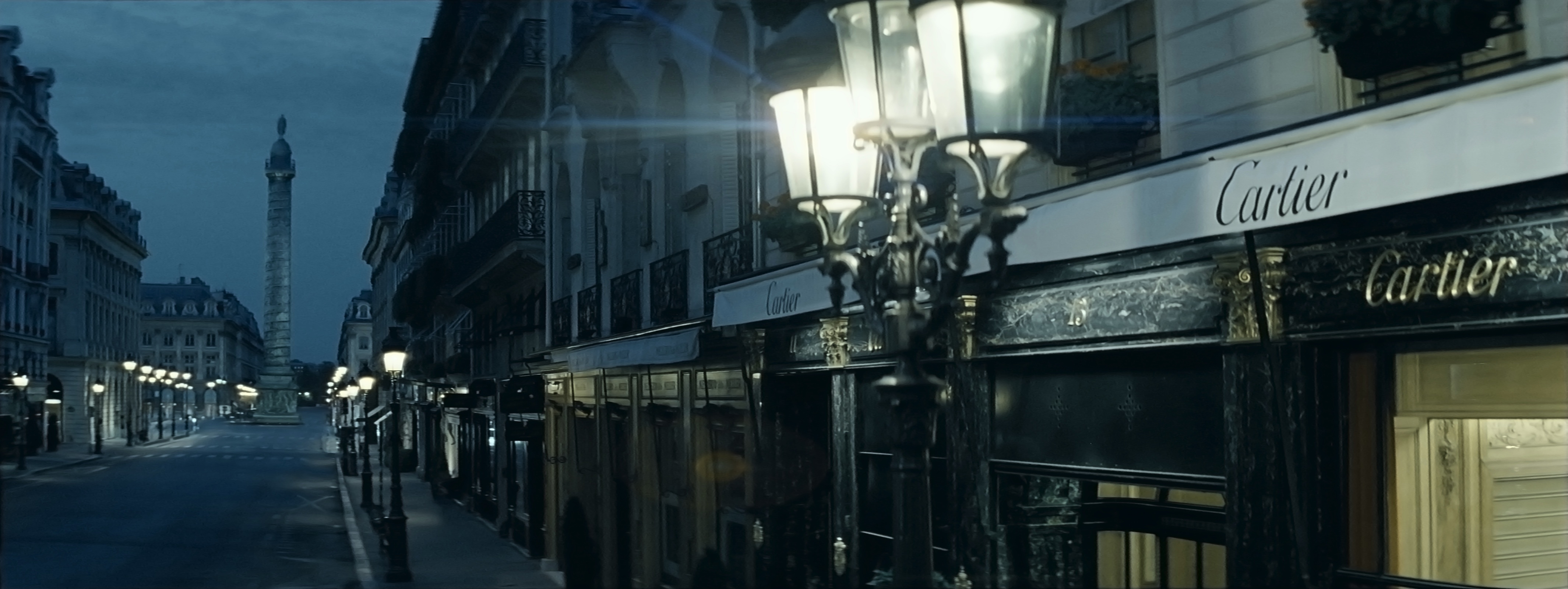
In Paris, three locations are involved: 13 rue de la Paix (exterior night), Place Vendôme (exterior night with panther), the Grand Palais: interior night in the staircase, nightfall in the nave and on the roofs.
The St Petersburg scene
The scene was shot on an airfield near Prague in June. The runway was covered in artificial snow under a blazing sun. All the architectural elements were recreated in animation.
Palais Indien stage
The interior stage of the Palais Indien was entrusted to Franck Bénézech, head film decorator. He designed an imaginary plant décor inspired by the Cartier jewellery décor known as “Tutti Frutti”, for its mix of precious rubies, emeralds and sapphires. These Cartier motifs were particularly popular with maharajas in the early 20th century. The architecture is also inspired by Mughal architecture of the 16th and 17th centuries. This 1/5th scale set required the collaboration of a six-week technical and creative team of sculptors, staffers, model-makers and painters. This is the lively setting for heritage pieces from the Cartier Collection, now on display in museums around the world.
The plane
Cartier’s desire for realism led it to build an almost identical replica of the plane built by Alberto Santos-Dumont in 1906, nicknamed “Le 14 bis”. This replica, 7m wide and 13m long, was built in collaboration with a microlight construction company, using the same materials as those used by the aviator at the time. A real challenge, crowned by the flight of the plane. This piece is unique to this day.
Cette publication est également disponible en :

